How to Build a Language Learning Platform with Interactive Features
Learning a new language has become more accessible through digital education. Students can practise speaking, improve pronunciation, attend live classes, and learn at their own pace without depending entirely on traditional classroom schedules. For educators and businesses, this creates opportunities to deliver flexible language-learning experiences through websites and mobile applications.
However, building a successful online language learning platform involves more than uploading lessons or connecting students with tutors. It requires a thoughtful combination of interactive learning tools, tutor management, scheduling, progress tracking, payment processing, and an intuitive user experience.
Whether you are planning an English-learning website, a language tutoring marketplace, or a mobile application for multilingual education, understanding the essential features and development process can help you turn your idea into a practical digital product.
What Is an Online Language Learning Platform?
An online language learning platform is a digital environment where learners can study languages through recorded lessons, interactive exercises, live tutoring, group classes, or structured learning programmes.
Depending on the business model, the platform may connect independent tutors with learners, offer courses developed by an educational organisation, or provide self-paced learning activities through a dedicated application.
Common platform models include:
- Self-paced learning platforms: Learners access recorded lessons, vocabulary exercises, quizzes, and practice activities according to their schedules.
- Live tutoring marketplaces: Learners discover tutors, compare profiles, book sessions, and receive personalised instruction.
- Online language academies: Educational organisations manage structured courses, teachers, batches, assessments, and certificates.
- Corporate language training platforms: Businesses provide language programmes for employees and monitor participation and learning outcomes.
- Hybrid learning platforms: A combination of live classes, recorded lessons, interactive practice, and instructor support.
The right model depends on your target audience, teaching approach, revenue strategy, and long-term business objectives.
How Does a Language Learning Platform Work?
A typical language-learning marketplace follows a straightforward workflow that supports learners, tutors, and administrators.
- Account registration: Learners create profiles, select their preferred language, identify their current proficiency, and set learning goals.
- Course or tutor discovery: Users browse lessons, courses, tutors, and available learning programmes.
- Lesson selection: Learners choose self-paced content, individual sessions, or group classes.
- Booking and payment: The system manages schedules, payments, packages, and booking confirmations.
- Learning and practice: Students attend virtual classes or complete exercises and assignments.
- Progress evaluation: Assessments, completed lessons, and performance reports help learners understand their progress.
- Continued learning: Recommendations, reminders, course packages, and learning goals encourage consistent participation.
A well-designed workflow reduces friction for users while making day-to-day operations easier for the platform owner.
Essential Features of a Language Learning Platform
1. User Registration and Personalised Profiles
Registration should be simple, secure, and relevant to each user type. Learners may need to specify their native language, target language, proficiency level, learning objectives, and preferred lesson format.
Tutor profiles should include teaching experience, qualifications, languages taught, availability, pricing, and a short introduction. Depending on the business model, administrators may verify tutor credentials before approving profiles.
Personalised profiles help the platform deliver more relevant search results and learning recommendations.
2. Language Categories and Proficiency Levels
Organised categories help learners find suitable programmes without browsing an overwhelming collection of lessons. A platform may organise content by language, proficiency, subject, learning objective, or course type.
For example, an English-learning platform could offer beginner conversation, business communication, pronunciation practice, academic writing, and examination preparation.
Proficiency levels can help users choose appropriate lessons and allow tutors to tailor their teaching approach to each learner.
3. Advanced Search and Tutor Discovery
For platforms that connect learners with tutors, discovery tools are particularly important. Users should be able to narrow their options based on practical criteria such as:
- Language taught and languages spoken
- Price and lesson duration
- Teaching experience and qualifications
- Availability and time zone
- Proficiency level and learning objective
- Ratings, reviews, and teaching preferences
Clear tutor profiles and relevant filters make it easier for learners to compare options and select an instructor who suits their needs.
4. Live Virtual Classrooms
Speaking and listening practice are central to many language-learning programmes. Virtual classrooms allow tutors and learners to interact in real time without travelling to a physical location.
Depending on the teaching model, a virtual classroom may include:
- Audio and video calling
- Screen sharing and presentation tools
- Interactive whiteboards
- Text chat and shared learning materials
- Lesson notes and downloadable resources
- Optional session recording, subject to consent and privacy requirements
Video conferencing can be integrated through a suitable third-party service or developed as part of a broader technical solution. The choice should consider reliability, privacy, expected usage, and operating costs.
5. Interactive Lessons and Practice Activities
Language learning requires active practice, not just watching videos or reading course material. Interactive activities give learners opportunities to apply what they have studied.
Useful activity types include:
- Vocabulary and flashcard exercises
- Multiple-choice and fill-in-the-blank questions
- Listening comprehension activities
- Sentence construction and translation practice
- Reading comprehension exercises
- Pronunciation and speaking practice
- Timed quizzes and revision tests
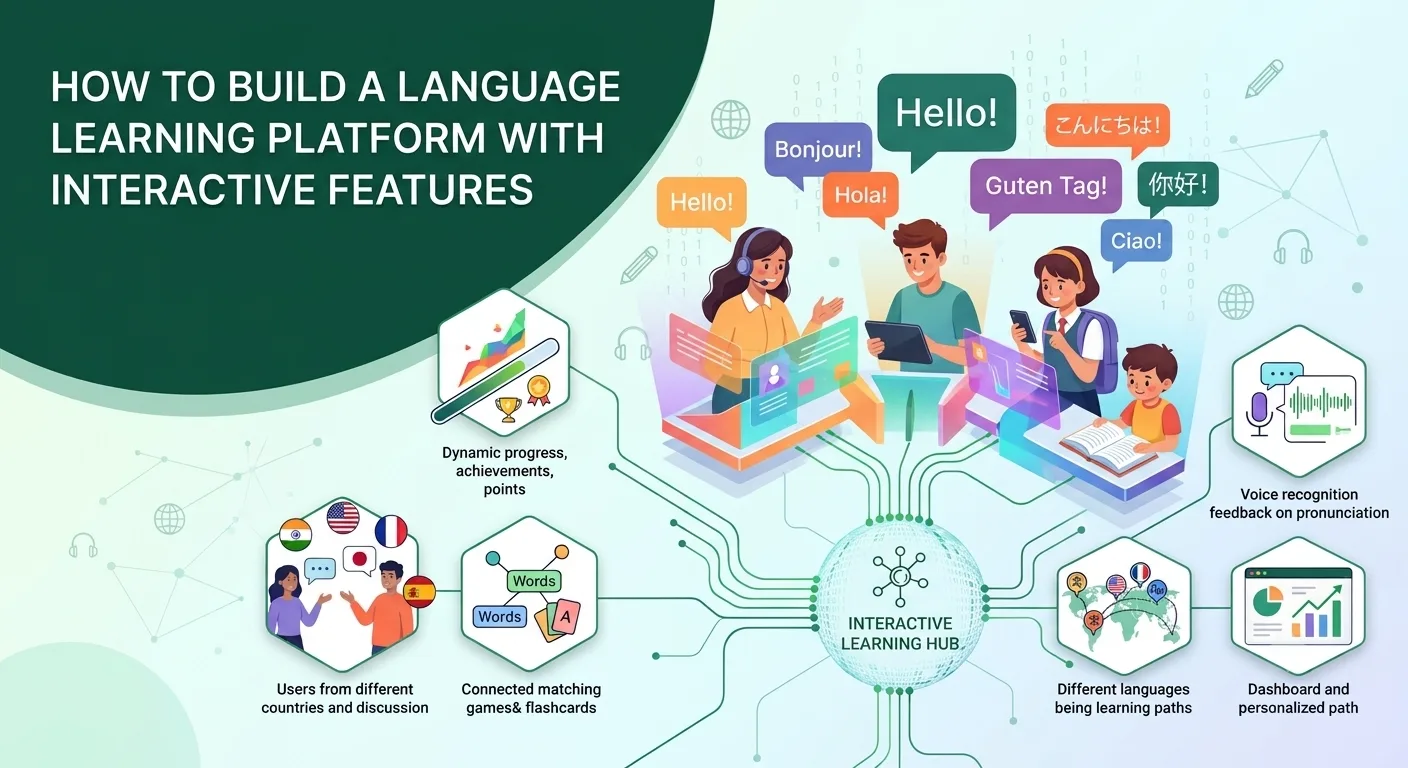
For advanced implementations, speech recognition or AI-assisted feedback may help learners practise pronunciation and receive additional guidance. These features should be tested carefully for accuracy across accents, languages, and speaking levels.
6. Progress Tracking and Learning Analytics
Learners benefit from understanding what they have completed and which areas need more practice. Progress tracking can turn a broad learning objective into a series of manageable milestones.
Depending on the learning format, the platform may track:
- Lessons and courses completed
- Quiz scores and assessment history
- Vocabulary and practice activity completion
- Time spent learning
- Upcoming lessons and missed sessions
- Progress towards personal learning goals
Tutors can use this information to adjust lessons, while administrators can identify popular courses and understand overall platform engagement.
7. Gamification and Learner Engagement
Regular practice is essential for language development, but learners may struggle to maintain a consistent routine. Gamification can make progress more visible and encourage users to return.
Possible features include learning streaks, achievement badges, experience points, milestone rewards, weekly challenges, and optional leaderboards.
These features should support meaningful learning rather than encourage users to complete activities quickly without understanding them. Rewards work best when they reinforce practice, consistency, and improvement.
8. Lesson Scheduling and Calendar Management
Platforms offering live tutoring need a reliable scheduling system. Learners should be able to view available time slots, book sessions, and receive confirmation without unnecessary back-and-forth communication.
The scheduling module should support tutor availability, cancellations, rescheduling rules, reminders, lesson duration, and time-zone conversion. For international platforms, displaying dates and times in each user's local time zone can reduce missed sessions and booking confusion.
9. Secure Payments and Flexible Pricing
A language learning business may use different pricing models depending on its audience and services.
- Pay-per-lesson: Learners pay for each tutoring session.
- Course purchases: Users pay once to access a course or learning programme.
- Subscription plans: Members receive access to selected content or learning benefits for a recurring fee.
- Lesson packages: Learners purchase multiple sessions together.
- Group-class fees: Participants pay to join a scheduled group session.
- Corporate plans: Organisations purchase access for teams or employees.
Payment functionality may include transaction history, invoices, refunds, promotional codes, tutor payouts, and platform commission calculations. The final setup should use payment providers that support the target markets and currencies.
10. Reviews, Ratings, and Feedback
Feedback helps learners evaluate tutors and gives platform owners insights into service quality. Reviews can be collected after completed sessions or courses, with clear moderation rules to reduce spam and inappropriate content.
Feedback should be presented transparently. Platforms should also provide processes for reporting concerns and resolving disputes when necessary.
11. Notifications and Learning Reminders
Timely notifications help users keep track of their learning activities. The platform may send reminders for upcoming lessons, booking changes, assignment deadlines, subscription renewals, new course availability, and learning milestones.
Notifications can be delivered through in-app messages, email, or push notifications, depending on user preferences and the supported applications. Users should have appropriate controls over optional marketing communications.
12. Mobile-Friendly Website and Learning App
Learners often want to study during short breaks, while travelling, or outside traditional classroom hours. A responsive website and, where justified, dedicated mobile applications can make learning more convenient.
Mobile experiences may include lesson access, practice exercises, tutor discovery, booking, progress reports, reminders, and payment features. Offline lesson access can also be considered for suitable downloadable content, subject to content rights and security requirements.
A progressive web app may be an option when a business wants an app-like experience without immediately maintaining separate native applications. The best approach depends on device requirements, offline needs, notifications, and budget.
Advanced Features That Can Differentiate Your Platform
AI-Assisted Learning Recommendations
AI can help recommend lessons based on a learner's goals, completed activities, assessment results, and preferred learning pace. It may also support vocabulary revision, conversation practice, or explanations of grammar concepts.
AI-generated feedback should be treated as assistance rather than an unquestionable source of truth. Learners should be able to identify when content is AI-generated and seek help from a qualified tutor when needed.
Speech Recognition and Pronunciation Practice
Speech-recognition tools can help learners practise spoken language and receive feedback on selected pronunciation or speaking tasks. Accuracy varies across languages, accents, background noise, and device microphones, so the feature should be evaluated against the intended audience before launch.
Personalised Learning Paths
A learning path can organise lessons and activities into a logical sequence based on proficiency, objectives, and assessment results. For example, a beginner may start with basic vocabulary and everyday phrases before progressing to listening comprehension and conversation practice.
Certificates and Course Completion Records
For structured courses, the platform may generate certificates after learners meet defined completion or assessment requirements. Administrators should be able to configure eligibility rules, certificate templates, and verification details.
Community and Group Learning
Discussion spaces, study groups, group classes, and moderated language-exchange activities can help learners practise with others. Community features require appropriate reporting, moderation, and privacy controls, particularly when younger learners use the platform.
Important Pages to Include in the Website
A well-planned website structure makes it easier for users to understand the offering and complete key actions.
Homepage
The homepage should clearly communicate the platform's learning focus, supported languages, course formats, and main benefits. Include visible calls to action, featured courses or tutors, learner testimonials where available, and clear navigation.
Courses and Classes Page
Organise available learning programmes by language, proficiency level, subject, price, and format. Course listings should show useful information such as the instructor, learning objectives, duration, and delivery method.
Tutor Listing and Profile Pages
Allow learners to browse and compare instructors. Detailed tutor profiles may include qualifications, experience, teaching languages, introductory videos, reviews, prices, and available time slots.
Registration and Onboarding Pages
Keep learner registration straightforward. Tutor registration may require additional details, teaching experience, qualifications, a demonstration video, and verification steps.
Learner Dashboard
The learner dashboard should provide quick access to upcoming lessons, enrolled courses, learning progress, saved tutors, assessments, payment history, and account settings.
Tutor Dashboard
Tutors need tools to manage their profiles, availability, bookings, course materials, learner interactions, session history, feedback, and earnings where applicable.
Admin Dashboard
The administration area should support user and tutor management, course moderation, category management, bookings, payments, commission rules, content updates, support requests, reporting, and platform configuration.
How to Build a Language Learning Platform
Step 1: Research Your Market and Audience
Identify the users you want to serve, the languages you will support, and the problems your platform will solve. Study existing alternatives to understand user expectations, pricing approaches, content formats, and areas where your idea can offer a distinct experience.
Step 2: Select a Clear Business Model
Decide whether the platform will focus on self-paced courses, private tutoring, group classes, corporate training, or a combination. The business model affects the required features, payment workflow, staffing needs, and operational processes.
Step 3: Define the MVP Features
A minimum viable product (MVP) should include enough functionality to validate the core idea without building every advanced feature at once.
For a tutoring marketplace, the initial release might include:
- Learner and tutor registration
- Tutor profiles and search
- Availability and lesson booking
- Online payment integration
- Virtual classroom integration
- Basic learner and tutor dashboards
- Administrative controls and reports
For a self-paced learning app, the priorities may instead be course delivery, quizzes, learning progress, reminders, and subscription management.
Step 4: Choose the Right Development Approach
The technology approach should match your requirements, budget, timeline, and expected growth.
Custom development: A platform built around your business model can support specialised workflows, tailored user experiences, and integrations. The scope and timeline depend on the complexity of the requirements.
Existing software or frameworks: An established solution may reduce the amount of functionality that needs to be built from scratch. Before selecting one, assess its source-code access, licensing, customisation limits, security, integrations, scalability, and ongoing costs.
Hybrid approach: Some projects can use existing services for functions such as video conferencing or payments while custom-building the learning experience and business workflows.
The right choice should be based on a documented comparison rather than initial price alone.
Step 5: Design the User Experience
Create wireframes and prototypes for the main user journeys before beginning full development. Test whether learners can find a suitable lesson, understand pricing, book a session, and access learning materials without confusion.
Use clear navigation, readable typography, accessible controls, responsive layouts, and consistent design patterns across devices.
Step 6: Develop and Integrate Core Modules
Build the agreed features and connect the necessary services, such as video conferencing, payment gateways, email delivery, notifications, and analytics. Establish appropriate access permissions so that learners, tutors, and administrators can access only the information and functions relevant to their roles.
Step 7: Test Security, Performance, and Learning Workflows
Test the platform across supported devices and browsers. Validate booking conflicts, payment failures, refunds, time-zone handling, course access, permissions, and notification delivery. Performance testing should reflect expected usage, especially for video sessions and high-traffic learning periods.
Step 8: Launch, Measure, and Improve
Launch with a focused set of courses or tutors, gather feedback, and monitor meaningful indicators such as learner activation, lesson attendance, course completion, repeat bookings, and subscription retention.
Use this information to prioritise improvements based on real user behaviour rather than assumptions.
How Much Does Language Learning Platform Development Cost?
The cost of developing a language learning website or app depends on the features, design, technology choices, integrations, and operational requirements. A simple self-paced learning product has a different scope from an international tutoring marketplace with live video, tutor payouts, mobile apps, and advanced personalisation.
Major cost factors include:
- Feature complexity: Course delivery, quizzes, live classrooms, gamification, and AI-assisted learning require different levels of effort.
- Number of applications: A responsive website, learner app, tutor app, and admin panel each add design, development, and testing work.
- Third-party integrations: Video services, payment gateways, speech recognition, and analytics may involve setup and recurring usage fees.
- Content requirements: Creating lessons, exercises, assessments, translations, and audio materials may require a separate budget.
- Security and compliance: Privacy requirements, access controls, data retention, and regional obligations affect implementation.
- Maintenance and hosting: Infrastructure, monitoring, bug fixes, upgrades, support, and ongoing improvements must be planned after launch.
Rather than relying on a generic cost estimate, prepare a feature list and request a scope-based estimate from your development partner. This makes it easier to compare proposals and identify what is included in the initial release.
Common Challenges and How to Address Them
Keeping Learners Engaged
Offer achievable learning goals, relevant exercises, progress feedback, and reminders that users can control. Review completion and retention data to identify where learners lose interest.
Maintaining Teaching Quality
Establish clear tutor onboarding, credential checks where appropriate, feedback processes, and standards for course materials. Provide a way for learners to report problems.
Managing International Scheduling
Use reliable time-zone handling, clear calendar displays, and automated booking confirmations. Test daylight-saving transitions for regions that observe them.
Protecting User Data
Use secure authentication, role-based access, protected communications, appropriate data retention policies, and regular security testing. Minimise the personal information collected and provide clear privacy information.
Scaling Without Hurting Performance
Monitor response times, database performance, media delivery, and infrastructure usage. Design the system so that capacity can be increased as learners, tutors, courses, and live sessions grow.
Why Work with a Custom Software Development Partner?
A language learning platform brings together several connected systems, from user accounts and course content to scheduling, payments, and reporting. A software development partner can help translate the business idea into a clear technical scope and identify which features should be built first.
When evaluating a development partner, consider its experience with web and mobile applications, UI/UX design, third-party integrations, data security, testing, and post-launch support. Ask for a clear breakdown of deliverables, milestones, assumptions, and ongoing costs.
At Vriksha Tech, businesses can discuss their software requirements and explore a development approach aligned with their goals. The scope can be planned around the intended audience, essential workflows, and future expansion needs.
Conclusion
Building a successful language learning platform requires more than delivering digital lessons. It involves creating a convenient learning journey, supporting tutors and administrators, encouraging consistent practice, and making payments and scheduling reliable.
Start with a clear audience and business model, prioritise the features that validate your idea, and choose a development approach that fits your long-term plans. As your platform grows, use learner feedback and performance data to guide improvements.
If you are planning a language learning website, educational mobile app, or customised e-learning solution, contact Vriksha Tech through our website to discuss your requirements and explore the next steps.
Frequently Asked Questions
What is language learning platform development?
Language learning platform development is the process of designing and building a website or application that delivers language courses, interactive exercises, live tutoring, assessments, or related learning services.
What features should a language learning platform include?
Common features include user profiles, course or tutor discovery, lessons, quizzes, progress tracking, scheduling, notifications, payments, and an admin dashboard. The exact feature set depends on whether the platform focuses on self-paced learning, live tutoring, or both.
Should I build a language learning website or mobile app first?
The decision depends on how users will learn and interact with the platform. A responsive website can be a practical starting point for many projects, while a mobile app may be valuable when frequent practice, push notifications, device-specific capabilities, or offline access are central to the experience.
Can a language learning platform support live and self-paced lessons?
Yes. A platform can combine live tutoring, recorded lessons, quizzes, downloadable resources, and structured courses. These features should be planned according to the teaching model and the needs of learners.
Can AI be integrated into a language learning app?
AI can support features such as personalised lesson recommendations, vocabulary practice, conversational exercises, and selected forms of writing or pronunciation feedback. Its usefulness depends on language coverage, accuracy, testing, and appropriate safeguards.
How long does it take to develop a language learning platform?
The timeline depends on the number of features, application types, integrations, content requirements, and testing needs. A focused MVP generally requires less time than a fully featured marketplace with multiple applications and advanced learning tools. A detailed scope is needed for a reliable estimate.
How can a language learning platform generate revenue?
Potential revenue models include course purchases, subscriptions, paid tutoring sessions, lesson packages, group-class fees, and corporate training plans. A platform may combine models when doing so fits its audience and business strategy.
How do I start planning a custom language learning platform?
Define your target learners, learning model, essential features, revenue approach, and launch priorities. Then document the user journeys and technical requirements before requesting a development estimate.
Ready to Build Your Next Digital Product?
Our experts will respond within 24 hours with a tailored approach for your project.