How to Successfully Onboard Vendors to Your Newly Launched Marketplace
Launching a marketplace is an important milestone, but attracting buyers is only one part of building a successful platform. A marketplace also needs reliable vendors who can provide quality products or services, manage orders, and deliver a positive customer experience.
For a newly launched marketplace, vendor acquisition can be challenging. Sellers may hesitate to join a platform that has limited traffic, fewer customers, or no established reputation. Marketplace owners must therefore create a clear onboarding strategy that explains the business opportunity, reduces registration difficulties, and helps vendors start selling with confidence.
In this guide, we explore practical strategies to attract, onboard, activate, and retain vendors on a newly launched marketplace.
1. Identify the Right Vendors for Your Marketplace
Before approaching potential vendors, define the type of sellers your marketplace needs. Not every vendor will be suitable for your business model or target audience.
Start by understanding your marketplace category, customer requirements, product or service expectations, and geographical coverage. This helps you approach vendors who can contribute to the platform's initial value.
For example:
- Fashion marketplace: Clothing brands, independent designers, boutiques, and accessories sellers.
- Food marketplace: Restaurants, cloud kitchens, bakeries, and local food suppliers.
- Service marketplace: Freelancers, agencies, consultants, and local service providers.
- Equipment rental marketplace: Equipment owners, rental companies, and machinery suppliers.
- Education marketplace: Tutors, training institutes, and independent educators.
Focus on vendors who offer relevant products or services, maintain consistent quality, and can fulfil customer requirements reliably.
2. Create a Compelling Value Proposition for Vendors
Vendors need a clear reason to join a newly launched marketplace. Simply inviting sellers to register may not be enough, especially when the platform has not yet built a large customer base.
Explain how your marketplace can help vendors reach new customers, improve their online presence, manage business activities, and explore additional sales opportunities.
Your value proposition can highlight:
- Access to a specific target audience.
- Additional sales and customer acquisition opportunities.
- Simple product, service, or inventory management.
- Centralized order and booking management.
- Performance reports and business insights.
- Marketing and promotional opportunities.
- Transparent commission and payment policies.
A strong value proposition should communicate actual benefits rather than making unrealistic promises about sales or customer traffic.
3. Offer Early Vendor Benefits
One of the challenges of a newly launched marketplace is convincing vendors to become early participants. A practical way to address this is by introducing introductory benefits for vendors who join during the launch period.
Consider offering:
- Reduced or zero commission for a limited introductory period.
- Free registration or onboarding assistance.
- Featured vendor placement during launch campaigns.
- Free product or service listing support.
- Priority access to promotional campaigns.
- Training sessions and dedicated onboarding assistance.
Clearly communicate the duration and conditions of these offers. Early benefits should encourage participation while supporting a sustainable long-term business model.
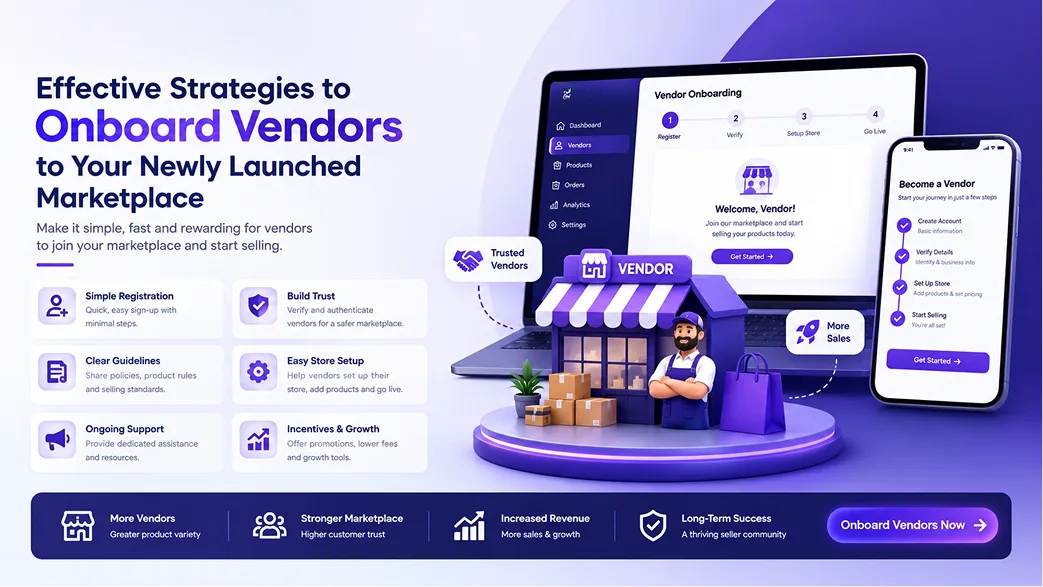
4. Make Vendor Registration Simple
A complicated registration process can discourage interested vendors before they even begin using the platform. Keep the onboarding journey straightforward and request only the information needed at each stage.
A typical vendor registration process may include:
- Account creation: Collect basic details such as name, email address, mobile number, and password.
- Business information: Request business name, category, address, and contact details.
- Verification: Collect required identity, business, tax, or compliance documents based on the marketplace category and applicable regulations.
- Payment information: Collect bank or supported payout details through a secure process.
- Profile setup: Allow vendors to add their logo, business description, images, and operating details.
- Submission and approval: Provide a clear review status and explain what happens next.
Where possible, use a step-by-step registration flow with progress indicators, save-and-continue functionality, and clear instructions. This makes onboarding easier, particularly for vendors who are not familiar with digital platforms.
5. Provide Personalised Onboarding Assistance
Not every vendor will be comfortable managing a new online platform independently. Some may need help creating listings, uploading images, setting prices, configuring availability, or understanding order management.
Provide onboarding support through:
- One-to-one onboarding calls or demonstrations.
- Step-by-step video tutorials.
- Simple user guides and FAQs.
- WhatsApp, email, or in-platform support channels.
- Assistance with the first product or service listing.
For high-value or strategically important vendors, a dedicated onboarding representative can guide them through the initial setup. Personal assistance can reduce confusion and help vendors become active sooner.
6. Help Vendors Create High-Quality Listings
Registration alone does not make a vendor successful. Vendors must add complete and accurate listings so customers can understand what they are purchasing or booking.
Encourage vendors to provide:
- Clear product or service titles.
- Detailed descriptions and specifications.
- High-quality images or relevant videos.
- Accurate pricing and applicable charges.
- Availability, delivery, or service-area information.
- Terms, cancellation policies, and other relevant conditions.
Marketplace owners can provide listing templates, image guidelines, examples, and quality checks. For selected vendors, offering initial listing assistance can help establish a consistent standard across the marketplace.
7. Build Trust Through Transparent Policies
Vendors are more likely to participate when they understand how the marketplace operates and what responsibilities they have.
Before onboarding, clearly explain:
- Commission rates and other applicable charges.
- Payment settlement schedules and payout conditions.
- Order, booking, cancellation, and refund procedures.
- Vendor responsibilities and service expectations.
- Customer complaint and dispute-handling processes.
- Account suspension and termination conditions.
- Data handling and privacy practices.
A written vendor agreement and accessible policy documentation help prevent misunderstandings. Avoid hidden fees and unclear settlement terms, as these can damage vendor confidence.
8. Provide an Easy-to-Use Vendor Dashboard
The vendor dashboard is where sellers manage their day-to-day marketplace activities. A confusing dashboard can affect vendor engagement even when the registration process is simple.
A useful vendor dashboard may include:
- Business profile: Manage business information and account settings.
- Product or service management: Add, edit, and update listings.
- Inventory and availability: Track stock, schedules, or service availability.
- Orders and bookings: View incoming requests and update their status.
- Payments: Review earnings, commissions, settlements, and transaction history.
- Notifications: Receive alerts about new orders, customer messages, and platform updates.
- Reports: Monitor sales, bookings, customer activity, and business performance.
- Support: Access help resources and contact the marketplace team.
The dashboard should present important actions clearly and work smoothly across desktop and mobile devices. Vendors should be able to understand their current tasks without navigating through unnecessary screens.
9. Promote Early Vendors to Generate Initial Activity
A newly launched marketplace may not have enough customer activity to encourage vendors to remain engaged. Marketplace owners can help bridge this gap through launch marketing and vendor-focused promotions.
Possible strategies include:
- Introducing selected vendors through social media campaigns.
- Publishing vendor stories and business profiles.
- Featuring early sellers on the marketplace homepage.
- Running category-specific promotional campaigns.
- Using email marketing to introduce new vendors to potential buyers.
- Collaborating with local business associations and industry communities.
These activities can help vendors gain visibility while giving customers a reason to explore the marketplace. Promotional campaigns should be aligned with the actual inventory and services available on the platform.
10. Collect Vendor Feedback and Improve the Onboarding Process
Vendor onboarding should not be treated as a one-time activity. Marketplace owners should regularly understand what vendors find difficult and improve the process based on their feedback.
Ask vendors about:
- Difficulty completing registration.
- Confusing document or verification requirements.
- Problems creating listings.
- Challenges using the dashboard.
- Payment and settlement concerns.
- Support response times.
Use surveys, feedback calls, support tickets, and platform analytics to identify recurring problems. Improving these areas can reduce onboarding drop-offs and increase vendor satisfaction.
11. Track Vendor Onboarding Performance
Measuring onboarding performance helps marketplace owners understand whether their strategies are producing active and reliable sellers rather than just increasing registration numbers.
Important metrics to monitor include:
- Vendor acquisition rate: Number of vendors who join during a specific period.
- Registration completion rate: Percentage of vendors who complete the registration process.
- Verification approval rate: Percentage of submitted vendor applications approved.
- Listing activation rate: Percentage of approved vendors who publish their first listing.
- Time to first listing: Time taken for a vendor to publish their first product or service.
- Time to first transaction: Time taken for a vendor to receive their first order or booking.
- Vendor retention rate: Percentage of vendors who remain active over time.
- Vendor support requests: Number and types of issues raised during onboarding.
Review these metrics regularly to identify where vendors drop out and which onboarding activities need improvement.
12. Build Long-Term Relationships with Vendors
Successful vendor onboarding does not end when an account is approved. Vendors need ongoing communication, operational support, and opportunities to grow within the marketplace.
Build long-term relationships by:
- Sharing regular platform updates and announcements.
- Providing performance insights and improvement suggestions.
- Recognising reliable and high-performing vendors.
- Offering training for new platform features.
- Responding quickly to vendor concerns.
- Creating opportunities for vendors to participate in campaigns.
- Communicating policy changes before they take effect.
When vendors feel supported and see value in participating, they are more likely to remain active and contribute to the marketplace's growth.
Common Vendor Onboarding Mistakes to Avoid
Even a well-designed marketplace can struggle with vendor acquisition if its onboarding approach creates unnecessary barriers.
- Targeting too many unrelated vendors: Focus on vendors who match the marketplace's intended audience and category.
- Complicated registration: Avoid collecting unnecessary information at the beginning.
- Unclear commission policies: Explain all charges and payout conditions before vendors join.
- No onboarding support: Do not assume every vendor knows how to use an online marketplace.
- Ignoring listing quality: Incomplete listings can reduce customer confidence and conversions.
- Focusing only on registrations: Track listing activation and first transactions, not just account creation.
- Lack of communication: Keep vendors informed about approvals, updates, payments, and platform changes.
Conclusion
Onboarding vendors to a newly launched marketplace requires more than a registration form or an invitation to join. It involves identifying suitable sellers, communicating clear benefits, simplifying registration, offering practical assistance, and creating an environment where vendors can operate confidently.
Marketplace owners should also invest in an intuitive vendor dashboard, transparent policies, effective launch promotions, and ongoing vendor support. By combining these strategies with measurable onboarding goals, businesses can build a reliable vendor network and establish a stronger foundation for marketplace growth.
At Vriksha Tech, we help businesses plan and develop custom digital platforms, including marketplace solutions with vendor management, registration workflows, dashboards, and business-specific features. Explore Vriksha Tech to learn more about our software development capabilities.
Frequently Asked Questions
What is vendor onboarding in a marketplace?
Vendor onboarding is the process of attracting sellers, collecting their business information, verifying their details, helping them create listings, and preparing them to sell products or services through a marketplace.
How can a newly launched marketplace attract its first vendors?
A new marketplace can attract vendors through direct outreach, industry networking, partnerships, targeted marketing, introductory commission offers, and clear communication of the platform's business benefits.
What information should a marketplace collect during vendor registration?
Depending on the business model, registration may require contact details, business information, category details, identity or business verification documents, payout information, and relevant compliance details.
How can marketplace owners encourage vendors to complete onboarding?
Simplify registration, provide step-by-step guidance, offer personal assistance, communicate approval timelines, and help vendors publish their first listings.
What features should a vendor dashboard include?
A vendor dashboard generally includes business profile management, product or service listings, inventory or availability controls, order management, payment tracking, notifications, reports, and support access.
How long does vendor onboarding take?
The duration depends on the marketplace's verification requirements, business category, and vendor readiness. A simple registration process may take minutes, while document verification and listing preparation can take longer.
How can marketplace owners measure vendor onboarding success?
Track registration completion, verification approval, listing activation, time to first listing, time to first transaction, vendor retention, and onboarding-related support requests.
Why is vendor retention important for a marketplace?
Active vendors help maintain product or service availability, fulfil customer demand, and create a reliable marketplace experience. Retaining good vendors also reduces the repeated effort and cost of acquiring replacements.
Ready to Build Your Next Digital Product?
Our experts will respond within 24 hours with a tailored approach for your project.