How Smart Contracts Can Automate Supply Chain Agreements
Supply chains involve many handoffs between suppliers, manufacturers, transporters, warehouses, and buyers. At several points, teams still depend on emails, documents, approvals, and manual verification before the next step can happen.
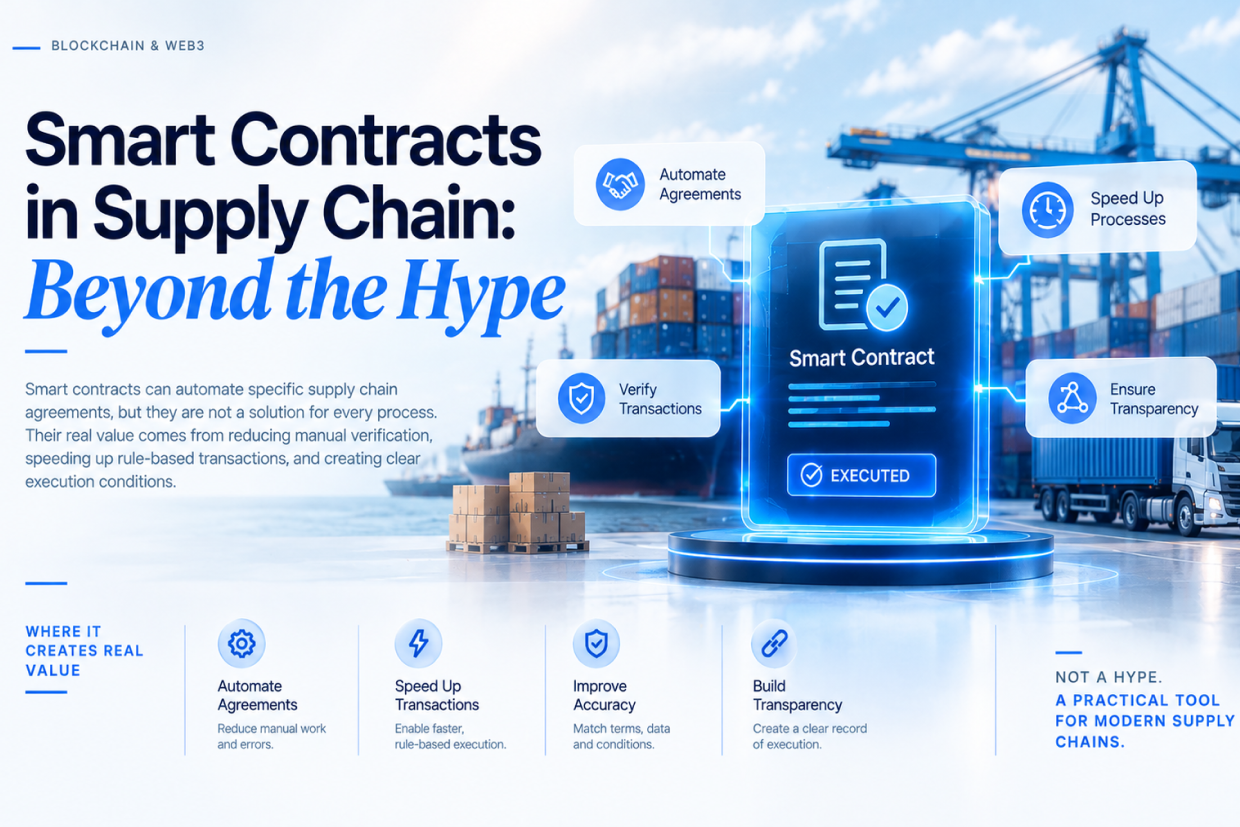
Smart contracts can automate some of these repetitive agreements.
For example, a payment can be released after a delivery is verified, a penalty can be calculated when a shipment misses an agreed deadline, or a reorder can be triggered when inventory reaches a defined level.
Where Smart Contracts Actually Help
The strongest use cases are usually processes that follow clear and repeatable rules. Instead of asking an employee to check whether specific conditions have been met, the smart contract can execute the predefined action when those conditions are satisfied.
A simple supply chain flow could be:
Delivery Confirmed → Conditions Verified → Payment Released
This can reduce unnecessary coordination and manual processing.
Smart Contracts Do Not Eliminate Every Middleman
Smart contracts are sometimes presented as a way to remove intermediaries completely. In practice, many supply chains still need people and organizations for physical inspections, legal approvals, transportation, quality checks, and dispute handling.
The useful question is not “Can we remove everyone?”
It is:
“Which manual handoffs can be replaced with reliable automated rules?”
Real-World Supply Chain Examples
Smart contracts can support processes such as automated payment release after delivery confirmation, penalty calculation for delayed shipments, supplier payment based on quality verification, warranty conditions, and inventory-based reorder triggers.
These use cases work best when the conditions can be clearly defined and reliably verified.
The Quality of Input Data Still Matters
A smart contract can execute a rule exactly as programmed, but it cannot independently verify whether the real-world information entering the system is correct.
If a delivery status is entered incorrectly, the contract may still execute based on that incorrect information.
This means smart contracts often need reliable APIs, IoT systems, databases, verification processes, and authorized users around them.
Start With One Clear Process
Businesses do not need to put their entire supply chain on blockchain.
A better approach is to identify one repetitive process where manual verification creates delays or disputes. The business can automate that specific step, measure the result, and expand only when the system proves useful.
Smart contracts work best as precision tools for well-defined agreements, not as blanket replacements for supply chain operations.
At Vriksha Techno Solutions, blockchain solutions can support supply chain workflows through smart contracts, automated approvals, transaction tracking, API integration, and verification systems designed around specific business processes.
Ready to Build Your Next Digital Product?
Our experts will respond within 24 hours with a tailored approach for your project.