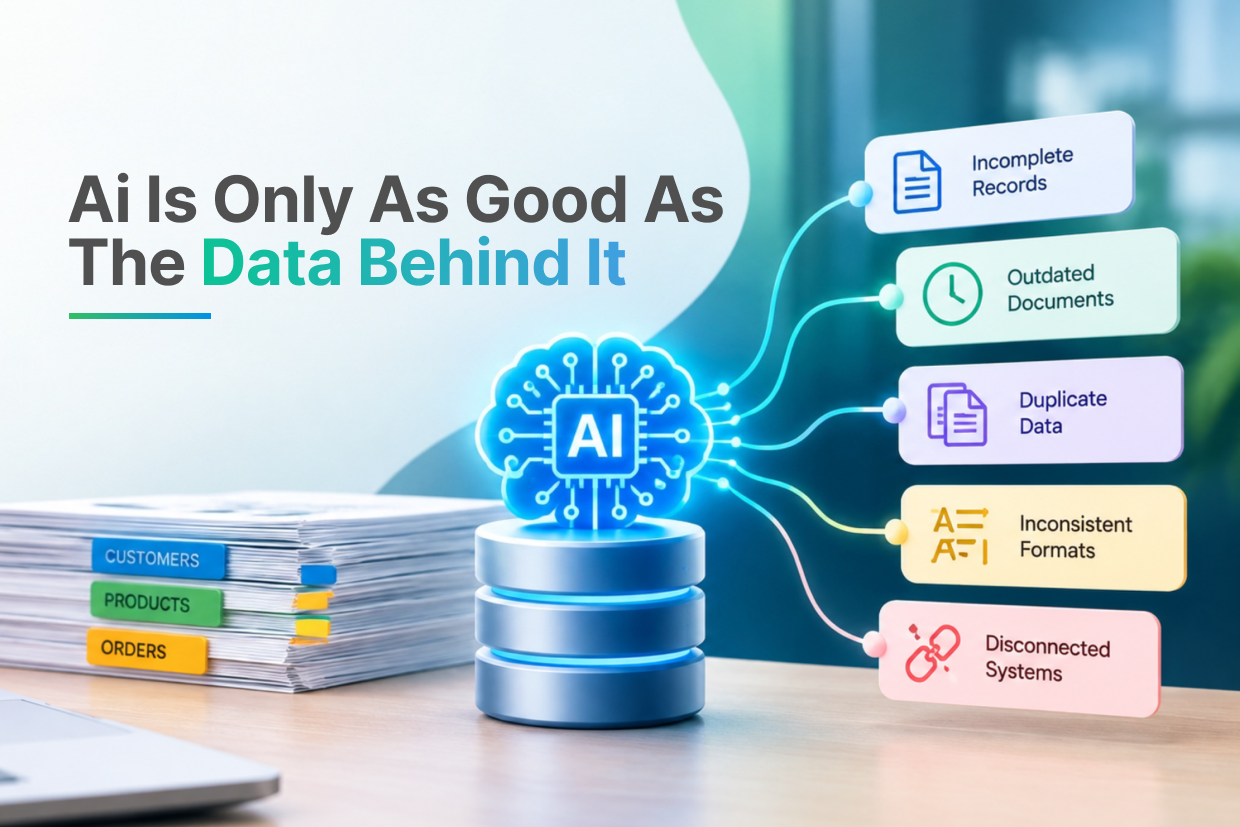
AI Is Only as Good as the Data Behind It
A company decides to introduce AI into its customer support operation.
The business already has thousands of customer records, product documents, support tickets, invoices, internal policies, and years of communication history.
The team assumes the AI has everything it needs because the information already exists somewhere inside the organization.
A model is selected, a chatbot interface is built, the required systems are connected, and the application goes live.
Then something unexpected happens.
The AI gives a customer an outdated answer. It cannot find a policy that employees use every day. It treats two records for the same customer as two different people. It provides an answer based on incomplete information.
Sometimes it even sounds confident when the required information is missing.
The development team starts looking at the model. Maybe the prompt is wrong. Maybe the model is not powerful enough. Maybe another model should be tested.
But the real problem may be much simpler.
The AI is receiving poor or incomplete business data.
This is one of the most important things businesses need to understand before implementing AI: AI does not automatically fix bad information. It processes the information it is given and uses the context available to it.
A sophisticated model can produce impressive results, but it still depends on the quality, freshness, structure, relevance, and accessibility of the information supporting the application.
The AI Model Is Only One Part of the System
When businesses begin an AI project, the discussion often starts with the model. Teams compare models based on their capabilities, response quality, speed, cost, context length, and ability to understand different types of content.
These are important considerations, but the model is only one component of a larger system.
A production AI application may depend on business databases, CRM systems, ERP platforms, support software, document repositories, internal knowledge bases, APIs, file storage, authentication systems, business rules, retrieval systems, and validation logic before the AI model even produces an answer.
A more realistic flow looks like this:
Business Data → Data Processing → Retrieval → Context → AI Model → Validation → Response or Action
The model sits in the middle of the process. It does not automatically know which customer record is current, which policy document has been approved, which price is active, or which internal rule should take priority.
For example, imagine a customer asks, “What is the current delivery policy for my order?”
The AI may need the customer's order details from one system, delivery information from another, and the current company policy from a knowledge base.
If one of those sources is outdated or the wrong record is retrieved, the answer can be incorrect even when the underlying AI model performs exactly as expected.
This is why AI implementation is also a data architecture problem.
Bad Data Does Not Always Look Bad
One of the most difficult data problems is that poor data does not always look obviously wrong.
Imagine a company has several customer records containing the names Ricky Davidson, Ricky D., R. Davidson, and Ricky Davidson - Chennai.
An employee who has worked with the customer may understand immediately that all of these records represent the same person. A software system cannot safely make that assumption unless the required identifiers and relationships have been defined.
Now consider an AI assistant that is asked, “Show me this customer's complete purchase history.”
The quality of the response depends on whether the underlying system can correctly identify the customer and combine the relevant records.
The AI did not create the duplicate records. It simply inherited them.
The same problem occurs with company names, product codes, addresses, employee information, supplier records, invoice numbers, service plans, and document versions.
Small inconsistencies that were manageable when employees handled the process manually can become much more visible when AI is expected to search, summarize, compare, or reason across those records.
Why Data Quality Directly Affects AI Results
Data quality is not simply a database administration concern. It directly influences whether an AI application can retrieve the correct information, understand the available context, and provide an appropriate response.
Imagine a customer support assistant that needs information about a customer's account.
It may require customer profile information, product details, warranty conditions, purchase history, previous support interactions, shipping information, and the company's current policies.
That information may be distributed across several systems.
If the customer profile is incomplete, the support history is stored somewhere else, and the policy document is outdated, the AI may generate a response that sounds professional but still gives the wrong answer.
This is where AI can become particularly difficult for businesses. A clearly broken system is easy to identify.
A system that produces a confident answer based on incomplete information is much harder to detect.
The problem is not only whether the AI can generate an answer. The problem is whether the information behind that answer is trustworthy.
Five Common Data Problems Behind Weak AI Results
Incomplete Information
Many business records contain only part of the information required for a useful decision.
A customer record might contain an email address but not the customer's current subscription. An order might contain a product ID but no current fulfilment status. An employee request might describe a problem without identifying the department responsible for handling it.
When information is missing, the AI may not have enough context to provide a reliable answer.
The correct response in such situations is not always to make an educated guess. Depending on the use case, the system may need to ask for clarification, retrieve additional information, or route the case to a person.
Duplicate Records
Duplicate information is another common problem.
The same customer, product, supplier, or document may exist in multiple systems.
A CRM might contain one version of a customer's details while a finance system contains another. A support application may contain a different phone number. A spreadsheet may contain an older address.
When these sources are connected to an AI application, the system needs a way to determine whether the records are related and which information should be treated as current.
Outdated Information
Business information changes constantly.
Pricing changes. Products are updated. Policies are revised. Employees move departments. Contracts expire. Delivery terms change.
The problem is that old information often remains available.
A company may update a policy on its website but forget to remove an older PDF from an internal knowledge repository.
An AI system may find the older document and use it as supporting context.
The answer may sound completely reasonable.
It may even have been correct six months ago.
But it is still wrong for today's situation.
Inconsistent Formats
Different applications often represent the same information in different ways.
A date may appear as 16/09/2026 in one system and 2026-09-16 in another.
One platform may call a product PRO-100, while another calls it Professional 100.
One system may use numeric status codes while another uses words.
Humans are often good at recognizing these relationships.
Software needs those relationships to be explicitly defined.
Conflicting Information
Conflicting information is more difficult than simple missing data because two sources may both appear legitimate.
A CRM might say that a customer is active. The billing platform might indicate an overdue payment. The support system might show an account restriction.
The AI cannot safely decide which information matters most unless the application defines how those sources should be interpreted.
Data needs business meaning, not just storage.
More Data Does Not Automatically Mean Better AI
When an AI project produces poor results, one common reaction is to provide more information.
That can help in some cases, but more information without structure can create additional problems.
Consider a company with years of product brochures, internal presentations, archived contracts, old pricing documents, support conversations, operating procedures, and policy manuals.
The business may have a huge amount of information, but that does not mean an AI system should treat every document as equally relevant.
Suppose a customer asks:
“What is your current cancellation policy?”
The system may have five documents that mention cancellations. One was published four years ago, another two years ago, and another last month.
The challenge is not finding a document containing the word “cancellation.”
The challenge is finding the correct, current, authoritative information.
That is why AI readiness is not measured simply by the amount of data available.
The goal is not to give AI more data. The goal is to give AI better data and better context.
A Single Source of Truth Matters
Businesses commonly use multiple systems because different departments have different requirements.
A CRM may manage customers, an ERP may manage finance and operations, an HR platform may manage employee information, and a support platform may manage customer issues.
There is nothing wrong with having different systems.
The problem occurs when no one clearly defines where a particular type of information should come from.
For example, the CRM may be the trusted source for customer profile information, while the finance platform is the trusted source for invoice status.
The order system may own shipment status, while a controlled knowledge base may own current company policies.
The AI application can then combine these sources without treating them as interchangeable.
This creates a clearer architecture:
- Customer Information → CRM
- Billing Information → Finance System
- Order Information → Order Management System
- Product Information → Product System
- Current Policies → Controlled Knowledge Base
The AI can then work across the business while respecting each system's responsibility.
AI Needs Context, Not Just Raw Information
Suppose an employee asks an AI system:
“Can this customer receive priority support?”
The application might discover that the customer has an enterprise plan. It may also find a special clause in the customer's contract.
The billing system may show that payment is overdue. The support system may show an active escalation.
The answer may depend on all of those facts.
This is why successful AI applications often require more than search.
They require context.
The system needs to know which information belongs to the customer, which rules apply, which records are current, and which business conditions affect the decision.
This is one of the reasons AI application development is different from simply adding a chatbot to a website.
A chatbot can generate language.
A business AI application must understand the business environment surrounding the question.
Structured Data and Unstructured Data Need Different Approaches
Business information is stored in many different forms.
Some information is highly structured, such as customer IDs, order numbers, transaction amounts, product codes, account status, and dates.
Other information is unstructured, such as contracts, policy documents, emails, support conversations, manuals, reports, and meeting notes.
These sources often need to be handled differently.
A database query may be appropriate when the system needs to retrieve a customer's current account balance.
A document retrieval system may be more appropriate when the AI needs to find a specific section of a warranty policy.
A business workflow may then combine those results before the AI generates a response.
This means the architecture should be designed around the type of information and the task being performed, not simply around the availability of an AI model.
The Data Pipeline Matters as Much as the Model
Imagine a company updates a product policy every month.
The source document is correct, but the AI knowledge base is synchronized only twice a year.
The AI system can still provide outdated answers.
The problem is not model intelligence.
The problem is the data pipeline.
A reliable AI system needs a clear process for detecting new information, processing it, updating the relevant knowledge source, handling older versions, removing obsolete material where necessary, and tracking where information came from.
This is particularly important when businesses use AI to answer customer questions.
A policy update that takes effect today should not remain invisible to the AI for several weeks.
The quality of the model does not solve a synchronization problem.
Data Freshness Depends on the Use Case
Not every piece of business information changes at the same speed.
Historical sales data may remain useful for years. Product pricing may change frequently. Inventory may change throughout the day. Customer account information may change whenever a transaction or service interaction occurs.
That means different information sources may require different update strategies.
| Data Type | Main Concern |
|---|---|
| Product specifications | Version and document updates |
| Pricing | Frequent changes |
| Inventory | Timely accuracy |
| Customer profile | Ongoing updates |
| Policies | Version control |
| Transactions | Accurate synchronization |
| Historical reports | Traceability and preservation |
A system designed to answer questions about historical reports does not require the same data freshness as an AI application recommending products based on current inventory.
The required data quality depends on what the AI is being asked to do.
When AI Gives a Wrong Answer, Find the Real Failure Point
When an AI application produces an incorrect response, the investigation should go further than simply saying:
“The AI was wrong.”
The correct data may not have existed.
The correct data may have existed but was not retrieved.
The right information may have been retrieved but was missing from the context provided to the model.
The business rules may have been applied incorrectly.
The model may have misunderstood otherwise correct information.
The final response may have been technically correct but presented in a misleading way.
These are different problems and require different solutions.
| Failure Point | Example |
|---|---|
| Data problem | Required customer information is missing |
| Retrieval problem | The correct document exists but was not found |
| Context problem | Relevant information was not included |
| Business logic problem | The wrong rule was applied |
| Model problem | Correct information was misunderstood |
| Output problem | Correct information was presented unclearly |
This type of analysis makes AI debugging much more practical because it helps teams fix the actual source of the problem instead of immediately replacing the model.
AI Should Be Allowed to Say “I Don't Know”
One of the most dangerous assumptions in AI design is that every question must receive an answer.
Sometimes the required information simply does not exist.
Imagine an employee asks:
“Was this customer's contract renewed last week?”
The system searches the connected sources but cannot find a current renewal record.
A poor implementation may generate an answer based on assumptions.
A better implementation may say:
“I could not find a current renewal record.”
The application could then ask the employee to check the contract system or route the request to the appropriate team.
For business-critical applications, this behavior can be extremely important.
Knowing when there is not enough information is part of building a reliable AI system.
Human Review Still Matters
AI does not have to make every decision by itself.
In many business processes, AI can collect information, summarize records, classify requests, identify patterns, or recommend an action while a human remains responsible for the final decision.
This can be useful for financial approvals, sensitive customer cases, legal documents, employee-related workflows, compliance processes, and other situations where the cost of an incorrect action is significant.
A human reviewer can also provide valuable feedback when the AI makes a mistake.
Suppose employees repeatedly correct the same type of AI response.
That pattern may reveal a problem with the underlying data, business rules, retrieval system, or model behavior.
Human feedback therefore becomes part of the improvement process rather than simply a manual correction.
Security Is Part of the Data Problem
Reliable information is not enough. The system also needs to control who is allowed to access it.
Imagine an internal AI assistant connected to CRM, HR, finance, and support systems.
An employee asks:
“Show me the salaries of everyone in the company.”
The data may exist in the HR system, but the employee may not have permission to access it.
The AI should not bypass the company's existing security boundaries.
This means AI applications need role-based access, data-level permissions, protected fields, logging, and clear rules around what information each user can retrieve.
The more systems connected to one AI interface, the more important these controls become.
AI should inherit appropriate access boundaries rather than becoming a shortcut around them.
AI Can Expose Problems That Already Existed
Sometimes an AI project appears to create data problems that were already present.
A company may have spent years working with separate spreadsheets, different customer records, outdated documents, department-specific naming conventions, and information that exists only in employees' knowledge.
Employees may have learned how to compensate for these gaps.
They know which spreadsheet is current.
They know which employee has the latest information.
They know that a particular report should not be trusted.
When AI is introduced, that hidden knowledge is no longer enough.
The application needs the information to be explicit and accessible.
AI can therefore expose the cost of disconnected business information that already existed inside the organization.
This can be a useful opportunity to improve the company's data architecture as part of the AI project.
Before Building AI, Audit the Data
Businesses do not necessarily need to rebuild every database before starting an AI initiative.
They do, however, need to understand what information the proposed AI feature depends on.
A practical audit should identify where the information lives, who owns each source, which system is authoritative, how frequently the information changes, whether important fields are missing, how many duplicate records exist, which documents may be outdated, what information is sensitive, and which users should have access to it.
The business should also identify what happens when two sources disagree.
This exercise can reveal hidden dependencies before the development team spends significant time building the AI application itself.
AI Readiness Depends on the Business Use Case
There is no single definition of “AI-ready data.”
The required level of accuracy depends on what the AI is supposed to do.
A marketing assistant that generates content ideas may be able to work with imperfect historical information.
A customer support assistant needs current product and policy data.
An AI system assisting with financial decisions requires much stronger accuracy, traceability, security, and validation.
The consequences of an incorrect response are different in each case.
That means businesses should evaluate data quality based on the risk and importance of the AI task, rather than trying to make every dataset perfect before any AI project begins.
Data Needs Business Meaning
Raw values are not always enough for AI applications.
Imagine a system contains:
Customer Type = 3
That value only becomes useful when the application knows what the number represents.
Perhaps 3 means an enterprise customer.
Perhaps it means a distributor.
Perhaps it has another meaning entirely.
The same problem applies to status codes, internal categories, product identifiers, and other system-specific values.
AI applications need enough context to understand what data represents.
That may require data dictionaries, metadata, business rules, clear naming conventions, and documented relationships between systems.
Good AI data is not only clean. It is understandable.
A Strong AI Architecture Looks Beyond the Model
A practical business AI architecture can be thought of as a connected system rather than a single model.
Business applications provide the source information. Data processing and validation prepare that information. Trusted systems define where important facts come from. Retrieval or query mechanisms identify the information relevant to the current request. Business rules provide additional context.
The AI model generates or interprets the response. Validation checks the result where necessary. Finally, the application either shows the response to a person or triggers a business action.
This creates a more controlled flow:
Business Systems → Data Validation → Trusted Sources → Retrieval → Business Logic → AI Model → Validation → Human or Automated Action
The model is still important, but it is no longer treated as the entire solution.
How Businesses Can Improve Their Data Before Scaling AI
Businesses do not need to solve every data problem at once.
A practical approach is to begin with the information required for the specific AI use case.
Identify the relevant data sources. Define which source is authoritative for each type of information. Standardize important identifiers. Remove or manage obvious duplicates. Establish ownership for critical datasets. Control document versions. Define how outdated information is handled. Review permissions for sensitive information. Monitor how systems synchronize with one another.
Most importantly, test the AI using the real questions employees or customers are expected to ask.
A system that performs well in a product demonstration may behave very differently when it encounters incomplete records, conflicting documents, and real operational data.
Testing AI With Real Business Questions
An AI demonstration may ask:
“What is artificial intelligence?”
Almost any capable model can generate an acceptable answer.
A meaningful business test is very different.
For example:
“What warranty applies to this customer's product based on the purchase date and current warranty policy?”
Now the application must identify the correct customer, find the right product, retrieve the purchase date, locate the current warranty information, and apply the relevant policy.
The model is only one part of the task.
This is why businesses should test AI applications using realistic scenarios from actual workflows.
The objective is not to prove that the model can produce impressive language.
The objective is to determine whether the entire application can produce reliable results from real business information.
AI Quality Should Be Measured by Business Outcomes
Businesses do not invest in AI simply because the technology can generate natural language.
The goal is usually something more practical.
A company may want to reduce customer support response times. Another may want employees to find internal information faster. Another may want to process documents more efficiently or reduce repetitive administrative work.
That means AI should be evaluated based on the outcome it supports.
A system that produces beautiful responses but frequently uses outdated information is not solving the business problem.
A system that retrieves the correct information consistently, explains its source, asks for clarification when necessary, and helps employees complete their work may deliver much more practical value.
AI should be measured by the reliability of the business process it supports, not simply by how impressive its responses look.
Data Quality Is an Ongoing Responsibility
Data quality is not something a company fixes once and forgets.
Customers change. Products change. Prices change. Employees move roles. Policies are updated. New systems are introduced. Documents are replaced. Business rules evolve.
The information supporting an AI application therefore needs ongoing management.
Organizations should monitor data freshness, duplicate records, missing fields, document versions, source reliability, retrieval quality, and recurring AI corrections.
This creates a feedback loop.
When employees repeatedly correct the same AI response, the team can investigate whether the problem is coming from the underlying data, the retrieval process, the business rules, or the model itself.
Over time, those corrections can help make the system more reliable.
The Biggest AI Improvement May Not Be a New Model
Businesses sometimes assume that improving an AI system means upgrading the model.
Sometimes a model change is appropriate.
But in many situations, the more meaningful improvement may come from fixing the information around the model.
- Cleaning customer records can help.
- Removing outdated documents can help.
- Connecting the correct database can help.
- Adding missing metadata can help.
- Improving search can help.
- Fixing data synchronization can help.
- Defining which system owns a particular piece of information can help.
- Adding validation can help.
These changes may not sound as exciting as using a more advanced model, but they can have a direct impact on whether the AI application produces useful results.
A better model cannot permanently compensate for an unreliable information foundation.
Build the Data Foundation Before Scaling AI
A small AI feature may work reasonably well with a controlled dataset.
As the application grows, the data requirements become more important.
More users begin asking questions. More systems are connected. More documents are added. More workflows depend on AI-generated information. More employees expect the system to understand business context.
At that point, data quality becomes part of the operational foundation of the product.
Businesses that establish trusted sources, clear ownership, controlled access, reliable synchronization, and evaluation processes early can make future AI expansion much easier.
The goal is not to create a perfect database before using AI.
The goal is to build enough structure around the data that the AI system can operate reliably for the problem it is designed to solve.
Good AI Starts With Good Information
AI can generate text, summarize documents, identify patterns, answer questions, classify requests, recommend actions, and automate parts of a workflow.
But every one of these capabilities depends on the information surrounding the model.
When data is incomplete, the system may lack important context. When data is outdated, the AI may provide old information. When records are duplicated, the application may retrieve conflicting results. When systems are disconnected, the AI may see only part of the business process. When permissions are poorly designed, sensitive information may be exposed.
The solution is not simply to use a larger or newer model.
Businesses need to create a reliable path between their data and their AI applications.
That means identifying trusted sources, improving data quality, managing document versions, connecting systems carefully, protecting sensitive information, validating important results, and defining what the system should do when it does not have enough information to answer safely.
AI is only as good as the data behind it—but reliable AI depends on the entire system built around that data.
At Vriksha Techno Solutions, AI application development can be approached as a complete business solution that connects data sources, integrations, retrieval, application logic, AI models, validation, security, and user workflows.
The objective is not simply to add AI to an existing product, but to build AI applications that can work with information the business can understand, manage, and trust.
Ready to Build Your Next Digital Product?
Our experts will respond within 24 hours with a tailored approach for your project.