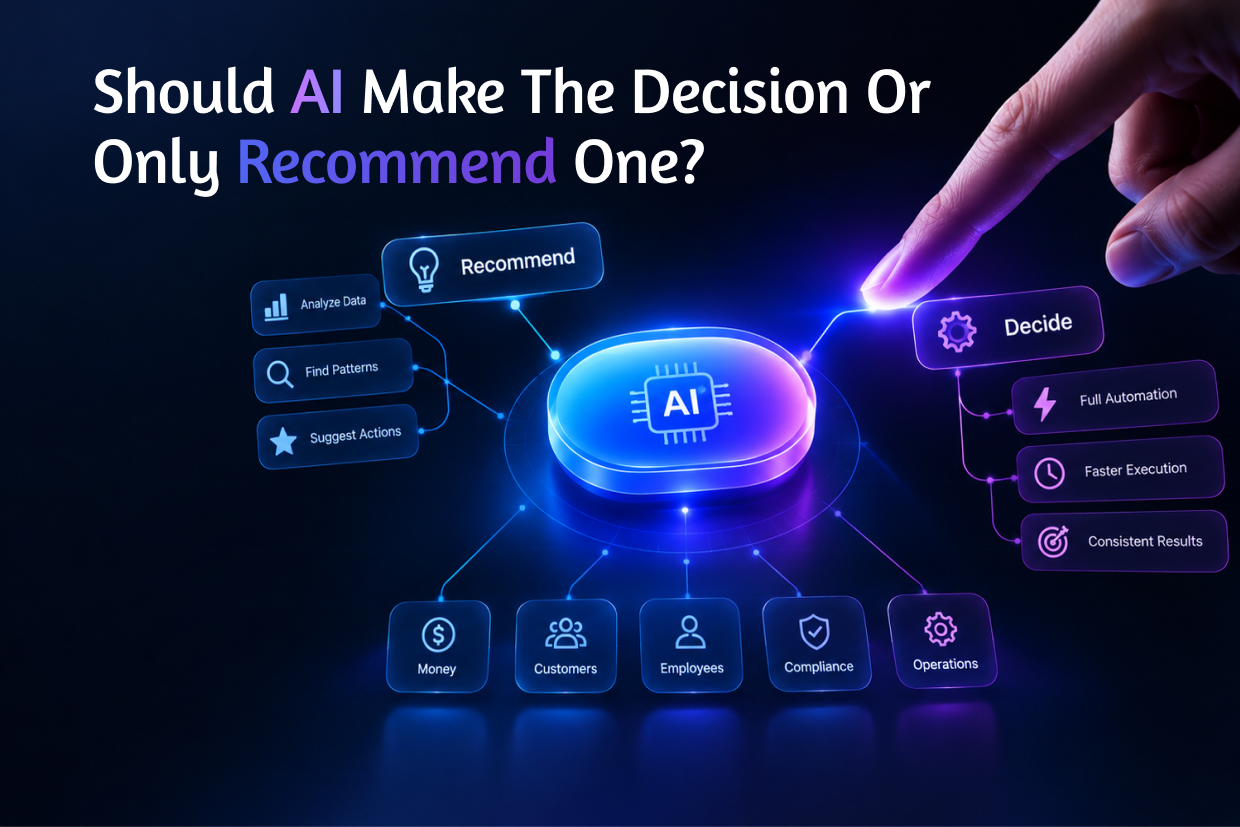
Should AI Make the Decision or Only Recommend One?
A company introduces an AI system to help its customer support team.
The system reads incoming requests, looks at customer history, checks the type of issue, and recommends what the support team should do next.
At first, the results are impressive.
The AI can review hundreds of requests faster than employees. It identifies common issues quickly. It recognizes patterns across previous support cases. It recommends responses that are often useful.
Then the product team asks an important question:
Why should an employee review the recommendation at all?
If the AI is already analyzing the information, why not let it make the decision automatically?
That sounds efficient.
But the answer depends on what the decision actually does.
Automatically categorizing a low-priority support ticket is very different from automatically cancelling a customer's account.
Suggesting a loan application for review is very different from approving the loan.
Recommending which employee should receive a task is very different from automatically changing someone's access to company systems.
The AI may be capable of handling all of these technically.
The business question is different:
Should it be allowed to make the final decision?
This distinction is becoming increasingly important as companies move from experimental AI features toward AI systems connected to real business workflows.
The goal should not be to automate every decision simply because automation is possible.
The goal should be to decide where AI should recommend, where it should act, and where a human should remain responsible for the outcome.
AI Can Be Very Good at Recommendations
AI is particularly useful when a decision requires analyzing a large amount of information.
A customer support system can examine previous conversations, product information, account history, and current policies before recommending a response.
A sales application can evaluate leads based on activity, company information, previous interactions, and engagement patterns.
A maintenance system can analyze equipment data and recommend which machine should be inspected first.
A finance application can flag transactions that appear unusual.
In each case, the AI can reduce the amount of information a person needs to process manually.
The employee does not start from an empty screen.
Instead, they receive something like:
“Based on the available information, this request appears to match the standard refund policy. Recommended action: approve.”
That recommendation may save time while still allowing the employee to verify the situation.
This can be a powerful middle ground.
AI handles analysis. Humans retain responsibility for the decision.
A Recommendation Is Not the Same as a Decision
The difference may sound small, but technically and operationally it is significant.
When AI recommends an action, the system produces an output that another person or workflow can review.
When AI makes the decision, the output directly changes what happens next.
Consider a simple example.
An AI system receives a customer complaint.
It determines that the issue is likely a billing problem.
As a recommendation system, it might say:
“Likely billing issue. Route to the finance support team.”
An employee or workflow reviews the recommendation and confirms the action.
In a fully automated system, the application could immediately transfer the case and send a notification to the customer.
Both systems use similar AI capabilities.
The difference is where authority sits.
This is why businesses need to define not only what an AI system can predict, but also what it is allowed to do with that prediction.
Not Every Decision Has the Same Risk
One of the simplest ways to think about AI autonomy is to look at the consequences of being wrong.
Some decisions are easy to reverse.
Others are not.
Suppose an AI sorts incoming support emails into categories.
If it assigns one email to the wrong category, an employee can correct it.
The impact may be small.
Now consider an AI system that automatically approves a large financial transaction.
If that decision is wrong, reversing the situation may be much harder.
This means businesses should evaluate decisions based on more than frequency or complexity.
They should also consider:
- What happens if the AI is wrong?
- Can the decision be reversed?
- How quickly can the mistake be detected?
- Who is affected?
- Is there a financial, legal, operational, or reputational consequence?
These questions help determine the appropriate level of human involvement.
A Simple Risk-Based Model
A practical way to approach AI decision-making is to divide decisions into different levels of impact.
| Decision Type | Example | Possible AI Role |
|---|---|---|
| Low impact and reversible | Categorizing support tickets | Automatic decision |
| Routine and rule-based | Routing internal requests | Automatic decision |
| Moderate impact | Prioritizing sales leads | AI recommendation with review |
| High impact | Financial approval | Recommendation with human approval |
| Sensitive or difficult to reverse | Employment or account action | Human decision supported by AI |
This is not a universal classification.
Each business needs to define its own risk levels.
The important principle is that AI autonomy should increase only when the organization is comfortable with the consequences of automated errors.
The Cost of a Wrong Decision Matters More Than the Cost of a Slow One
Businesses naturally focus on speed.
Automation promises faster processing.
Fewer manual steps.
Lower operational effort.
More requests handled per employee.
These are valuable outcomes.
But in some workflows, speed is not the most important metric.
Suppose a customer service team takes five minutes to review a recommendation before issuing a refund.
The business may save some time by removing that review.
But if the automated system incorrectly approves a large number of refunds, the cost of those errors could be much higher than the saved processing time.
The same principle applies to account changes, financial operations, supplier decisions, employee access, and other workflows where mistakes can create meaningful consequences.
Automation is valuable when the cost of automation is lower than the cost of the problem it creates.
The Best Workflow May Be AI First, Human Second
Many businesses think they have only two options.
Either:
Human makes the decision
or:
AI makes the decision
There is a useful middle ground.
The workflow can be:
AI analyzes → AI recommends → Human reviews → System executes
This structure allows the AI to perform the time-consuming analytical work while keeping a person involved at the point where judgment matters.
For example, the AI can read a customer request, review account history, identify the relevant policy, summarize the situation, and recommend the appropriate action.
The employee then sees:
Customer: Existing enterprise account
Issue: Billing dispute
Relevant policy: Refund eligible under condition X
Recommended action: Approve partial refund
Instead of spending several minutes gathering the information manually, the employee spends that time validating the recommendation.
That is a much more productive use of human attention.
Human Review Should Add Value, Not Become a Checkbox
There is a danger in adding human approval to every AI decision without thinking about what the reviewer is actually doing.
Imagine a system generates a recommendation.
An employee opens it.
They see the AI recommendation.
They click Approve.
They do this hundreds of times a day without examining the supporting information.
Technically, a human is involved.
Practically, the review may have become meaningless.
This is sometimes called rubber-stamp approval.
The purpose of human review should not be to create the appearance of control.
The reviewer should have enough information, context, and authority to disagree with the AI when necessary.
That means the interface should show:
- Why the recommendation was made.
- Which information influenced it.
- What important conditions were detected.
- How confident the system is where confidence is meaningful.
- What alternative action could be taken.
Without this context, the human becomes a button-clicker rather than a decision-maker.
AI Should Explain the Recommendation in Useful Terms
An employee may hesitate to trust an AI recommendation if the system simply says:
“Recommended: Reject.”
Reject what?
Why?
Based on which information?
Was something missing?
Did the system identify a policy violation?
Was the decision based on a historical pattern?
The explanation does not need to reveal technical model details.
It needs to provide useful business context.
For example:
“Recommended action: Request additional documentation. The submitted invoice does not contain the required purchase order number, and the department's approval policy requires one for this expense category.”
Now the employee has something they can evaluate.
AI recommendations become more useful when people can understand the reasoning behind the recommendation at the level required for the task.
Confidence Alone Is Not Enough
AI systems often produce confidence scores or probability-like indicators.
These can be useful in some applications, but businesses should not assume that a high confidence value automatically means the recommendation is correct.
A system can be highly confident and still be wrong because the underlying information is incomplete, outdated, or misleading.
Consider an AI assistant that recommends:
“Approve the request — 96% confidence.”
But the system failed to retrieve a recent policy update.
The number may create a false sense of security.
For this reason, businesses should consider the quality and completeness of the evidence, not only the model's confidence.
A useful system can show the relevant information supporting the recommendation rather than relying on a single confidence number.
Human Judgment Matters Most at the Edges
AI often performs well when cases closely resemble the situations represented in its available data and rules.
The difficult cases are usually the unusual ones.
A customer with an exceptional contract.
A supplier with special terms.
A transaction that combines several unusual conditions.
An employee request that does not fit an established policy.
A product failure that does not match previous incidents.
These cases are exactly where human experience can become valuable.
A strong AI workflow can therefore be designed so that normal cases move automatically while unusual cases are escalated.
For example:
Standard case → AI processes automatically
Unusual case → AI recommends → Human reviews
This lets automation handle predictable volume while keeping people involved where exceptions matter.
Exceptions Should Be Designed Into the Workflow
One common mistake is designing automation around the normal path only.
Imagine a refund system.
The standard rule says refunds below a certain amount can be approved automatically.
That sounds simple.
But what happens when:
- The customer has already received several refunds?
- The order contains a disputed item?
- The payment status is uncertain?
- The customer has an active complaint?
- The transaction is outside the normal time period?
A strong workflow does not simply ask whether the AI can process the request.
It defines what conditions move the request out of the automatic path.
This is where business rules, validation, and exception handling become important.
Good AI automation knows when to stop.
Reversibility Is an Important Design Question
Before giving an AI system permission to act automatically, ask:
Can we undo the action?
Some decisions are highly reversible.
A support ticket can be moved to another category.
A recommendation can be changed.
A draft response can be edited.
Other decisions are harder to reverse.
A payment may already have been transferred.
A customer may have received a cancellation notice.
Access credentials may have been revoked.
A contract may have been processed.
An irreversible action deserves much more careful control.
This is why AI autonomy should generally be evaluated alongside reversibility.
The harder an action is to undo, the more important strong validation and human oversight become.
Speed Does Not Always Justify Full Automation
Suppose a business can reduce processing time from ten minutes to one minute by removing human review.
That looks impressive.
But what if the error rate doubles?
The business must consider the full cost of those errors.
This means AI success should not be measured only in:
- Processing time.
- Number of tasks completed.
- Automation percentage.
- Human hours saved.
Businesses should also evaluate:
- Incorrect decisions.
- Escalation rates.
- Customer complaints.
- Manual corrections.
- Financial impact.
- Missed cases.
- Unintended actions.
The goal is not maximum automation.
The goal is maximum useful automation.
Where AI Can Often Act More Independently
Some tasks are naturally suited to higher levels of automation because they are repetitive, rule-based, and easy to reverse.
For example, AI may automatically classify incoming documents, summarize customer conversations, extract information from invoices, detect duplicate support tickets, route requests to the appropriate queue, generate internal drafts, or trigger routine notifications.
These tasks can still require validation, especially when the output affects important workflows, but the risk may be easier to control.
In many such situations, forcing a human to manually approve every low-impact action can create unnecessary work.
The AI can handle the routine path.
Humans can focus on exceptions.
Where AI Recommendations May Be More Appropriate
Other decisions may benefit from AI assistance without fully handing over authority.
Examples include prioritizing high-value sales leads, recommending inventory actions, identifying potentially fraudulent transactions, suggesting customer retention actions, reviewing business applications, or recommending whether a case should be escalated.
In these situations, the AI can reduce the amount of analysis a person needs to perform while allowing the person to make the final decision.
The important part is that the reviewer receives enough context to challenge the recommendation.
Where Human Decision-Making May Still Be Essential
Some decisions can have consequences that are too significant or sensitive to delegate entirely to an automated system.
The exact boundaries depend on the business and applicable requirements, but examples can include sensitive employee decisions, complex legal matters, major financial actions, critical account restrictions, or situations involving significant customer harm.
In such workflows, AI can still provide substantial value.
It can gather information.
Summarize documents.
Identify relevant policies.
Compare historical cases.
Highlight missing information.
Generate possible options.
But the final decision can remain with an appropriately authorized person.
This does not make the AI less useful.
It gives the AI a role that matches the risk of the decision.
The Human Should See the Evidence, Not Just the Answer
If an AI system recommends an action, the user interface should help the reviewer investigate quickly.
Imagine an approval screen containing only:
AI Recommendation: Approve
That is not enough for many business decisions.
A better interface might show:
Recommendation: Approve
Reason: Request meets the standard approval conditions.
Relevant information: Order value, customer type, policy status, previous approvals.
Potential issue: None detected.
Supporting source: Current approval policy.
Action: Approve / Reject / Request More Information
Now the human can make an informed decision.
The interface becomes a decision-support tool instead of a simple approval button.
AI Should Be Allowed to Escalate
A mature AI system should not only know how to recommend an action.
It should also know when the normal process does not apply.
Imagine an AI reviewing expense requests.
For most cases, the request matches the policy.
One request contains unusual documentation.
Another involves an unfamiliar supplier.
Another exceeds the normal approval threshold.
Instead of forcing the AI to choose anyway, the system can mark those cases for human review.
This creates an escalation path:
Normal → Automated
Unclear → Human Review
High Risk → Human Decision
The exact categories depend on the business.
The principle remains the same:
Uncertainty should change the workflow.
What Happens When the AI Is Wrong?
This question should be answered before the system goes live.
Suppose the AI makes an incorrect recommendation.
Who notices?
Who can reverse the action?
How quickly can the problem be corrected?
Can the business identify affected transactions?
Can employees override the decision?
Is there an audit record?
Can the team determine why the AI made the recommendation?
A production AI system needs more than an accuracy target.
It needs an operational response to failure.
This is especially important when AI becomes connected to actions rather than remaining a purely informational feature.
Auditability Becomes More Important as AI Gains Authority
When a human makes a decision, organizations often have established processes for recording who approved something and when.
AI-driven workflows need similar traceability.
The system may need to record what information was considered, what recommendation was generated, what action was taken, who approved it when human review occurred, and whether the result was later corrected.
The exact level of logging depends on the use case, but the principle is broadly useful:
The more authority an AI system has, the more important it becomes to understand what happened after the decision was made.
Without traceability, investigating mistakes becomes much harder.
AI Decisions Should Be Monitored After Deployment
An AI workflow can perform well during initial testing and behave differently after being exposed to real business activity.
Data changes.
Customer behavior changes.
Products change.
Business rules change.
New edge cases appear.
The AI may begin encountering situations that were not represented during testing.
This means production monitoring should look beyond whether the model is online.
Teams can monitor:
- Recommendation acceptance rates.
- Human override rates.
- Exception frequency.
- Incorrect decisions.
- Customer complaints.
- Manual corrections.
- Escalation patterns.
- Changes in outcome quality.
If employees frequently override the same recommendation, that pattern may indicate a problem with the model, data, business rules, or workflow design.
The Right Question Is Not “Can AI Decide?”
Technically, AI can participate in many decision processes.
That is not the most useful question.
The better question is:
“What level of authority should AI have in this decision?”
The answer depends on the task.
A system might have permission to:
- Observe — gather and summarize information.
- Recommend — suggest an action.
- Approve — make a defined low-risk decision.
- Execute — carry out an action automatically.
- Escalate — send uncertain or high-risk cases to a person.
This creates a more useful way to think about AI autonomy than simply calling a system “automated.”
Design AI Authority as a Spectrum
AI does not need to move from zero automation directly to complete autonomy.
There are many levels between the two.
At the lowest level, AI may only provide information.
The next level may involve recommendations.
Then the system may automatically handle routine cases while escalating exceptions.
After sufficient evidence and controls are established, certain categories of decisions may become fully automated.
This gradual approach allows teams to learn how the AI behaves before giving it broader authority.
It also makes risk management easier.
Trust can be increased based on evidence rather than assumption.
Start With a Recommendation Before Granting Full Authority
For many businesses, one practical approach is to begin with recommendations.
Let the AI analyze real cases.
Allow employees to accept or reject the suggestions.
Record the results.
Study where the AI is reliable.
Identify recurring exceptions.
Improve the data and business rules.
Then determine whether specific low-risk cases can move to automatic execution.
This creates a feedback loop:
AI Recommendation → Human Decision → Outcome → Measurement → Improvement
Over time, the organization gains evidence about where automation is genuinely useful.
This is often more practical than deciding on day one that the AI should control the entire workflow.
Not Every Human Decision Needs to Stay Human
There is also a risk of going too far in the opposite direction.
Some teams may keep humans involved in every single step because they do not trust automation.
Imagine an AI system that can accurately categorize ten thousand incoming requests but requires an employee to approve every category individually.
The AI has created analysis without meaningful efficiency.
In these situations, the team should ask:
What exactly is the human adding at this step?
If the reviewer is simply confirming obvious decisions repeatedly, automation may be appropriate.
The objective is not to preserve human involvement for its own sake.
The objective is to preserve meaningful human judgment where it adds value.
The Best Workflow May Be Different for Different Decisions
A company does not need one universal AI policy.
One workflow may be fully automated.
Another may require human approval.
Another may use AI only for analysis.
Another may use AI to generate a draft but require a person to make the final decision.
This is normal.
The level of AI authority should be designed at the decision level, not necessarily at the application level.
One application can therefore contain:
- Automatic processing for low-risk tasks
- AI recommendations for moderate-risk tasks
- Mandatory human review for high-risk tasks
The important part is that those boundaries are deliberate.
AI Should Make Humans More Effective, Not Just Less Busy
Reducing manual work is valuable.
But the stronger outcome is often improving the quality of human attention.
Employees should not have to spend their time collecting information, checking routine conditions, comparing documents, and moving data between systems when software can assist with those tasks.
Instead, they can focus on:
- Unusual cases.
- Complex customer situations.
- Strategic decisions.
- Negotiation.
- Relationship management.
- Creative problem-solving.
- Risk assessment.
This changes the role of AI.
It is not simply replacing a person.
It is helping the person spend more time on work that benefits from experience and judgment.
A Practical Decision Framework
Before allowing AI to make a decision automatically, a business can evaluate several questions.
- Is the decision repetitive?
- Are the input conditions well understood?
- Is the expected outcome clearly defined?
- How costly is a wrong decision?
- Can the action be reversed?
- Can the decision be independently validated?
- Does the AI have access to the information required?
- Can unusual cases be detected?
- Can employees override the action?
- Can the business audit what happened?
If the decision is low-risk, repetitive, reversible, and easy to validate, greater automation may be appropriate.
If the decision is high-impact, difficult to reverse, poorly defined, or heavily dependent on context, human involvement may be more appropriate.
This is not about creating a universal percentage for automation.
It is about matching AI authority to the characteristics of the decision.
AI Autonomy Should Grow With Evidence
A business should not give an AI system full decision-making authority simply because the initial demonstration looks impressive.
The system should earn broader authority through real-world evidence.
Start with recommendations.
Measure outcomes.
Monitor mistakes.
Study exceptions.
Improve the underlying data.
Strengthen validation.
Add controls.
Then consider whether specific categories of decisions can move to automatic execution.
This creates a more responsible progression:
Assist → Recommend → Automate Low-Risk Cases → Expand Carefully
The exact stages will differ between organizations, but the underlying philosophy is useful.
Autonomy should be based on demonstrated reliability, not enthusiasm about the technology.
The Real Value Is in Designing the Right Balance
The debate around AI often becomes too simple.
People ask whether AI will replace human decision-making.
For many real business applications, that is not the most useful question.
The more practical question is:
Which parts of the decision process should AI handle, and which parts should remain under human control?
AI may be excellent at collecting information.
It may be excellent at comparing records.
It may be excellent at detecting patterns.
It may be excellent at generating recommendations.
Humans may be better positioned to handle unusual circumstances, ambiguous situations, sensitive outcomes, or decisions where accountability matters.
The strongest systems combine those capabilities rather than forcing one side to do everything.
AI Should Know What It Is Allowed to Do
An AI model may technically be able to perform an action.
That does not mean the application should allow it.
This distinction should exist in the product architecture.
The AI can generate a recommendation, but the application can require approval before a sensitive action is executed.
The AI can identify a potentially fraudulent transaction, but the application can place it in a review queue instead of automatically blocking the customer.
The AI can determine that a support case appears routine, but the system can automatically process only low-value cases while escalating unusual ones.
This is how business rules and AI capabilities can work together.
Model capability and business authority should not be treated as the same thing.
The Goal Is Controlled Automation
A mature AI application is not necessarily the one that automates the greatest number of decisions.
It is the one that automates the right decisions while providing appropriate controls around the rest.
Controlled automation can mean automatic processing for routine cases, human review for exceptions, confirmation for sensitive actions, audit trails for important decisions, and clear rollback mechanisms when something goes wrong.
This allows businesses to gain the efficiency of AI without pretending that every situation can be reduced to a simple automated answer.
So, Should AI Make the Decision?
Sometimes yes.
Sometimes no.
The right answer depends on the nature of the decision, the quality of the information available, the consequences of being wrong, the ability to reverse the action, and the controls surrounding the workflow.
AI can independently handle many low-risk, repetitive, and well-defined tasks.
It can recommend actions in situations where human judgment still matters.
It can analyze complex information and present a clear set of options.
And in high-impact situations, it can support people without becoming the final authority.
The important thing is not to choose between “AI decides everything” and “humans decide everything.”
Design the workflow so that AI has exactly as much authority as the decision can safely support.
When that balance is designed carefully, AI becomes more than an automation feature. It becomes a decision-support layer that helps employees process information faster, focus on meaningful exceptions, and make better-informed choices.
At Vriksha Techno Solutions, AI application development can be designed around different levels of automation, from intelligent recommendations and human approval workflows to controlled automation for routine decisions. The focus is on connecting AI capabilities with business rules, data quality, validation, permissions, and measurable outcomes.
Ready to Build Your Next Digital Product?
Our experts will respond within 24 hours with a tailored approach for your project.