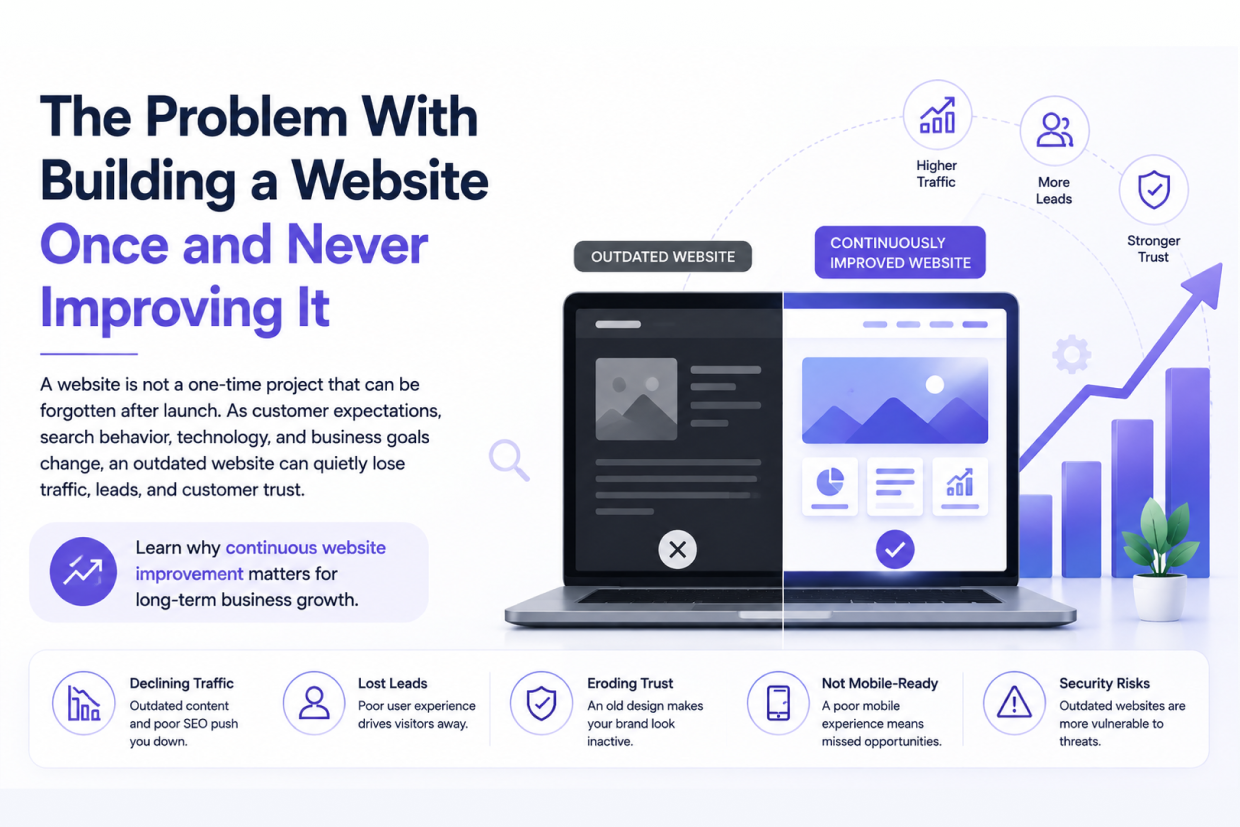
The Problem With Building a Website Once and Never Improving It
Short answer: A website is not a finished product but an ongoing business tool. Content, customer behavior, search engines and small UX problems change over time, so businesses should measure, identify, improve, test and measure again instead of leaving a site untouched for years.
A business launches a new website.
The design looks modern.
The pages are published.
The contact form works.
The website goes live.
Then nothing happens.
Months pass. Then years.
The business continues using the same pages, the same navigation, the same forms, the same images, and sometimes even the same information that was written when the website was first created.
This is a common mistake.
A website is not a finished product. It is a business tool that needs to evolve.
Customers change. Products change. Search behavior changes. Competitors improve. Technology changes. Even a successful website can gradually become less effective when it is never reviewed or updated.
A Website Can Be Working and Still Be Failing
One of the most dangerous website problems is that everything appears normal.
The website opens.
The pages load.
Nobody receives an obvious error.
But leads may be decreasing.
Customers may be leaving earlier.
Important pages may no longer match what people are searching for.
A contact form may technically work while asking visitors for too much information.
The website may be receiving traffic but failing to convert it.
| What You See | What May Actually Be Happening |
|---|---|
| Website is online | Visitors are leaving quickly |
| Contact form works | Users are abandoning it |
| Traffic exists | The wrong visitors are arriving |
| Pages look modern | Content may be outdated |
| Website loads | Important actions may still feel slow |
| SEO was done earlier | Search intent may have changed |
This is why website maintenance should not be confused with website improvement.
Maintenance keeps a website functioning.
Improvement makes the website more effective.
Your Customers Are Not Using the Website the Way They Used To
A website is designed around assumptions.
You may assume customers want to read every service description.
They may actually want pricing first.
You may expect visitors to use the main navigation.
They may arrive directly on an internal page from Google.
You may expect customers to call your sales team.
They may prefer WhatsApp, chat, or an online booking form.
Real user behavior often reveals problems that were impossible to predict when the website was originally designed.
That is why website improvement should be based on actual customer behavior, not only internal opinions.
The Website Content Can Become Outdated Without Anyone Noticing
A company may change its services, pricing, locations, team, products, or technology stack.
But old website content can remain unchanged.
This creates a credibility problem.
Imagine a customer visiting a page that mentions a service the company no longer provides.
Or a customer sees an outdated phone number.
Or a product page describes a feature that no longer exists.
These may look like small content issues.
But customers often judge the reliability of the business through the accuracy of its website.
Outdated information creates unnecessary doubt.
Search Engines Change Too
Website improvement is also important because search behavior evolves.
The keywords customers used several years ago may not be the phrases they use today. Search engines also continue to improve how they understand content, page experience, structured information, and search intent.
That means a page that once performed well may gradually lose visibility.
Instead of simply asking:
"Is our website indexed?"
Businesses should also ask:
"Does our website still answer what our customers are searching for?"
Updating content, improving page structure, strengthening internal linking, and removing outdated information can help keep the website relevant.
Small UX Problems Can Become Lost Revenue
Sometimes the problem is not the website itself.
It is one small step.
A customer has to fill out a long form.
A product is difficult to find.
The CTA is unclear.
The checkout requires unnecessary information.
The mobile menu is difficult to use.
Individually, these issues may seem minor.
But thousands of visitors experiencing the same friction can create a significant business impact.
A useful website improvement process asks:
Where are users getting stuck?
Then it removes that obstacle.
Don't Redesign Everything Just Because the Website Is Old
Another mistake is assuming that every older website needs a complete redesign.
That is not always necessary.
Sometimes a business needs:
- Better content
- Faster pages
- Improved navigation
- Simpler forms
- Updated service information
- Better mobile UX
- Stronger calls to action
- Improved SEO structure
A complete redesign can be appropriate when the underlying architecture or experience is fundamentally outdated, but smaller targeted improvements can often deliver value sooner.
Think of Your Website as a Product
A useful mindset is to stop treating the website like a brochure.
A brochure is created once and printed.
A digital product can be measured, tested, updated, and improved.
Businesses can look at:
- Which pages attract visitors
- Where users leave
- Which forms are completed
- Which pages generate enquiries
- What customers search for
- Which devices visitors use
- Which pages receive little engagement
These insights can guide future improvements.
What Should Be Reviewed Regularly?
| Area | What to Check |
|---|---|
| Content | Is the information still accurate and useful? |
| Performance | Are pages loading efficiently? |
| Mobile UX | Is the experience easy on smaller screens? |
| Forms | Are visitors completing important actions? |
| SEO | Does the content match current search intent? |
| Security | Are software and integrations up to date? |
| Analytics | Where are users dropping off? |
The objective is not to change something every week.
It is to continuously identify and remove friction.
A Simple Website Improvement Cycle
A successful improvement process can be continuous:
Measure → Identify → Improve → Test → Measure Again
Measure
Use analytics, customer feedback, search data, and performance information.
Identify
Find the pages, tasks, or journeys causing the most friction.
Improve
Make a focused change rather than redesigning everything unnecessarily.
Test
Check whether the change actually improved the result.
Measure Again
Compare the new behavior with the previous performance.
This turns website development into an ongoing optimization process instead of a one-time project.
When Should a Business Review Its Website?
A website deserves a review when:
- Traffic is declining.
- Leads are decreasing.
- Customers complain about usability.
- Important information is outdated.
- Mobile users have difficulty navigating.
- The website takes too long to load.
- New services are not represented properly.
- Competitors are providing better online experiences.
- The website has not meaningfully changed for years.
A website doesn't need to be broken before it deserves improvement.
It only needs to be less effective than it could be.
The Cost of Doing Nothing
Businesses often calculate the cost of redesigning a website.
Few calculate the cost of leaving an ineffective website unchanged.
Suppose a website receives thousands of visitors every month but loses a portion of potential customers because of slow pages, outdated content, confusing navigation, or weak conversion paths.
The business is already paying for those lost opportunities.
The question becomes:
Is improving the website an expense—or is continuing to lose potential customers the more expensive option?
Conclusion
A website should grow alongside the business.
New customers bring new expectations. New services require new information. Search behavior changes. Technology evolves. Competitors improve.
A website that remains unchanged for years can slowly become disconnected from the people it is supposed to serve.
The strongest businesses treat their website as an ongoing digital product—something they measure, improve, test, and adapt.
At Vriksha Techno Solutions, we help businesses continuously improve their websites through performance optimization, UX improvements, SEO-focused development, content structure, integrations, and scalable web solutions.
Frequently Asked Questions
Why should a website be improved after launch?
Customers use websites differently over time, content becomes outdated without anyone noticing, search engines change and small UX problems can turn into lost revenue.
What is a simple website improvement cycle?
Measure how visitors actually use the site, identify the problems, improve them, test the changes, then measure again.
Do you need a full redesign when a website is old?
Not necessarily. The article advises against redesigning everything just because a site is old, and suggests treating the website as a product that is improved continuously.
Ready to Build Your Next Digital Product?
Our experts will respond within 24 hours with a tailored approach for your project.