How a Centralized Platform Simplifies Campus Operations
Managing a university involves much more than conducting classes and maintaining student records. Admissions, course registration, examinations, fee collection, library services, accommodation, staff administration, and reporting all require coordination across different departments.
When these activities are handled through disconnected tools or manual processes, maintaining accurate information and coordinating daily operations can become difficult. Staff may need to update the same information in multiple places, while students may have to contact different departments to complete routine tasks.
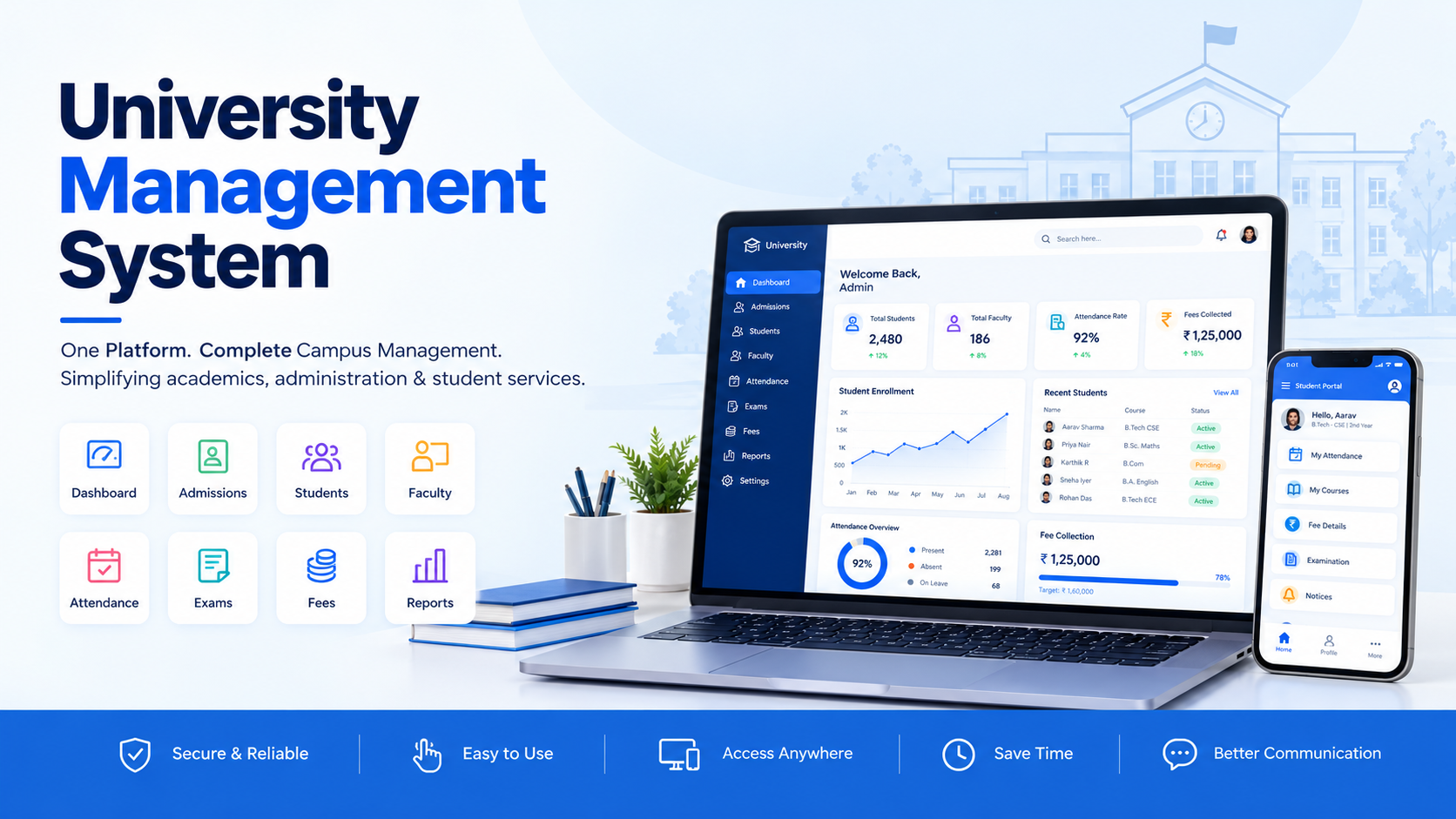
A University Management System brings these activities together through a centralized digital platform. By organizing academic, administrative, and financial processes, universities can improve information flow, simplify routine work, and provide students and staff with more convenient access to essential services.
Why Universities Need a Centralized Management System
A university involves multiple departments, programs, administrative teams, faculty members, and student groups. Each area manages different information, but many of these activities are closely connected.
For example, admission details influence student registration, course enrollment, fee records, examination eligibility, and academic reporting. When these processes operate independently, maintaining consistency across the institution becomes more challenging.
A centralized system helps universities coordinate these activities by maintaining organized records and connecting related workflows.
- Better information management: Keep student, faculty, financial, and administrative records organized.
- Connected workflows: Coordinate activities across departments and academic programs.
- Reduced manual work: Simplify routine registration, reporting, and record-maintenance tasks.
- Improved accessibility: Provide authorized users with access to relevant information through their respective accounts.
- Clearer administration: Help administrators monitor records, activities, and reports from a central interface.
What Is a University Management System?
A University Management System is a web-based software platform designed to manage an institution's academic and administrative activities. It connects different operational areas, including admissions, student information, courses, examinations, finance, library services, accommodation, personnel, and reporting.
Rather than treating each department as an isolated operation, the system provides a shared environment where authorized users can manage information and perform their responsibilities according to their access permissions.
The platform can also provide separate account areas for students, academic staff, non-academic staff, administrators, and funding organizations. Each user group can access the functions relevant to its role.
Key Modules of a University Management System
A university management platform can include several interconnected modules. The exact configuration depends on the institution's requirements, academic structure, and administrative processes.
1. Online Admission and Student Registration
Admission and registration are among the first interactions students have with a university. Managing these activities digitally can make the process more organized for both applicants and administrative staff.
An online admission module can present admission requirements and eligibility criteria, support different entry modes, and guide applicants through the required registration steps.
- Publish admission requirements and eligibility information.
- Collect student details through online registration forms.
- Support different entry modes and registration procedures.
- Manage applicable admission and registration fees.
- Generate payment receipts and registration form printouts.
- Assign student identification or enrollment numbers according to institutional rules.
Organizing registration within a centralized system helps establish student records that can be used throughout subsequent academic and administrative processes.
2. Student Information Management
Universities maintain a wide range of student information, from personal details and enrollment status to course registration and academic records. A student information module provides a structured place to maintain and manage these records.
Authorized administrators can add, import, update, and retrieve student information through the administrative interface. Student records can also be associated with programs, courses, semesters, and other relevant academic details.
Depending on the institution's configuration, student identification numbers, examination numbers, activity statuses, and academic documents can also be managed within the system.
Keeping these records organized helps administrative teams retrieve information more efficiently and prepare reports when needed.
3. Faculty, Department, and Course Management
Universities may operate multiple faculties, departments, programs, and courses. Maintaining these structures accurately is important for registration, academic administration, and reporting.
A university management platform can allow authorized administrators to create and manage academic structures from a central administrative area.
- Manage faculties and departments.
- Create and maintain academic programs.
- Organize courses by program, academic level, or year.
- Support course registration for students.
- Manage staff accounts and relevant permissions.
Connecting academic structures with student records helps keep enrollment and course information organized as the institution grows or changes its academic offerings.
4. Online Assignments and Academic Activities
Assignments are an important part of academic administration. A digital assignment module can help lecturers distribute work to students registered for a particular course or subject.
Depending on the configured assessment features, lecturers can create assignments, specify submission deadlines, and make them available to the relevant students. Students can then access assigned work and submit their responses through the system.
For example, a lecturer can prepare a multiple-choice assignment for a particular subject, set a due date, and allow registered students to complete and submit it online.
This creates a more organized way to manage assignment distribution and submission without relying entirely on separate communication channels.
5. Examination, Results, and Transcripts
Examination administration involves recording results, calculating grades, maintaining academic histories, and preparing student records. These activities require accurate information and consistent procedures.
A result management module can support semester-wise result entry and computation, while transcript management can help maintain academic records for individual students.
- Manage student results by semester.
- Calculate and maintain examination results.
- Generate student grade sheets and transcripts.
- Prepare academic performance reports.
- Support student promotion after the required results are declared.
When result records and student information are maintained within the same platform, authorized staff can access the relevant academic information more conveniently.
6. Fee Collection and Financial Management
Financial administration includes collecting student fees, maintaining receipts, recording transactions, and monitoring financial information. Handling these activities manually can make record retrieval and reconciliation more demanding.
A financial management module can organize fee-related information and maintain records of deposits, receipts, transactions, and funds.
Depending on the institution's payment configuration, students may be able to pay applicable fees through supported online payment methods or bank deposits.
- Maintain student fee records.
- Record fee deposits and payment receipts.
- Support configured online payment and bank deposit workflows.
- Maintain transaction and fund records.
- Generate relevant financial and administrative reports.
Centralized financial records help authorized staff review payment information without depending entirely on separate spreadsheets or paper-based records.
7. Library Management and Digital Resources
Library services are an important part of the student experience. A digital library module can make it easier for students to find resources and manage book-related requests.
Students can search for books by title or category and submit requests to borrow available resources. Where supported, the library module can also provide access to electronic books for online reading or download.
Additional library resources, such as journals, serial publications, and research projects, may be included depending on the institution's requirements and selected configuration.
By connecting library services with student accounts, universities can also provide relevant information, such as book-due notifications, through the student dashboard.
8. Hostel and Accommodation Management
For institutions that provide student accommodation, hostel administration involves managing applications, related records, and applicable fees.
A hostel management module can allow students to apply for accommodation through their accounts and complete the associated payment process where supported.
Bringing accommodation applications into the wider university platform helps administrative staff manage this activity alongside other student services.
9. Staff Administration and Role-Based Access
University operations involve different groups of users, including administrators, lecturers, non-academic staff, and other authorized personnel. Each group has different responsibilities and should not necessarily have access to every part of the system.
A staff administration module can maintain user records, generate login credentials, and organize permissions according to assigned roles or groups.
- Create and maintain staff accounts.
- Provide separate login areas for different user groups.
- Assign permissions according to responsibilities.
- Restrict access to relevant administrative functions.
- Maintain clearer accountability for actions performed within the system.
Role-based access helps organize responsibilities and supports more controlled management of institutional information.
10. Notifications and University Communication
Students and staff regularly need updates about assignments, fees, library due dates, registration activities, and other university-related matters.
A notification module can send email notifications to relevant users using configured message templates. Student dashboards can also display important notices related to their activities.
Other communication features may include:
- University news and event announcements.
- Student and lecturer chat facilities.
- Discussion forums within protected account areas.
- Polling to collect student opinions.
- Voting facilities for supported university elections.
- Alumni communication and community features.
These capabilities provide different ways to share information and encourage communication within the university community.
11. Reporting and Administrative Dashboards
University administrators need access to reliable information to monitor activities and prepare reports. A reporting module can bring relevant records together to support administrative review and planning.
Depending on the available configuration, reports may cover student registration, examination results, student performance, financial activity, and other institutional operations.
Organized reporting can help administrative teams identify missing information, review academic records, and make informed decisions using the data available to them.
12. Funding and Research Project Management
Some universities coordinate funding from external organizations for projects, scholarships, and research activities. These processes may involve approvals, project records, and ongoing monitoring.
A funding management module can provide designated funding organizations or officers with access to relevant projects and approval workflows.
Project tracking can help authorized users review project status and monitor activities associated with the funding process. Depending on institutional requirements, sponsorship and research funding features may also be included.
13. Audit Trails and Activity Tracking
Universities need to maintain oversight of important administrative operations. An audit trail module can record actions performed by users in different sections of the administrative area.
Authorized administrators can review these logs to understand which actions were performed and examine activity associated with particular user accounts.
Activity codes can also be used to categorize student statuses, such as active, suspended, or expelled, according to the institution's configured rules.
These capabilities support more organized record management and help administrators review changes and activities within the system.
How a Centralized System Improves Daily University Operations
The value of a university management platform comes from how its modules work together. Connecting related processes can reduce unnecessary administrative effort and make information easier to access.
Reduce Repetitive Administrative Work
Online registration, digital assignment submission, centralized records, and automated notifications can reduce the need to manage every activity manually.
Keep Information Organized
Maintaining student, academic, financial, and administrative records in a connected environment can make information retrieval and record maintenance more manageable.
Improve Access for Students and Staff
Separate account areas allow users to access relevant services, information, and functions according to their assigned permissions.
Support Better Administrative Visibility
Reports, activity logs, and centralized records give authorized administrators a more organized view of institutional activities.
Coordinate Activities Across Departments
When admissions, courses, results, finance, and other functions are connected, departments can work with related information through a shared platform rather than relying entirely on isolated processes.
What to Consider When Choosing a University Management System
Selecting a university management platform requires more than reviewing a list of features. Institutions should evaluate how the system fits their academic structure, administrative workflows, and operational requirements.
Department and Module Configuration
The system should support the institution's faculties, departments, programs, and required administrative functions. The ability to configure relevant modules is important when different departments follow different workflows.
Role-Based Access
Review how student, academic staff, non-academic staff, administrator, and other user accounts are managed. Access permissions should align with each user's responsibilities.
Reporting Requirements
Identify the reports required by academic and administrative teams, including registration, results, performance, and financial reporting.
Payment Workflows
Confirm whether the available payment options support the institution's fee collection procedures, including online payments or bank deposits where required.
Data Management and Auditability
Evaluate how student and administrative records are maintained, how access is controlled, and whether relevant user actions can be reviewed through audit logs.
Student and Staff Experience
Review whether users can easily access the functions they need, such as course registration, assignments, library services, notifications, and administrative tasks.
Build a More Connected University Management Process
Managing a university requires coordination between students, faculty, administrative staff, academic departments, finance teams, and other institutional stakeholders. When these activities rely on disconnected processes, maintaining accurate information and coordinating daily work can become increasingly difficult.
A centralized university management system provides a structured way to connect admissions, student records, academics, finance, library services, accommodation, communication, and reporting within a shared digital environment.
At Vriksha Techno Solutions Pvt. Ltd., we develop digital solutions designed around business and institutional workflows. Our approach focuses on understanding operational requirements and building software that helps organizations manage information, connect processes, and support their evolving needs.
If your institution is exploring ways to simplify administration and create more connected digital workflows, the right software solution can be an important step toward more organized campus operations.
Frequently Asked Questions
What is a University Management System?
A University Management System is software that helps institutions manage academic and administrative operations, including admissions, student records, courses, examinations, finance, library services, accommodation, and reporting.
What modules are commonly included in university management software?
Common modules include admission and registration, student information, course management, assignments, results, transcripts, financial management, library services, accommodation, staff administration, notifications, and reporting. Additional modules depend on institutional requirements.
Can students access university services online?
Yes. A system with a student account area can provide access to services such as profile management, course registration, assignment activities, library services, fee receipts, notifications, and hostel applications, depending on its configuration.
Can university management software handle different user roles?
Yes. Role-based access can provide separate account areas and permissions for students, lecturers, non-academic staff, administrators, and other authorized users.
Can the system support online fee payments?
A university management platform can support configured online payment workflows and bank deposit processes. The available methods depend on the institution's requirements and payment integrations.
How does a university management system help administrators?
It can centralize institutional records, organize workflows across departments, simplify routine administration, provide reports, and maintain activity logs that help authorized administrators review operations.
Ready to Build Your Next Digital Product?
Our experts will respond within 24 hours with a tailored approach for your project.