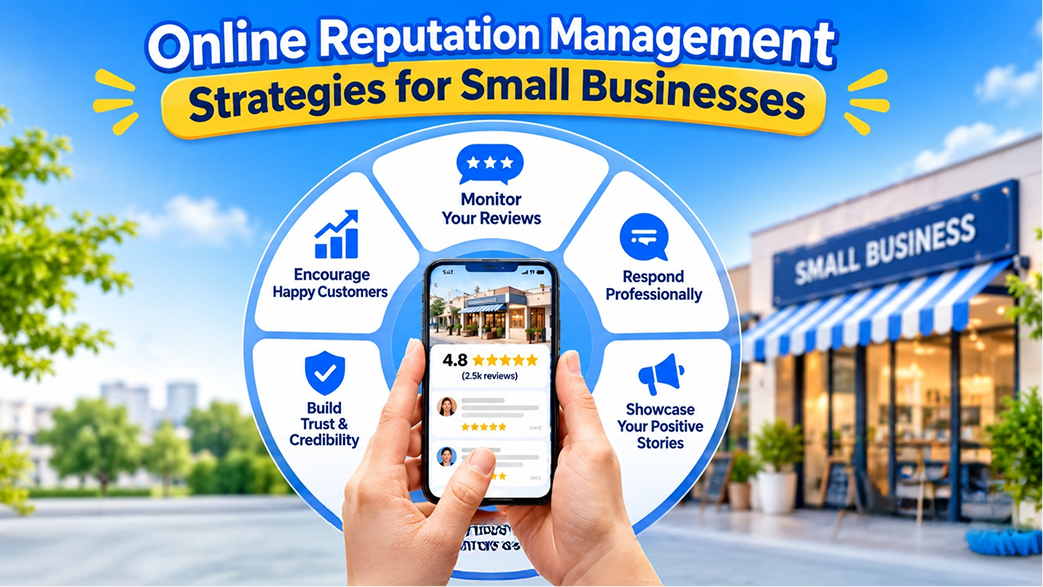
Short answer: online reputation management for a small business is a simple routine: ask every customer for a review at the right moment, reply to every review within a day or two, fix the problems that complaints keep pointing to, and keep your business listings accurate. The businesses that do this well build the routine into their own systems, so review requests and complaint follow-ups happen automatically instead of depending on someone remembering.
This guide is for owners of shops, clinics, service businesses and online stores. It covers 13 practical strategies, a weekly routine, and how to use your app, website and CRM to collect feedback and act on it.
Customers often research a business online before deciding to make a purchase, book a service, or start a conversation. They may read customer reviews, check social media profiles, compare business listings, or look for recommendations from other customers. These online interactions influence how people perceive a brand.
For small businesses, building a positive online reputation is especially important. A business may offer excellent products or services, but inaccurate listings, unanswered reviews, or unresolved customer complaints can create doubts among potential customers.
Online reputation management (ORM) is the ongoing process of monitoring, managing, and improving how a business is perceived across digital platforms. It involves more than collecting positive reviews. It also requires listening to customers, responding professionally, addressing problems, and consistently communicating the value of the business.
Here are practical online reputation management strategies for small businesses that can help build credibility and strengthen customer relationships.
1. Understand Your Current Online Reputation
Before improving your reputation, understand what customers currently see when they search for your business online.
Start by searching your business name on search engines and reviewing the results. Check your website, social media profiles, customer review platforms, business directories, and other public mentions.
Pay attention to:
- Customer ratings and written reviews
- Comments and discussions about your business
- Accuracy of business contact information
- Old announcements, promotions, or outdated information
- Customer complaints that have not received a response
- Articles, blogs, and other websites mentioning your brand
Create a simple record of what you find. This gives you a starting point for identifying reputation-related issues and deciding which areas need attention first.
2. Encourage Genuine Customer Reviews
Customer reviews provide potential buyers with insights into other people's experiences. Genuine feedback can help build confidence because it gives customers a perspective beyond the information published by the business itself.
Small businesses can encourage customers to share their experiences through simple methods such as:
- Follow-up emails: Send a polite review request after a purchase or completed service.
- Website prompts: Provide an easy way for customers to access the appropriate review platform.
- In-app feedback: Ask users to share their experience after completing a relevant action.
- QR codes: Display review links on receipts, packaging, or in-store materials.
- Personal requests: Ask satisfied customers for feedback during normal customer interactions.
Make the process simple and convenient. Customers are more likely to provide feedback when they can reach the review page easily.
Always follow the policies of the platform where reviews are collected. Do not purchase fake reviews, create misleading testimonials, or pressure customers to leave only positive feedback. The objective is to collect honest and representative customer experiences.
3. Maintain an Active Presence on Relevant Platforms
Your online reputation is not limited to your business website. Customers may discover and discuss your business across several platforms, depending on your industry and location.
For example, a local service provider may receive feedback through Google Business Profile, while a travel business may also receive reviews on travel platforms. An eCommerce business may receive product feedback through its own website and social media channels.
Consider maintaining relevant profiles on:
- Google Business Profile
- Industry-specific directories
- Relevant marketplace and review platforms
You do not need to create an account on every available platform. Focus on the channels your customers actually use.
Keep important information consistent across these profiles, including:
- Business name and description
- Address and contact information, where applicable
- Website link
- Business hours
- Products and services
- Relevant images and updates
Accurate information helps customers understand your business and reduces confusion when they want to contact or visit you.
4. Respond to Customer Reviews Professionally
Responding to reviews demonstrates that a business pays attention to customer experiences. Both positive and negative reviews deserve appropriate attention.
Responding to Positive Reviews
Thank customers for taking the time to share their experiences. A response can acknowledge a specific detail from the review and encourage them to continue their relationship with the business.
For example:
Thank you for sharing your experience with us. We're glad you were satisfied with our service and appreciate your support. We look forward to serving you again.
Responding to Negative Reviews
Negative feedback can be difficult to receive, but it can also reveal problems that need attention. Avoid arguing with customers or responding emotionally.
A professional response should:
- Acknowledge the customer's concern.
- Apologise when the business has made a mistake.
- Ask for relevant details if the situation is unclear.
- Explain the next step towards resolving the issue.
- Move conversations involving private customer information to an appropriate private channel.
For example:
We're sorry to hear that your experience did not meet expectations. We would like to understand what happened and help resolve the issue. Please contact our support team with your order or service details so we can look into it.
Remember that public responses are also read by potential customers. A calm and helpful reply can demonstrate how your business handles problems.
5. Monitor Social Media Mentions and Conversations
Customers may mention your business even when they do not directly tag your official social media account. They might discuss your products, share an experience, or ask others for recommendations.
Social listening helps businesses identify these conversations and understand how people perceive their brand.
Make it a regular practice to:
- Check comments on your social media posts.
- Review mentions and tagged content.
- Search for your business name and relevant product names.
- Monitor discussions in relevant communities where permitted.
- Identify repeated customer questions or complaints.
- Respond when a conversation requires clarification or support.
Social media monitoring is not only about handling negative comments. It can also help identify customer preferences, content opportunities, frequently asked questions, and positive experiences worth sharing.
6. Showcase Customer Testimonials and Success Stories
Testimonials allow potential customers to learn about real experiences with your business. They can be particularly useful when a product or service requires customers to build confidence before making a decision.
Consider displaying genuine customer feedback in relevant places, such as:
- Your website homepage
- Product and service pages
- Dedicated testimonial sections
- Social media posts
- Marketing emails
- Case studies and project showcases
For businesses providing professional services, detailed case studies can explain the original customer challenge, the solution delivered, and the outcome. Obtain the customer's permission before publishing their name, photograph, logo, or other identifying information.
Keep testimonials authentic. Do not change the meaning of customer feedback or present an edited statement in a way that misrepresents the original experience.
7. Encourage User-Generated Content
User-generated content (UGC) includes photographs, videos, reviews, social media posts, and other content created by customers about their experiences with a business.
When customers voluntarily share how they use a product or service, it can provide a more relatable view of the brand.
Small businesses can encourage user-generated content through:
- Customer photo and video sharing campaigns
- Branded hashtags for social media participation
- Customer stories and product experiences
- Community discussions and interactive posts
- Invitations to share feedback after a purchase
- Customer features on official social media channels
Always request permission before reusing customer-created content in advertisements, website pages, or other promotional materials. Respect the creator's rights and follow the platform's content policies.
8. Publish Useful and Informative Content
Your website and blog are important channels for communicating your expertise. Regularly publishing useful content can help customers understand your products, services, processes, and industry knowledge.
Content marketing can support online reputation management by creating helpful information that customers can discover and share.
Consider publishing:
- Educational blog articles related to your industry
- Frequently asked questions and detailed answers
- Product and service guides
- How-to articles and tutorials
- Customer success stories
- Company updates and announcements
- Expert insights and practical recommendations
Focus on accuracy and usefulness rather than publishing content only to increase volume. Keep important pages updated when products, services, policies, or business information change.
A useful content library can also help address common customer concerns before they contact your support team.
9. Monitor Brand Mentions and Online Discussions
Review platforms and social media are not the only places where people discuss businesses. Your brand may also appear in blogs, news articles, online forums, industry communities, and other websites.
Monitoring brand mentions can help businesses identify relevant conversations and respond when necessary.
Some practical approaches include:
- Set up search alerts for your business name and important brand terms.
- Search for your company name periodically using different variations.
- Review relevant industry forums and communities.
- Monitor important product or service names.
- Record significant mentions and follow up where appropriate.
Small businesses can begin with manual searches and basic alert services. As the number of mentions grows, dedicated monitoring tools may help consolidate information from different platforms.
10. Use Reputation Management Tools to Save Time
Managing reviews, social media comments, and brand mentions manually can become difficult as a business grows. Reputation management tools can help organise these activities and make monitoring more efficient.
Depending on the business's needs, useful tool categories include:
- Review monitoring tools: Help track customer reviews across supported platforms.
- Social listening tools: Identify brand mentions, comments, and relevant conversations.
- Search alerts: Notify businesses when selected terms appear in monitored web content.
- Customer feedback systems: Collect and organise feedback through surveys or forms.
- Analytics tools: Help understand engagement, traffic, and customer interactions.
- Customer relationship management systems: Organise customer interactions and support follow-ups.
Before choosing a tool, consider which platforms it supports, its reporting capabilities, data access, pricing, and ease of use. A small business does not necessarily need an expensive platform to start managing its reputation effectively.
11. Turn Negative Feedback into Business Improvements
Responding to a complaint is important, but resolving the underlying problem is even more valuable. When several customers report similar issues, it may indicate a weakness in a product, service, process, or communication method.
For example:
- Repeated delivery complaints may indicate a logistics or order-tracking problem.
- Confusing product information may indicate a need for clearer descriptions.
- Delayed responses may indicate gaps in customer support processes.
- Booking errors may indicate problems in the application or scheduling workflow.
- Billing confusion may indicate that pricing and payment information need to be explained more clearly.
Organise feedback into categories and review recurring issues with the relevant team. Assign responsibility for resolving problems and check whether the changes improve customer experiences.
This creates a useful feedback loop: listen to customers, identify the cause, improve the process, and evaluate the results.
12. Prepare a Plan for Handling Reputation Issues
Not every reputation issue can be resolved through a routine review response. A serious complaint, inaccurate public information, service disruption, or widely shared customer experience may require a coordinated response.
Small businesses should prepare a basic reputation management plan that identifies:
- Who is responsible for monitoring public feedback?
- Who is authorised to respond on behalf of the business?
- Which issues require immediate escalation?
- How will facts be checked before a public statement is made?
- When should a complaint be handled privately?
- How will the business communicate updates until the issue is resolved?
During a serious issue, avoid publishing unverified explanations or making promises that cannot be fulfilled. A clear, factual, and consistent response helps reduce confusion and demonstrates accountability.
13. Measure Your Online Reputation Management Efforts
Online reputation management should be reviewed regularly to understand whether your activities are improving customer engagement and trust.
Useful indicators include:
- Review volume: The number of genuine customer reviews received over a defined period.
- Average rating: The average score on relevant review platforms.
- Response rate: The proportion of customer reviews or comments that receive a response.
- Response time: How quickly the business addresses incoming feedback.
- Customer sentiment: Common themes and overall tone in customer feedback.
- Brand mentions: The frequency and context of online conversations about the business.
- Referral traffic: Website visits that come from relevant review or listing platforms.
- Customer enquiries and conversions: Whether reputation-related improvements support business outcomes.
Do not rely on one rating or metric alone. Read the actual feedback, look for recurring patterns, and evaluate whether changes to business operations are improving the customer experience.
Build Review Requests and Feedback Into Your App and CRM
Reputation work fails when it depends on memory. If you already have an app, an online store or a CRM, it can do most of the routine for you:
- Automatic review requests: when an order is delivered, a booking ends or a service job is closed, send one short message by WhatsApp, SMS or email with a direct link to your Google review page. Timing matters more than wording: ask within a day, while the experience is fresh.
- Ask everyone the same way: Google's review policies do not allow "review gating" (only sending happy customers to the review page) or offering rewards for reviews. In India, the BIS standard on online consumer reviews (IS 19000:2022) also covers fake and paid reviews. Ask every customer, and collect private feedback in a separate step if you want it.
- Complaints become tickets: every complaint, from a review, a call or a social message, is logged in your CRM with an owner and a due date, so nothing is forgotten and you can reply publicly once it is solved.
- Tag the reason: late delivery, staff behaviour, price, product quality. A monthly report of complaint reasons shows which problem to fix first, which does more for your rating than any reply.
- Close the loop: when an issue is fixed, the system reminds staff to update the customer, and to update the public reply.
Our Vrix CRM handles customer records, follow-ups and tasks, and can be extended with review requests and complaint tracking. If your sales, orders and support live in different tools, read how to unify your operations with CRM integration or why growing businesses outgrow manual processes.
A Simple Online Reputation Management Routine for Small Businesses
Reputation management does not need to become a complicated daily project. A manageable routine can help small businesses stay informed and respond consistently.
| Frequency | Recommended Activity |
|---|---|
| Daily | Check urgent customer messages, new reviews, and important social media comments. |
| Weekly | Review customer feedback, respond to outstanding comments, and monitor brand mentions. |
| Monthly | Check business listings, review recurring complaints, and evaluate reputation metrics. |
| Quarterly | Review the overall reputation strategy, content, customer experience, and improvement priorities. |
The frequency can be adjusted according to the size of the business, the number of customer interactions, and the platforms it uses.
Common Online Reputation Management Mistakes to Avoid
Even businesses that actively manage their online presence can make mistakes that reduce customer trust. Avoid these common practices:
- Ignoring negative reviews: Unanswered concerns can make customers feel that their feedback is not valued.
- Buying fake reviews: Artificial feedback damages credibility and may violate platform policies.
- Arguing with customers publicly: Defensive responses can make a difficult situation worse.
- Using identical responses everywhere: Generic replies may make customers feel that their concerns were not understood.
- Ignoring outdated listings: Incorrect contact information or business hours can create unnecessary frustration.
- Deleting genuine criticism: Removing legitimate feedback instead of addressing the underlying issue can damage trust.
- Collecting feedback without acting on it: Repeated complaints require operational improvements, not just public replies.
- Making unsupported claims: Promotional content and testimonials should accurately represent the business and customer experience.
Conclusion
Online reputation management is an ongoing business activity that requires listening, communication, transparency, and continuous improvement. Small businesses can strengthen their online presence by encouraging genuine customer reviews, maintaining accurate listings, responding professionally to feedback, monitoring social conversations, and sharing useful content.
The most effective approach is to treat customer feedback as an opportunity to improve the business rather than simply a way to maintain a high rating. When customer experiences improve, the business has a stronger foundation for building lasting trust.
Want review requests and complaint follow-ups to run on their own? Tell us which tools you use today (billing, online store, WhatsApp, spreadsheets). We will suggest a simple feedback workflow for your business, using Vrix CRM or custom software connected to the systems you already have. Vriksha Tech has built web and mobile software from Chennai since 2006, with 800+ clients and 1,200+ projects delivered.
Frequently Asked Questions
What is online reputation management for small businesses?
Online reputation management is the process of monitoring and improving how a business is perceived online. It includes managing customer reviews, responding to feedback, monitoring social media mentions, maintaining accurate listings, and publishing useful content.
Why is online reputation management important for small businesses?
It helps potential customers evaluate a business before making a decision. A trustworthy online presence can support customer confidence, improve communication, and help businesses identify areas where their products or services need improvement.
How can a small business get more customer reviews?
Businesses can politely request feedback after a purchase or completed service through email, QR codes, website links, or in-app prompts. Requests should be genuine and follow the policies of the review platform.
How should a business respond to negative reviews?
Acknowledge the concern, remain professional, apologise when appropriate, and explain how the issue can be investigated or resolved. Avoid arguments and move discussions involving private customer information to a suitable private channel.
Which platforms should small businesses monitor?
Businesses should monitor platforms relevant to their industry and customers. These may include Google Business Profile, Facebook, Instagram, LinkedIn, industry directories, marketplaces, and specialised review websites.
What is social listening in reputation management?
Social listening involves monitoring online conversations, mentions, and discussions related to a business, its products, or its industry. It helps businesses understand customer opinions and identify opportunities to respond or improve.
Can customer testimonials improve online reputation?
Genuine testimonials can help potential customers understand other people's experiences. They can be displayed on relevant website pages, marketing materials, and social media channels with the customer's permission.
Are reputation management tools necessary for small businesses?
Not always. Businesses can begin with manual searches, platform notifications, and a simple review-tracking process. Dedicated tools become useful when managing feedback across multiple platforms becomes difficult.
How often should a business monitor its online reputation?
Businesses should check important reviews and messages regularly, review brand mentions weekly where practical, and perform a more complete audit of their online presence periodically. The frequency depends on customer activity and business size.
Can negative online reviews be removed?
Genuine negative reviews generally should be addressed rather than removed. A business can report reviews that violate a platform's policies, but the platform decides whether they qualify for removal. No service can legitimately guarantee removal of every negative review.
Ready to Build Your Next Digital Product?
Our experts will respond within 24 hours with a tailored approach for your project.