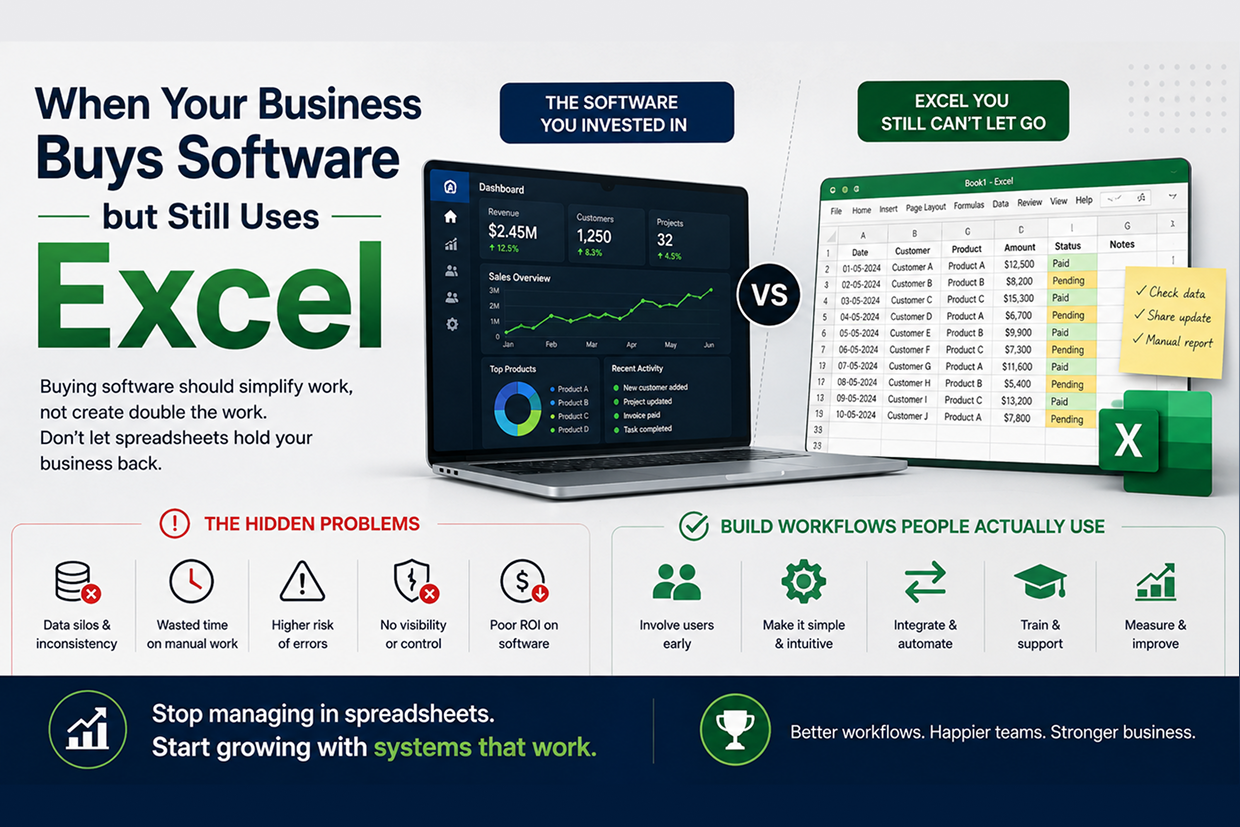
Your Business Is Growing, But Your Process Is Still Manual
Short answer: As a business grows, manual processes such as notebooks, spreadsheets and messages create errors and delays, and hiring more people doesn't always solve it. Turning repeated manual work into digital workflows saves time, speeds up responses, gives managers visibility and makes growth easier.
A business can start with a phone, a notebook, a few spreadsheets, and a messaging app.
In the beginning, it works.
A customer sends an enquiry. Someone writes it down. A quotation is prepared. A payment is checked manually. An employee sends a follow-up message. The owner keeps track of important tasks.
But as the business grows, the same process starts creating problems.
More customers mean more enquiries. More orders mean more records. More employees mean more coordination. More branches mean more communication.
What worked for ten customers may not work for a thousand.
The business has grown, but the process has stayed the same.
That is when manual operations can quietly become one of the biggest barriers to growth.
When Manual Work Starts Costing the Business
Most manual processes don't look expensive at first.
Entering one customer record may take only a few minutes. Checking one payment may take another minute. Sending one reminder may take less than a minute.
But repeat those tasks hundreds of times and the business starts paying for them through employee hours, delays, errors, and missed opportunities.
| Manual Process | What Can Go Wrong |
|---|---|
| Customer details entered manually | Duplicate or incorrect records |
| Follow-ups tracked in spreadsheets | Missed sales opportunities |
| Payments checked separately | Delayed order processing |
| Approvals handled through messages | No clear status |
| Reports prepared manually | Decisions take longer |
The problem is rarely one big mistake.
It is the accumulation of small inefficiencies every day.
Human Error Grows With Business Volume
People make mistakes. That is normal.
An employee may copy the wrong phone number. A quotation may contain an old price. A follow-up reminder may be forgotten. A payment may be marked as pending even after it was completed.
When a business is small, these mistakes may be easy to fix.
As the number of transactions increases, the same errors become harder to find and more expensive to correct.
For example:
10 customers → 1 mistake may be manageable.
But:
1,000 customers → repeated manual work → repeated mistakes becomes a process problem.
The answer is not to expect employees to remember everything perfectly.
The answer is to design a system that prevents avoidable mistakes.
Why Adding More Employees Doesn't Always Solve the Problem
When operations become difficult to manage, businesses often hire more people.
Additional employees can certainly increase capacity, but they can also increase the number of handoffs and manual processes.
Imagine a customer enquiry moving through five employees:
Sales → Verification → Finance → Operations → Support
If every department uses a different spreadsheet or messaging thread, the business may have more people but still lack a reliable process.
Instead of adding people to compensate for inefficient workflows, businesses should first ask:
Which parts of this process can be standardized or automated?
Turning a Manual Workflow Into a Digital Workflow
Consider a service business that receives customer enquiries.
The manual process might look like:
Customer Message → Employee Reads Message → Excel Entry → Manager Checks → Follow-Up Reminder → Quotation → Customer Response
A digital workflow can turn this into:
Customer Enquiry → Automatic Lead Creation → Employee Assignment → Follow-Up Reminder → Quotation → Status Tracking
The employee still controls the important decisions.
The system handles the repetitive coordination.
That difference can save time without removing the human side of the business.
What Should Actually Be Automated?
Not every business activity needs automation.
The best candidates are usually tasks that are:
- Repetitive
- Rule-based
- Time-consuming
- Easy to standardize
- Prone to human error
For example, sending a reminder after a quotation has been pending for three days is a good candidate for automation.
Deciding whether a major client should receive a special contract may still require human judgment.
Good automation removes repetitive work while keeping people responsible for important decisions.
A Simple Example: From Chaos to Control
Imagine a small wholesale business handling hundreds of orders every month.
Before improving its process:
- Orders arrive through WhatsApp and email.
- Staff enter order details into Excel.
- Payment status is checked separately.
- Warehouse receives updates manually.
- Customers call for delivery information.
After implementing a connected business system:
Order Received → Payment Verified → Inventory Updated → Warehouse Notified → Delivery Updated → Customer Notified
The business hasn't necessarily hired more employees.
It has simply removed unnecessary manual coordination.
The Business Benefits of Process Automation
When repetitive work is moved into a reliable digital workflow, businesses can improve several areas at once.
Employees Save Time
Teams spend less time copying information, checking spreadsheets, and sending repetitive messages.
Customers Get Faster Responses
Important updates can be triggered automatically instead of waiting for an employee to remember them.
Managers Get Better Visibility
A centralized system can show which tasks are pending, completed, delayed, or waiting for approval.
Businesses Make Fewer Avoidable Errors
Validation rules and structured workflows reduce mistakes caused by manual data entry.
Growth Becomes Easier
New employees and branches can follow the same workflow instead of creating their own methods.
Software Should Adapt as Your Business Changes
A common mistake is building a system around today's process without considering tomorrow's requirements.
Your business may start with one branch and later expand to five.
You may start with ten employees and later have fifty.
You may process one hundred orders today and thousands later.
Your software should be able to evolve with those changes.
That is where custom software development becomes valuable.
Instead of forcing the business into a fixed workflow, a custom system can be designed around its processes and extended as new requirements appear.
What a Growing Business Should Track
Automation is more useful when businesses can measure its impact.
| Metric | What It Tells You |
|---|---|
| Processing Time | How long a task takes |
| Error Rate | How often manual mistakes occur |
| Response Time | How quickly customers receive help |
| Pending Tasks | Where work is getting stuck |
| Conversion Rate | Whether process improvements affect sales |
| Employee Hours Saved | How much repetitive work was removed |
This turns automation from a technology project into a measurable business improvement.
The Right Time to Change Your Process
You don't have to wait until your business becomes unmanageable.
Consider improving your workflows when:
- Employees maintain multiple spreadsheets for the same information.
- Customers repeatedly ask for updates that staff have to check manually.
- The owner is personally approving or tracking too many small tasks.
- Different departments follow different versions of the same process.
- A new employee takes weeks to understand how everyday work is done.
These are signs that the business has outgrown its manual process.
From Manual Work to Scalable Operations
Digital transformation does not mean replacing every existing system.
Sometimes the best solution is small.
- One automated approval
- One centralized customer database
- One dashboard
- One integration
- One notification workflow
- One internal application
The goal is to identify where the business loses the most time and solve that problem first.
Small improvements can create significant operational gains when they are repeated every day.
Conclusion
Growth should make a business stronger, not more chaotic.
When customer numbers, employees, orders, and operations increase, manual processes eventually become difficult to control. Spreadsheets, messages, memory, and repeated data entry may have helped the business get started, but they may not be enough to support its next stage.
The solution is not always hiring more people.
It is often building better processes and using software to support them.
At Vriksha Techno Solutions, we help businesses identify manual bottlenecks and turn them into structured digital workflows through custom software, automation, integrations, and scalable business applications.
Frequently Asked Questions
When does manual work start costing a business?
When growing volumes of enquiries, orders and records make manual tracking error-prone. Human error grows with business volume.
Does hiring more employees solve manual process problems?
Not always. The article notes the solution is often better processes supported by software, not just more people.
What benefits does process automation bring?
Employees save time, customers get faster responses, managers get better visibility, the business makes fewer avoidable errors and growth becomes easier.
Ready to Build Your Next Digital Product?
Our experts will respond within 24 hours with a tailored approach for your project.