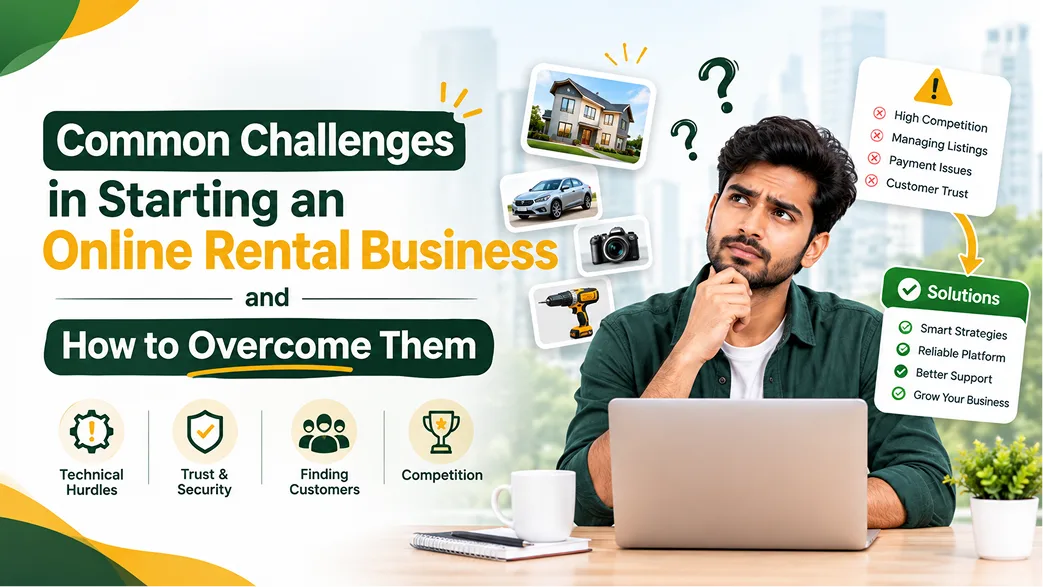
Short answer: The biggest challenges in starting an online rental business are legal setup, choosing the platform, pricing that covers damage and delivery, onboarding providers, search, damage protection, delivery and returns, marketing both sides of the marketplace, and trust. Solve them with clear deposit and damage policies, KYC verification, transparent pricing, condition photos at handover and return, and a focused MVP in one category and city.
Most online rental businesses do not fail because of the idea. They fail because of operational problems the founders did not plan for: prices that do not cover damage and delivery, owners who will not list valuable items without protection, customers who return late, and a marketplace that launches with too few listings to be useful.
Whether you rent cars, furniture, cameras, construction equipment or event supplies, the same challenges come up: legal setup, the right platform, pricing, onboarding, search, damage protection, delivery and returns, marketing, and trust. Each of them can be solved with clear policies and the right features, and most of them cost far less to fix before launch than after.
This guide walks through the 11 most common challenges and what to do about each one, adds the India-specific points around deposits, KYC and GST, and ends with a step-by-step launch plan.
Why Is the Online Rental Business Model Growing?
The rental business model provides temporary access to products without requiring customers to purchase and permanently own them. It can be useful for expensive products, specialised equipment, or items that people need only for a limited period.
For example, customers may rent construction machinery for a project, furniture for a temporary residence, vehicles for travel, or event equipment for a specific occasion.
The model can create value for both sides:
- Customers: They can access products for a defined period without paying the full purchase price.
- Product owners: They can generate additional income from assets that might otherwise remain unused.
- Marketplace operators: They can earn revenue by connecting customers and providers and facilitating rental transactions.
Some rental marketplaces operate with inventory owned by the platform, while others follow a peer-to-peer or multi-vendor model in which independent owners list their products. The choice affects investment, operations, pricing, and technology requirements.
11 Common Challenges in Starting an Online Rental Business
1. Understanding Business Licensing and Legal Requirements
One of the first challenges is understanding the legal requirements for operating a rental business. Licensing, registration, taxation, insurance, and consumer protection obligations can differ depending on the product category and the locations in which the business operates.
For example, vehicle rentals, property rentals, construction equipment, and event supplies may involve different legal and safety considerations.
How to overcome this challenge:
- Identify the legal requirements applicable to your business category.
- Research local and national government regulations.
- Understand the permits, registrations, and insurance requirements that may apply.
- Prepare rental terms and conditions, cancellation policies, and damage policies.
- Consult qualified legal and accounting professionals where necessary.
Completing these checks before accepting bookings can help reduce legal and operational risks. Requirements should be verified for every jurisdiction in which the business intends to operate.
2. Choosing the Right Hosting and Technical Infrastructure
An online rental marketplace needs reliable technical infrastructure to manage listings, customer accounts, bookings, payments, and product availability. Poor hosting or an unsuitable technical setup can lead to slow page loading, downtime, and difficulties as user activity increases.
The infrastructure should be selected based on expected traffic, data storage, application complexity, security requirements, and future expansion.
How to overcome this challenge:
- Choose hosting infrastructure suitable for the expected workload.
- Use SSL/TLS protection and secure configuration practices.
- Plan regular backups and recovery procedures.
- Monitor application performance, uptime, and server resources.
- Consider scalable cloud infrastructure when future growth requires it.
- Plan security updates and ongoing technical maintenance.
Infrastructure decisions should support the business's current needs without making future expansion unnecessarily difficult.
3. Selecting the Right Website or Marketplace Development Approach
Entrepreneurs need to decide how their rental marketplace will be developed. Common approaches include using an existing platform, customising a ready-made solution, or building a custom application from the ground up.
Each approach has different implications for cost, flexibility, development time, ownership, and long-term maintenance.
- Ready-made solutions: May provide common marketplace features that can help reduce initial development effort, but businesses should check customisation limits and ongoing costs.
- Custom development: Allows the platform to be designed around specific rental workflows, pricing rules, integrations, and business requirements.
- SaaS platforms: Can provide managed infrastructure and recurring service arrangements, but may involve subscription fees and provider-specific limitations.
How to overcome this challenge:
- Document the rental business model before selecting a platform.
- Compare feature coverage, customisation, ownership, and support.
- Check whether the platform supports rental periods, availability, returns, deposits, and cancellations.
- Review security, scalability, integrations, and data portability.
- Request a product demonstration and test important workflows before committing.
For a business with specialised requirements, custom software development can provide a way to build workflows around its specific operations.
A ready-made base can also shorten the timeline. Our rental marketplace software already handles date-based availability, deposits, verification, inspections and payouts, and can be customised to your category instead of being built from zero.
4. Defining the Right Custom Features
Every rental business has different operational needs. A vehicle rental platform may require document verification, vehicle availability, and trip tracking, while a furniture rental marketplace may need delivery scheduling, condition reports, and return management.
Trying to develop every possible feature in the first release can increase cost, delay launch, and make the platform unnecessarily complicated.
How to overcome this challenge:
- Identify the main problem the platform needs to solve.
- Separate essential launch features from future enhancements.
- Map customer, provider, and administrator workflows.
- Prioritise features based on business value and operational necessity.
- Validate complex requirements with users and subject-matter experts.
- Develop an MVP and improve it using actual customer and provider feedback.
Starting with a focused feature set helps entrepreneurs test the business model before investing in a more extensive platform.
5. Establishing the Right Rental Pricing Model
Pricing is a major consideration in rental businesses because charges may depend on rental duration, product category, demand, availability, location, and additional services.
A pricing model that is too high may discourage customers, while a price that is too low may not cover maintenance, logistics, platform fees, and other operating expenses.
Common pricing approaches include:
- Fixed rental pricing: A predefined price for a specified rental period.
- Hourly or daily pricing: Charges based on the time for which the product is rented.
- Long-term rental pricing: Special rates for weekly, monthly, or extended rental periods.
- Dynamic pricing: Prices that change based on demand, availability, season, or other business rules.
- Owner-defined pricing: Providers set their own rental rates within the marketplace's policies.
How to overcome this challenge:
- Research competitor pricing and customer expectations.
- Calculate operating costs, maintenance, delivery, and platform expenses.
- Define how extra charges, late returns, and cancellations will be handled.
- Allow suitable pricing flexibility for providers where the business model requires it.
- Test pricing with a limited customer group before expanding.
Pricing rules should be transparent so customers understand the total amount before confirming a booking.
6. Simplifying Seller and Customer Onboarding
Onboarding is the process through which customers and product owners register and begin using the platform. If the process is confusing or requires too many steps, users may leave before completing registration.
Rental marketplaces often need different onboarding journeys for customers and providers. Product owners may need to submit additional information, upload product images, provide verification documents, and configure rental terms.
How to overcome this challenge:
- Create separate registration journeys for customers and providers.
- Use clear instructions and simple forms.
- Explain document and verification requirements.
- Provide guided listing creation and product upload steps.
- Show users the status of their registration or listing approval.
- Offer help documentation and support for common onboarding questions.
A well-planned onboarding experience can help reduce confusion and encourage users to complete the process.
Supply is usually the harder side to win. Our guide on onboarding vendors to a new marketplace covers practical ways to get your first providers listed.
7. Improving Product Discovery and Search
A rental marketplace may contain products from many providers, with different prices, locations, availability periods, and specifications. Helping customers find the right product quickly is therefore an important challenge.
Basic keyword search may not be enough for categories where customers need to compare several attributes before booking.
Two common discovery approaches are:
Centralised discovery: The platform presents a controlled set of available products or services based on location, category, or other predefined rules. This can be useful for standardised services where customers have relatively similar requirements.
Flexible or filter-based discovery: Customers can refine results using multiple criteria. This is useful for rental categories with significant differences in product specifications, features, pricing, and location.
How to overcome this challenge:
- Provide category-based browsing and keyword search.
- Add filters for price, location, availability, product type, and specifications.
- Display clear product images and descriptions.
- Show rental duration, charges, and availability before booking.
- Use location-based discovery when relevant to the business model.
- Allow customers to compare suitable listings.
Search and filtering should reflect the actual criteria customers use when selecting a rental product.
We saw this first-hand when building OwnCarz, a car rental platform. Customers were struggling to find an available car for their location and dates, so the platform was built around search and filters by location, time and vehicle type, with availability shown before booking. Discovery, not the payment page, was what decided whether a visitor booked.
8. Protecting Products Against Damage and Misuse
Product safety and damage protection are important concerns in rental operations. Product owners may hesitate to list valuable assets if there are no clear processes for handling damage, loss, misuse, or late returns.
The level of risk depends on the type of product, its value, rental duration, and how it is used.
How to overcome this challenge:
- Security deposits: Collect a refundable deposit where appropriate and clearly define the conditions under which deductions may be made.
- Insurance arrangements: Explore suitable insurance coverage for eligible products and rental activities.
- Condition records: Capture product condition through photos, checklists, or inspection records before and after rental.
- Rental agreements: Clearly explain customer responsibilities, damage policies, and return conditions.
- Provider verification: Introduce suitable verification procedures for providers and listings.
Security deposits and insurance are not interchangeable. Their suitability depends on the product category, applicable regulations, and the terms offered by the insurance provider.
9. Managing Shipping, Delivery, and Returns
Unlike a standard online purchase, a rental transaction often involves both delivery and return logistics. The product must reach the customer at the agreed time and be returned or collected after the rental period.
Delivery costs can also affect profitability, especially for low-value rentals, heavy equipment, or products that need specialised handling.
How to overcome this challenge:
- Define whether the provider, marketplace, or customer is responsible for delivery.
- Calculate delivery and collection charges transparently.
- Provide estimated delivery and return timelines.
- Support pickup or collection options where suitable.
- Track delivery, handover, and return status.
- Establish procedures for delayed returns and damaged shipments.
- Use logistics integrations when they provide operational value.
For peer-to-peer marketplaces, providers may handle delivery independently, while other businesses may centralise logistics. The correct approach depends on the products and service area.
10. Building an Effective Marketing Strategy
Even a well-developed rental platform may struggle if customers and product owners do not know it exists. Marketing is especially important during the early stages, when the marketplace needs to attract both demand and supply.
A platform with many customers but very few available listings may fail to meet expectations. Similarly, a large catalogue without active customer demand may not generate enough transactions for providers.
How to overcome this challenge:
- Choose a specific starting market: Focus on a product category, customer group, or geographic area instead of targeting everyone immediately.
- Build a pre-launch presence: Use a landing page, email updates, and social media to introduce the concept before launch.
- Attract providers: Explain the benefits of listing products and make provider onboarding straightforward.
- Invest in SEO: Create useful category pages and content that match what potential customers search for.
- Use targeted advertising: Test paid campaigns based on location, product category, and customer intent.
- Encourage referrals: Consider referral programmes and partnerships that help attract relevant users.
- Measure results: Monitor enquiries, registrations, listing activity, bookings, and customer acquisition costs.
Marketing should focus on building an active marketplace rather than simply increasing website visits.
11. Establishing Trust and Platform Security
Trust is essential in rental marketplaces because transactions involve temporary access to products owned by another person or business. Customers need confidence that listings are genuine and products are available, while providers need confidence that customers will follow the rental terms.
Without suitable safeguards, concerns about fraud, inaccurate listings, payment disputes, and product damage can affect marketplace participation.
How to overcome this challenge:
- User verification: Introduce appropriate identity or business verification for relevant user categories.
- Listing checks: Review product details, images, and supporting information before approving listings where required.
- Secure payments: Use reliable payment processing and clearly explain refunds, deposits, and cancellation policies.
- Ratings and reviews: Allow users to share feedback based on completed rental transactions.
- Dispute management: Provide a clear process for reporting issues and resolving disagreements.
- Data protection: Apply access controls and security measures to protect personal and payment-related information.
- Transparent policies: Make rental terms, fees, responsibilities, and return conditions easy to understand.
Trust is built through consistent platform policies, reliable operations, and positive experiences—not through verification features alone.
Running a Rental Business in India: Deposits, KYC and GST
If you are launching in India, a few local practices shape both your policies and your software:
- KYC before handover: for vehicles and high-value items, collect identity proof (and a driving licence for vehicles) before the booking is confirmed. Digital verification through DigiLocker or an approved KYC provider is faster than manual document checks and reduces fake bookings. Collect only the documents you genuinely need and store them securely.
- Security deposits through UPI and cards: customers expect a quick, clearly stated refund timeline. The platform should hold the deposit, record the reason for any deduction with photos from the return inspection, and refund the balance automatically.
- GST on rentals: renting goods is generally a taxable service under GST, and the rate depends on the category. Configure the rates with your chartered accountant and let the platform show the GST amount on every booking and invoice, so the final price never surprises the customer.
- Digital rental agreements: accept terms with a checkbox at booking for low-value items, and use an e-signed agreement for vehicles, equipment and long-term rentals.
- Doorstep delivery and pickup: customers in Indian cities expect it for furniture, appliances and equipment. Price it separately by distance or zone, and schedule pickup at the same time as delivery.
Building these into the first version saves you from handling deposits, documents and disputes over WhatsApp and spreadsheets once bookings grow.
Essential Features of an Online Rental Marketplace
Addressing these challenges requires a platform that supports the complete rental lifecycle. The exact features will depend on whether the business follows a peer-to-peer, multi-vendor, or inventory-owned rental model.
Customer Panel
- Registration and profile management
- Product search and category browsing
- Availability and rental period selection
- Product details, images, and specifications
- Rental booking and payment
- Order history and booking status
- Cancellation and return requests
- Ratings, reviews, and support
Provider or Seller Panel
- Provider registration and verification
- Product listing and image management
- Rental pricing and availability settings
- Booking and order management
- Rental handover and return updates
- Deposit and payment information
- Earnings and transaction history
- Customer communication
Administrator Panel
- Customer and provider management
- Listing approval and moderation
- Category and location management
- Booking and transaction monitoring
- Commission and fee configuration
- Refund and dispute management
- Verification and document review
- Reports, analytics, and platform settings
Rental-Specific Capabilities
- Date-based availability management
- Hourly, daily, and long-term rental pricing
- Security deposit configuration
- Rental agreements and policy acceptance
- Delivery, pickup, and return scheduling
- Late return and extension handling
- Product condition and inspection records
- Damage reporting and dispute workflows
How to Launch an Online Rental Business Step by Step
Once the business challenges and platform requirements are understood, entrepreneurs can follow a structured launch process.
Step 1: Select a Rental Niche
Choose the product category and target audience. Research customer demand, supplier availability, competition, operational complexity, and potential profitability.
Category guides can help here: see how to build an equipment rental platform or a niche plant rental marketplace.
Step 2: Choose the Business Model
Decide whether the platform will own the rental inventory, connect independent product owners with customers, or combine both approaches. Define the responsibilities of the platform, providers, and customers.
Step 3: Define the Revenue Model
Potential revenue sources include rental commissions, booking fees, delivery charges, provider subscriptions, featured listings, and optional service fees. The selected model should be transparent and suitable for the marketplace's participants.
Step 4: Validate Demand and Supply
Speak with potential customers and providers. Understand what products are needed, how often they are rented, what prices are acceptable, and what operational issues providers face.
Step 5: Plan the MVP
Define the minimum features required to complete a rental transaction. Prioritise registration, listings, availability, booking, payments, and essential administration. Add more advanced features after validating the initial business model.
Step 6: Develop and Test the Platform
Build the website or application, integrate the required services, and test the complete rental journey. Include booking changes, cancellations, returns, refunds, and dispute scenarios—not just successful payments.
Step 7: Launch in a Focused Market
Start with a manageable product category or geographic area. Build a reliable supply of listings before expanding to additional markets.
Step 8: Monitor and Improve
Track listing activity, booking conversion, cancellations, repeat rentals, delivery performance, and customer feedback. Use the results to improve the platform and operational model.
How Much Does It Cost to Start an Online Rental Business?
The cost of launching an online rental business depends on the business model, product category, operational setup, technology, and launch strategy. A peer-to-peer marketplace may have different initial requirements from a business that purchases and manages its own inventory.
Technology-related cost factors include:
- Website and mobile application development
- Customer, provider, and administrator modules
- Rental availability and pricing logic
- Payment gateway and notification integrations
- Verification and document management
- Delivery and logistics integrations
- UI/UX design and testing
- Hosting, security, and ongoing maintenance
Other business expenses may include licensing, insurance, marketing, customer support, product procurement, storage, delivery, and maintenance. These costs should be assessed separately from software development.
Preparing a detailed scope and launch budget helps entrepreneurs prioritise investment and avoid spending on features that are not immediately necessary.
Conclusion
Starting an online rental business offers opportunities to connect product owners with customers who need temporary access to goods and equipment. However, success depends on much more than creating an online catalogue.
Entrepreneurs need to address legal requirements, platform development, pricing, onboarding, product discovery, safety, logistics, marketing, and trust. A well-planned rental marketplace should support the complete journey from product listing and booking to payment, delivery, and return.
At Vriksha Tech, we develop custom web applications, mobile applications, and digital platforms around business-specific workflows. Our rental marketplace software and platform solutions cover key marketplace requirements such as availability, deposits, verification, inspections, returns, and seller payouts.
If you are planning to launch a rental marketplace, you can also explore our guide on how to build an online rental marketplace for your business.
Planning a rental business? Tell us what you want to rent out and where, and we will suggest the launch features, the policies to build in from day one and a realistic plan to go live.
Frequently Asked Questions
What are the biggest challenges in starting an online rental business?
Common challenges include legal requirements, choosing the right technology, defining rental pricing, onboarding providers, managing product availability, protecting rented items, handling delivery and returns, marketing, and building customer trust.
How does an online rental marketplace make money?
A rental marketplace may generate revenue through booking commissions, transaction fees, provider subscriptions, delivery charges, featured listings, or additional services. The revenue model depends on the marketplace's business structure.
What is the difference between a peer-to-peer rental marketplace and a traditional rental business?
In a peer-to-peer rental marketplace, independent owners list products for customers to rent. In a traditional inventory-owned rental business, the company owns or controls the products and manages the rental process itself.
What features are important in rental marketplace software?
Important features include user registration, provider listings, product search, date-based availability, rental pricing, booking management, payments, deposits, delivery tracking, returns, reviews, and administrator controls.
How can an online rental business prevent product damage?
Businesses can use appropriate security deposits, insurance arrangements, rental agreements, provider and customer verification, and product condition records. The right protection depends on the product category and applicable policies.
How can a new rental marketplace attract customers and providers?
Start with a focused product category or location, build a useful supply of listings, simplify provider onboarding, improve search visibility, use targeted marketing, and encourage referrals and customer reviews.
Should I build a custom rental marketplace or use ready-made software?
Ready-made software may be suitable when its existing workflows meet the business requirements. Custom development may be preferable when the business needs specialised pricing, verification, booking, logistics, or operational workflows.
How long does it take to develop an online rental marketplace?
The timeline depends on the number of modules, rental workflows, integrations, design requirements, and testing scope. A focused MVP can be developed first, followed by additional features based on business needs.
Ready to Build Your Next Digital Product?
Our experts will respond within 24 hours with a tailored approach for your project.