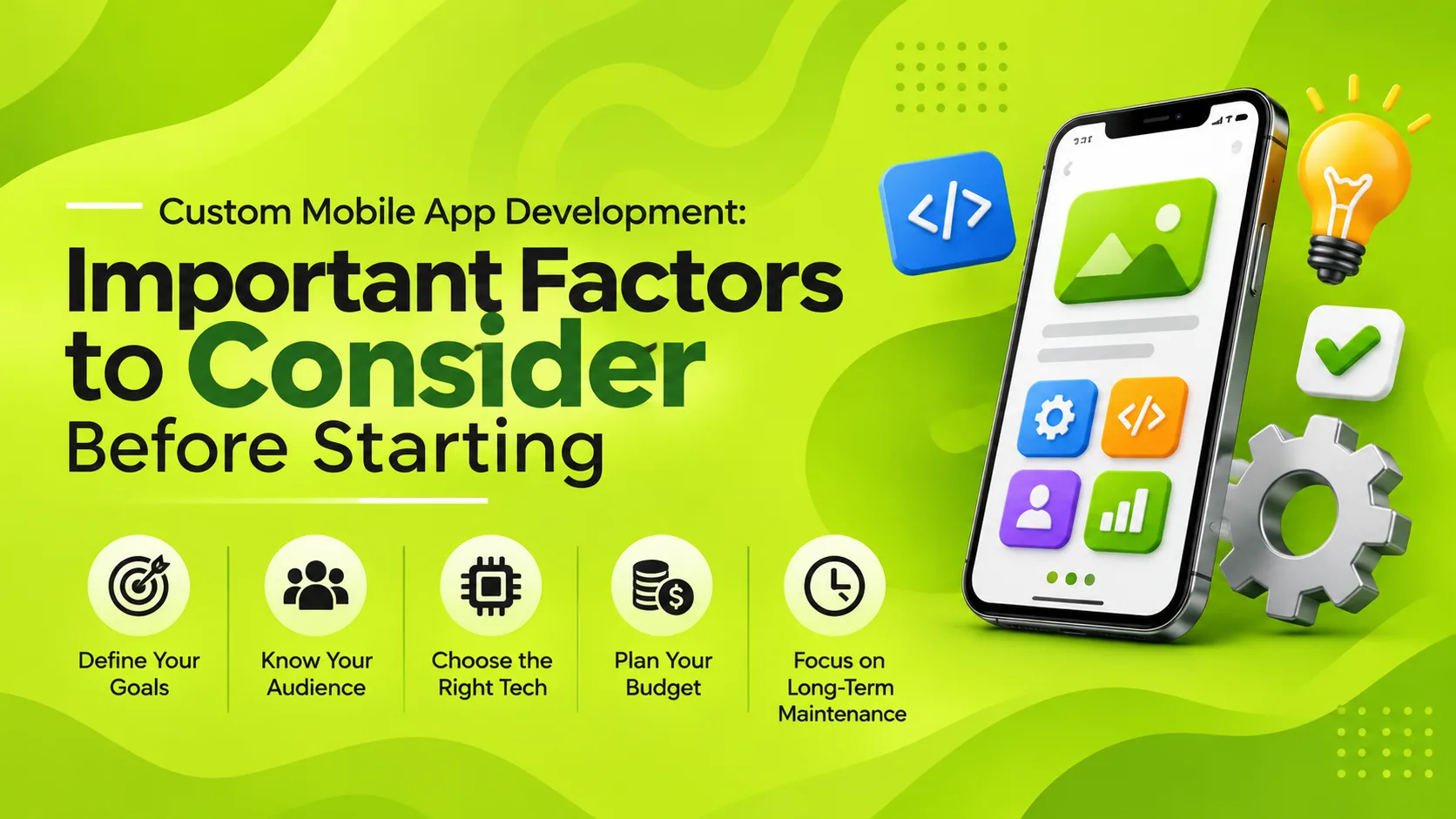
Short answer: before you start a custom mobile app, settle five things: the one business problem the app must solve, who will use it first, the smallest set of features that solves that problem (your MVP), whether to build native or cross-platform, and a budget that covers launch plus ongoing maintenance. Teams that agree on these before design starts usually spend less and launch sooner than teams that start with a long feature list.
This guide is for business owners, product managers and founders planning their first app or replacing an old one. It walks through 14 factors, the mistakes to avoid and how to choose a development partner.
Building a mobile app can help a business improve customer engagement, simplify operations, introduce new services, and reach users through their smartphones. However, a successful app requires more than an interesting idea. It needs a clear business purpose, a well-defined audience, the right features, suitable technology, and a realistic development strategy.
Before investing in custom mobile app development, businesses should evaluate several important factors. Early planning helps prevent unnecessary features, avoid technical limitations, and ensure that the final application supports actual business goals.
This guide explains the key considerations to review before starting a custom mobile app project.
1. Define the Purpose and Business Goals
Start by identifying the problem your mobile application is expected to solve. An app should offer a clear benefit to its users rather than simply moving an existing website or business process onto a smartphone.
Consider the following questions:
- What problem will the application solve?
- Who will use the application?
- What will users be able to accomplish through it?
- How will the application support business growth?
- What makes the proposed solution different from existing alternatives?
For example, a retail business may need an app to simplify product discovery and ordering, while a service company may need one to manage appointments, customer requests, and payments.
Clear goals help determine the application's scope, required features, development priorities, and success measures.
2. Understand Your Target Audience
Understanding your intended users is essential before deciding how the application should look and function. Different audiences have different expectations, technical abilities, and usage patterns.
Research your target audience by considering:
- User profile: Age group, location, occupation, and other relevant characteristics.
- User needs: The problems users want the app to solve.
- Usage behaviour: When, where, and how frequently they may use the application.
- Device preferences: Whether they primarily use Android, iOS, or both.
- Accessibility needs: Whether the interface should support additional accessibility requirements.
Interviews, surveys, competitor research, and feedback from existing customers can help validate assumptions. These findings should influence the user journeys, navigation, and feature priorities.
3. Identify the Essential Features
Feature planning is one of the most important stages of mobile app development. Adding too many features at the beginning can increase development effort and make the application difficult to use.
Separate the requirements into three categories:
- Core features: Functions necessary for the app to solve its primary problem.
- Supporting features: Functions that improve convenience and the overall experience.
- Future enhancements: Advanced capabilities that can be introduced after the first release.
Depending on the business model, a mobile application may include:
- User registration and secure login
- User profiles and account settings
- Search, filters, and content discovery
- Product, service, or information management
- Booking, ordering, or transaction workflows
- Payment gateway integration
- Push notifications and alerts
- In-app communication or customer support
- Ratings, reviews, and feedback
- Reports and activity history
- Admin dashboard and user management
Not every application requires all these features. The final list should be based on the business requirements and the needs of its users.
4. Create a Lean Business and Product Plan
A lean product plan helps businesses validate an idea before committing substantial resources to development. It connects the user problem, proposed solution, market opportunity, and business objectives.
A useful planning exercise is to document:
- Problem: What user or business problem needs to be addressed?
- Solution: How will the application solve that problem?
- Target market: Which users or businesses are expected to use it?
- Value proposition: Why should users choose this application?
- Key metrics: How will you measure adoption, engagement, and business performance?
- Competitive advantage: What can make the application valuable and sustainable?
This planning process helps businesses avoid building an application based only on assumptions. It also gives the development team a clearer direction.
5. Decide How the Application Will Generate Revenue
If the application is intended to generate revenue, its monetisation strategy should be considered before development. The revenue model can influence the app's features, payment architecture, user experience, and subscription management requirements.
Common mobile app monetisation models include:
In-App Purchases
Users can download the application and purchase additional content, services, digital items, or premium features within it. This approach is useful when users can receive value from a basic experience before choosing paid options.
Subscription Model
Users pay recurring fees, usually monthly or annually, to access content, services, or premium functionality. Subscription applications need features for plan selection, renewals, payment status, and subscription management.
Advertising
Businesses can generate revenue by displaying advertisements within the application. This model is more suitable when the app has an audience and usage pattern that can support advertising without significantly affecting the user experience.
Commission-Based Model
Marketplace and service applications can earn a commission from transactions completed through the platform. Such applications may require payment processing, order tracking, vendor management, and payout functionality.
Paid Application
Users pay a one-time amount to download or access the application. This model is suitable when the app provides a clearly defined value that users are willing to purchase upfront.
The right model depends on the application category, audience, market expectations, and long-term business plan. Some applications may combine multiple revenue streams.
6. Choose the Right Mobile App Development Approach
Businesses should decide which platforms they want to support before development begins. The choice between native and cross-platform development can influence the technology stack, project scope, budget, and maintenance requirements.
Native App Development
Native applications are developed specifically for an operating system.
- Android: Commonly developed using Kotlin and Android development tools.
- iOS: Commonly developed using Swift and Apple's development tools.
Native development can be suitable when an application requires deep platform integration, specialised device capabilities, or highly platform-specific performance and user experiences.
Cross-Platform App Development
Cross-platform frameworks such as Flutter and React Native allow development teams to share a substantial portion of the application code across Android and iOS.
This approach can reduce duplicated development effort and help businesses maintain a consistent experience across platforms. However, the suitability of a framework depends on the app's functionality, required integrations, and performance needs.
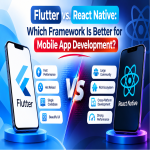
There is no universal best option. Evaluate the project requirements before selecting a development approach. You can also read our guide on Flutter vs. React Native for mobile app development to understand the differences between two popular cross-platform frameworks.
7. Select a Suitable Technology Stack
The technology stack includes the programming languages, frameworks, databases, servers, APIs, and development tools used to build and operate the application.
Some important technology decisions include:
- Frontend development: The technologies used to build the mobile interface and user interactions.
- Backend development: The server-side logic responsible for business rules, data processing, and application operations.
- Database: The system used to store and retrieve user, transaction, and application data.
- APIs and integrations: Connections with payment gateways, maps, CRM, ERP, communication tools, and other services.
- Cloud infrastructure: The hosting and infrastructure required to operate the application.
- Security tools: Technologies and practices that protect accounts, data, and application communication.
The selected stack should support the current requirements while allowing the application to evolve. It should also be compatible with the team's technical capabilities and the project's long-term maintenance plan.
8. Plan the User Interface and User Experience
A mobile application's interface directly influences how users interact with it. Even a feature-rich application can struggle if users cannot understand its navigation or complete important tasks easily.
During UI/UX planning, consider:
- Simple and consistent navigation
- Clear buttons, labels, and instructions
- Readable typography and suitable colour contrast
- Responsive layouts for different screen sizes
- Short and understandable user journeys
- Accessible design and interaction patterns
- Helpful loading, empty, and error states
Wireframes and interactive prototypes can be created before development to validate the layout and user flow. Testing these designs with potential users can reveal usability issues early.
9. Consider Third-Party Integrations
Many mobile applications depend on external services to provide important functionality. Planning these integrations early helps the development team understand technical dependencies, access requirements, and ongoing service costs.
Common integrations include:
- Payment gateways for online transactions
- Maps and location services
- CRM systems for customer information
- ERP systems for business operations
- Cloud storage and file management
- Push notification services
- Analytics and reporting tools
- SMS, email, and communication services
- Authentication and identity verification services
Before choosing an integration, review its documentation, pricing, platform compatibility, security requirements, and usage limitations. Also identify what should happen if an external service becomes unavailable.
10. Set a Realistic Budget and Development Timeline
The cost and timeline of a custom mobile app depend on its complexity and the resources required to build and maintain it. A simple application with limited functionality will generally require a different level of effort from a multi-user platform with complex workflows and integrations.
Important cost factors include:
- Number of platforms and applications
- UI/UX design complexity
- Number and complexity of features
- Backend and database requirements
- Third-party integrations
- Security and testing requirements
- Admin dashboard and reporting functionality
- Deployment and ongoing maintenance
Instead of estimating the entire project from a feature count alone, businesses should prepare a detailed scope and prioritise requirements. A development estimate should clearly explain deliverables, assumptions, milestones, exclusions, and payment terms.
It is also important to reserve time and budget for testing, app store submission, post-launch support, and future improvements.
11. Start with a Minimum Viable Product (MVP)
A Minimum Viable Product is an initial version of an application that includes the essential functionality needed to deliver its primary value. It allows a business to introduce the idea to real users, gather feedback, and validate assumptions before expanding the product.
For example, an online appointment booking app may begin with:
- User registration and login
- Service or provider listing
- Availability selection
- Appointment booking
- Booking confirmation and notifications
- Basic admin management
Advanced features such as loyalty programmes, AI-based recommendations, detailed analytics, and additional automation can be considered in later releases if they support the product roadmap.
An MVP should still be reliable, secure, and usable. It is not an excuse to release an unfinished or poorly tested application. The objective is to launch a focused product that can be evaluated and improved.
12. Plan Testing, Security, and Quality Assurance
Testing should be part of the development process, not an activity left until the final stage. Mobile applications need to work across supported devices, operating system versions, screen sizes, and network conditions.
Important testing areas include:
- Functional testing: Confirm that features work according to the requirements.
- Usability testing: Check whether users can complete important tasks easily.
- Compatibility testing: Verify behaviour across supported devices and operating systems.
- Performance testing: Evaluate loading speed, responsiveness, and resource usage.
- Security testing: Identify vulnerabilities and verify access controls and data protection.
- Integration testing: Confirm that APIs, payment services, and other connected systems work correctly.
- Regression testing: Ensure that new updates do not break existing functionality.
Security planning should include appropriate authentication, authorisation, secure communication, protected data storage, and careful handling of sensitive information. The specific controls should reflect the application and the data it processes.
13. Prepare for App Store Launch and Marketing
Development does not end when the application is ready for testing. Before launch, businesses should prepare the app store listing, descriptions, screenshots, app icon, privacy information, and other required materials.
Google Play and Apple App Store have their own submission and review requirements. These should be checked during planning so that technical or policy-related changes do not delay the release.
Businesses should also prepare a launch strategy that may include:
- Website and landing page promotion
- Social media campaigns
- Email marketing to existing customers
- App Store Optimisation (ASO)
- Paid advertising, where appropriate
- Product demonstrations and introductory offers
- Customer onboarding and support
Early marketing helps the intended audience discover the application and gives the business an opportunity to collect feedback from initial users.
14. Measure Performance and Plan Ongoing Maintenance
Once the application is launched, businesses should track how people use it and whether it is meeting its objectives. The most useful key performance indicators (KPIs) depend on the application's purpose.
Possible metrics include:
- Downloads and registrations
- Active users and repeat usage
- User retention and uninstall patterns
- Feature adoption and engagement
- Conversion and transaction completion
- Crash reports and application availability
- Loading time and performance
- Customer feedback and support requests
Analytics should be used to identify which features are valuable and where users experience difficulties. Feedback and performance data can guide future improvements.
Ongoing maintenance is equally important. Operating system updates, security fixes, changing third-party APIs, and growing user demand may require regular technical updates. A maintenance plan helps keep the application stable, secure, and compatible over time.
Common Mistakes to Avoid Before Starting a Mobile App Project
Even a promising app idea can face challenges when planning is incomplete. Avoid these common mistakes:
- Starting without validating the idea: Research the problem and target audience before committing to development.
- Adding too many features: Prioritise essential functionality and consider an MVP approach.
- Choosing technology based only on trends: Select technologies that fit the app's actual requirements.
- Ignoring user experience: Make navigation and important tasks easy to understand.
- Underestimating integrations: Identify external systems and dependencies early.
- Skipping quality assurance: Test functionality, compatibility, security, and performance before release.
- Forgetting post-launch costs: Include maintenance, infrastructure, and ongoing support in the business plan.
A One-Page App Brief to Prepare Before You Talk to Developers
You do not need a full specification to get an accurate estimate. A one-page brief that answers these questions saves weeks of back-and-forth and makes quotes from different companies comparable:
- The problem: one or two sentences on what the app fixes or enables, and how you will know it worked (orders per week, bookings, hours saved).
- User roles: customer, staff, vendor, driver, admin. Each role often means a separate app or panel, which changes cost more than any single feature.
- Top five user journeys: for example "customer searches, books, pays and gets a confirmation". Journeys are easier to estimate than feature names.
- Must-have now vs later: split the list into launch features and phase-two features.
- Integrations: payment gateway (Razorpay, Stripe), SMS or WhatsApp alerts, maps, your ERP, CRM or accounting software.
- Platforms and devices: Android, iOS, web admin; budget Android phones if your users are in India.
- Accounts and ownership: Google Play and App Store developer accounts, domains and cloud accounts should be in your company's name, and the contract should say who owns the source code.
- Budget range and deadline: a range lets the developer suggest what fits, instead of guessing.
When we built Fudzo, a food delivery platform, the brief had three user roles: customers, restaurants and delivery partners. That meant three apps plus an admin panel, and agreeing on each role's journeys first is what kept the launch scope under control. If you are still validating the idea, read how to validate a business idea quickly or start with a proof of concept.
How to Choose the Right Mobile App Development Partner
Selecting a development partner is another important decision. A suitable team should understand both the technical requirements and the business purpose behind the application.
Before making a decision, review the following:
- Experience with similar application types and industries
- Knowledge of native and cross-platform development
- UI/UX design and prototyping capabilities
- Backend, database, and API integration expertise
- Security and quality assurance practices
- Project communication and delivery methodology
- Clarity of estimates, milestones, and deliverables
- Post-launch maintenance and support arrangements
Ask potential development partners to explain how they will approach your requirements, manage changes, test the application, and support it after launch. A clear scope and documented agreement help establish expectations before the project begins.
Conclusion
Custom mobile app development should begin with a clear understanding of the business problem, target users, required features, and long-term objectives. Technology selection, monetisation, budget, user experience, integrations, and maintenance all influence the success of the project.
Planning these areas before development helps businesses make informed decisions, prioritise the right functionality, and build an application that can evolve with changing user and business needs.
Planning a custom app? Send us your one-page brief or a short description of the idea. We will reply with a free first-version feature list, a phased plan and the questions that decide cost, so you can budget before you commit. Vriksha Tech has built web and mobile software from Chennai since 2006, with 800+ clients and 1,200+ projects delivered. See our mobile app development services or the cost of hiring dedicated developers in India if you prefer a dedicated team.
Ready to Build Your Next Digital Product?
Our experts will respond within 24 hours with a tailored approach for your project.