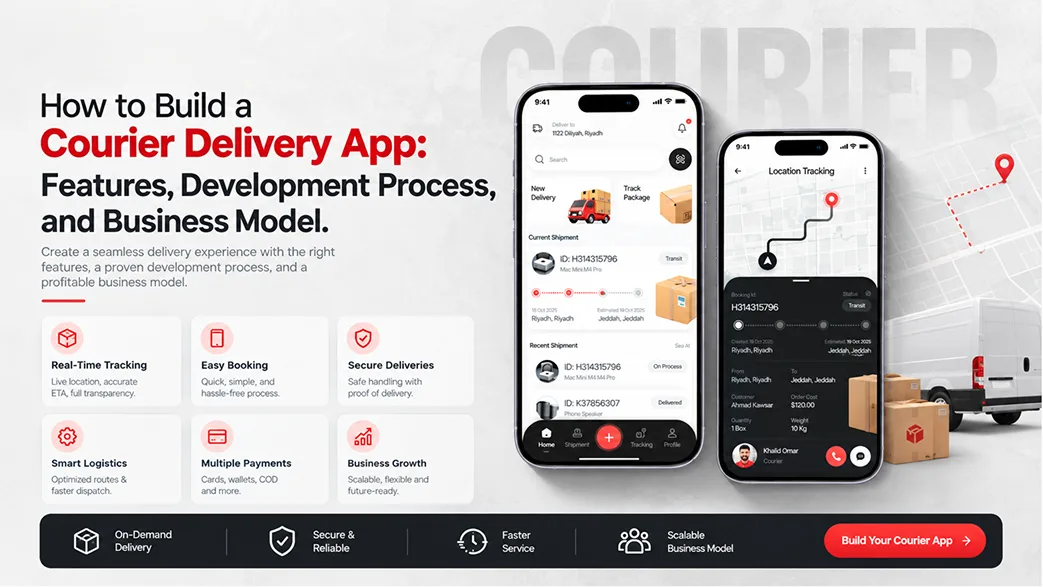
Short answer: A courier delivery app needs three parts: a customer app for booking and tracking parcels, a driver app for pickups and deliveries, and an admin panel to manage orders, pricing and drivers. Build it with real-time tracking and payments, then earn through delivery fees, subscriptions or business contracts.
Courier and parcel delivery services have become an important part of modern business operations. From e-commerce orders and business documents to personal packages, customers increasingly expect convenient booking, reliable delivery, and real-time shipment updates.
For courier companies and entrepreneurs, this creates an opportunity to build digital platforms that simplify parcel booking, automate delivery operations, and improve communication between customers, delivery partners, and administrators.
However, building a courier delivery app involves more than adding a booking form and tracking screen. A complete solution needs to manage pickup requests, shipment information, delivery assignments, route planning, payments, proof of delivery, and operational reporting.
In this guide, we explore how to build a courier delivery app, the essential features for each user, available business models, the development process, and important factors to consider before launching.
1. Understand the Courier Delivery App Business Model
A courier delivery app is a digital platform that connects customers who need to send packages with courier companies or delivery partners who handle collection and transportation.
The platform manages the delivery journey from booking to final delivery. Depending on the business model, it may operate as a single courier company's application or a marketplace connecting multiple delivery providers.
Common courier delivery services include:
- Local parcel delivery: Pickup and delivery within a city or nearby service area.
- Same-day delivery: Delivery services designed to complete eligible orders within the same day.
- Express delivery: Faster delivery options for time-sensitive packages.
- Intercity courier services: Transportation of parcels between cities or regions.
- Business-to-business delivery: Scheduled document, parcel, and goods transportation between businesses.
- E-commerce delivery: Last-mile delivery of online shopping orders.
- Scheduled delivery: Pickup and delivery arranged for a selected future date or time window.
Defining the delivery categories early helps determine the required app features, logistics operations, pricing structure, and technology integrations.
2. Choose the Right Courier Delivery Business Model
The business model determines who owns the delivery fleet, how delivery partners are managed, and how revenue is generated.
Single Courier Company Model
In this model, a courier company develops its own application to manage customers, shipments, delivery staff, and operations.
The company controls service areas, pricing, pickup schedules, delivery assignments, and customer support. This model is suitable for established courier businesses that want to digitise their existing operations.
Multi-Provider Courier Marketplace
A multi-provider platform allows multiple courier companies or independent delivery providers to register and offer services through a shared application.
Customers can compare available services based on delivery time, pricing, service coverage, and other relevant details. The platform manages provider onboarding, booking distribution, payments, and service monitoring.
On-Demand Delivery Model
This model focuses on customers who need packages collected and delivered quickly. The system identifies available delivery partners and assigns eligible requests based on factors such as location, availability, capacity, and service requirements.
Business-to-Business Courier Platform
This model focuses on companies that regularly send documents, packages, or goods to customers, branches, suppliers, and business partners.
It may support bulk shipment creation, recurring pickups, business accounts, consolidated billing, and shipment reports.
3. Identify Your Target Customers
Understanding the intended customers helps define the services, pricing, and delivery workflows your courier platform should support.
Potential customer groups include:
- Individual customers: People who need to send personal packages, gifts, or documents.
- E-commerce businesses: Online sellers looking for reliable parcel delivery and shipment tracking.
- Retail stores: Businesses that need local delivery for customer purchases.
- Small and medium-sized businesses: Organisations that regularly send documents and business packages.
- Large enterprises: Companies requiring scheduled, recurring, or high-volume courier services.
- Courier agencies: Delivery providers seeking a digital system to manage bookings and operations.
Each customer segment may have different expectations. For example, an individual customer may prioritise easy booking, while an e-commerce business may need bulk shipment creation and delivery reports.
4. Essential Features of a Courier Delivery App
A complete courier application generally includes three main interfaces: a customer app, a delivery partner app, and an admin dashboard. Each interface supports a different part of the delivery process.
A. Customer Application
The customer application should make it easy to create shipments, schedule pickups, make payments, and monitor deliveries.
- User registration and login: Allow customers to create accounts and securely access the application.
- Pickup and delivery addresses: Add sender and recipient details with address selection and location support.
- Shipment creation: Enter parcel information such as package type, dimensions, weight, and delivery instructions.
- Service selection: Choose available delivery options based on service coverage and delivery requirements.
- Delivery cost estimation: Display estimated charges based on configured pricing rules.
- Pickup scheduling: Select an available pickup date and time window.
- Online payment: Pay using supported digital payment methods.
- Shipment tracking: Monitor shipment progress through status updates and available location information.
- Delivery notifications: Receive booking confirmations, pickup updates, and delivery alerts.
- Delivery history: View previous and active shipments.
- Cancellation management: Request cancellation according to the applicable service policy.
- Customer support: Raise queries or report shipment-related issues.
- Ratings and feedback: Share feedback about the delivery experience.
B. Delivery Partner Application
The delivery partner app helps drivers and courier agents manage assigned shipments and update delivery progress.
- Partner registration: Submit personal, contact, and vehicle details where applicable.
- Document verification: Upload required identity, driving, and vehicle documents for review.
- Availability management: Switch between available and unavailable status.
- Delivery assignments: Receive pickup and delivery tasks assigned by the system or dispatcher.
- Pickup navigation: View pickup addresses and navigate to the collection location.
- Shipment information: Access authorised package details and delivery instructions.
- Pickup confirmation: Confirm parcel collection using supported verification methods.
- Route navigation: Access map-based directions to pickup and delivery destinations.
- Delivery status updates: Update shipment stages such as picked up, in transit, out for delivery, and delivered.
- Proof of delivery: Capture an authorised recipient signature, OTP confirmation, photograph, or other supported evidence.
- Delivery history: Review completed and assigned shipments.
- Earnings information: View eligible delivery earnings and payment details.
- Notifications: Receive new assignments, schedule changes, and operational alerts.
C. Admin Dashboard
The admin dashboard provides centralised control over customers, shipments, delivery partners, service areas, and business operations.
- Dashboard overview: Monitor total bookings, active shipments, completed deliveries, pending pickups, and operational performance.
- Customer management: View and manage customer accounts and support requests.
- Delivery partner management: Review applications, verify documents, and manage partner availability.
- Shipment management: Create, assign, update, and monitor shipment records.
- Assignment management: Assign shipments manually or through configured automated rules.
- Service area management: Define supported pickup and delivery locations.
- Pricing management: Configure delivery charges based on distance, weight, package type, service level, or other business rules.
- Payment management: Monitor transactions, refunds, and payment status.
- Partner settlements: Manage eligible delivery partner payments and settlement records.
- Delivery tracking: Monitor active shipments and available partner location information.
- Complaint management: Handle delivery issues, disputes, and customer requests.
- Reports and analytics: Analyse bookings, delivery performance, revenue, and operational activity.
- Notifications and content: Manage announcements, alerts, and informational content.
- Admin permissions: Assign access rights to authorised operational staff.
5. Understand the Complete Courier Delivery Workflow
A well-designed courier application should manage the complete shipment journey with clear status updates and responsibilities.
- Customer booking: The customer enters pickup and delivery details and creates a shipment request.
- Service and price calculation: The platform checks service availability and calculates the applicable delivery charges.
- Payment and confirmation: The customer completes payment or selects an approved payment method.
- Delivery assignment: The system or dispatcher assigns an eligible delivery partner.
- Pickup: The delivery partner reaches the pickup address and confirms parcel collection.
- Shipment in transit: The shipment progresses through the configured transportation stages.
- Out for delivery: The parcel reaches the destination delivery stage.
- Delivery confirmation: The recipient receives the package, and the partner records proof of delivery.
- Shipment completion: The system updates the final status and makes the shipment record available for reporting.
Additional workflows should cover failed delivery attempts, incorrect addresses, recipient unavailability, damaged parcels, cancellations, returns, and delivery disputes.
6. Implement Real-Time Shipment Tracking
Shipment tracking is one of the most important features of a modern courier application. Customers want visibility into where their parcels are and whether the expected delivery schedule is being maintained.
A tracking system may combine delivery partner location updates with shipment status changes.
Important tracking capabilities include:
- Live or periodic delivery partner location updates, where enabled and permitted.
- Map-based shipment visibility.
- Pickup and delivery status notifications.
- Estimated delivery windows based on available operational information.
- Shipment tracking through a unique tracking number.
- Delivery confirmation and proof-of-delivery records.
- Alerts for delays or failed delivery attempts.
Location tracking should operate with appropriate user permissions, access controls, and privacy safeguards. The system should also distinguish between a parcel's shipment status and a delivery partner's current location.
7. Add Smart Delivery Assignment and Route Management
When a courier business handles many shipments, manually assigning every delivery can become time-consuming. Automated assignment can help improve operational efficiency.
Depending on the delivery model, the system can consider:
- Delivery partner availability.
- Pickup location and proximity.
- Service area eligibility.
- Vehicle or parcel capacity.
- Current delivery workload.
- Delivery priority and service level.
- Configured operating hours and restrictions.
Route management can help delivery partners plan pickup and delivery stops more efficiently. For larger operations, route optimisation tools can consider multiple stops, delivery windows, and operational constraints.
Automated assignment rules should also include exception handling. If a partner rejects an assignment or becomes unavailable, the shipment should return to an appropriate allocation workflow.
8. Choose the Right Technology Stack
The technology stack determines how the courier platform handles bookings, location updates, integrations, user accounts, and operational data.
Typical technology components include:
- Frontend development: Web technologies for customer portals and administrative dashboards.
- Mobile application development: Android and iOS applications for customers and delivery partners.
- Backend development: Server-side services for shipment management, authentication, pricing, assignments, and business logic.
- Database: Structured storage for users, shipments, addresses, payments, and operational records.
- Maps and location services: Integrations for address selection, navigation, distance calculation, and location updates.
- Real-time communication: Suitable technologies for live updates, notifications, and status synchronisation.
- Payment gateway: Integration with supported payment providers.
- Cloud infrastructure: Hosting, backups, monitoring, and scalable deployment.
- Analytics: Reporting tools for delivery performance and business activity.
Select the technology based on the expected shipment volume, operating regions, integration requirements, budget, and long-term maintenance plan.
9. Decide How Your Courier Delivery Business Will Generate Revenue
The revenue model should match the type of courier service and its operating costs. Businesses can use one or more revenue approaches.
Per-Delivery Charges
Charge customers for each completed shipment. Pricing may depend on distance, package weight, dimensions, delivery speed, and service area.
Business Subscription Plans
Offer recurring plans for businesses that regularly use courier services. Different plans may include shipment limits, reporting features, and negotiated delivery rates.
Corporate Delivery Contracts
Partner with retailers, e-commerce businesses, and enterprises that need recurring parcel transportation under agreed commercial terms.
Commission-Based Marketplace
A multi-provider courier marketplace may earn an agreed service commission from participating delivery providers or through clearly disclosed booking charges, subject to the applicable commercial arrangement.
Express Delivery Charges
Offer additional charges for eligible priority or faster delivery services when the operational capacity supports them.
Additional Logistics Services
Businesses may offer related services such as scheduled pickups, bulk shipment handling, return logistics, or fulfilment support.
Calculate profitability after considering driver payments, fuel, vehicle expenses, technology costs, payment fees, customer support, failed deliveries, and other operating expenses.
10. Follow a Structured Courier App Development Process
Building a courier delivery application requires a planned development process that connects customer requirements with actual delivery operations.
Step 1: Define the Business Requirements
Identify your courier service categories, target customers, operating locations, delivery partners, pricing model, and expected shipment volume.
Step 2: Prepare the Functional Scope
Document customer, delivery partner, and admin workflows. Define shipment statuses, assignment rules, payment processes, and exception handling.
Step 3: Design the User Experience
Create wireframes and interface designs for the mobile applications and admin dashboard. Keep booking, assignment, tracking, and status updates easy to understand.
Step 4: Develop the Backend and Database
Build the core services for user management, shipment creation, pricing, delivery assignments, payments, notifications, and reporting.
Step 5: Develop the Mobile Applications
Implement customer and delivery partner applications with the required booking, tracking, navigation, and operational features.
Step 6: Develop the Admin Dashboard
Create centralised management tools for customers, partners, shipments, service areas, pricing, payments, and reports.
Step 7: Integrate External Services
Connect suitable map, payment, notification, navigation, and other third-party services required by the business.
Step 8: Test the Complete Delivery Workflow
Test booking, pricing, payment, assignment, pickup, tracking, delivery confirmation, cancellations, and failed-delivery scenarios. Include usability, security, and performance testing.
Step 9: Launch in a Controlled Service Area
Start with selected locations and a manageable delivery network. Monitor real shipments, partner performance, customer feedback, and operational issues.
Step 10: Improve and Expand
Use operational data to improve assignment rules, route planning, customer experience, and delivery capacity before expanding to additional regions.
11. Common Challenges in Courier App Development
Courier platforms must coordinate multiple people, locations, and operational activities. Planning for common challenges can reduce delivery disruptions.
- Incorrect pickup or delivery information: Use address validation, location selection, and clear customer instructions.
- Delivery partner availability: Maintain accurate availability status and appropriate assignment rules.
- Delayed deliveries: Monitor shipment progress and provide timely updates to customers.
- Failed delivery attempts: Define procedures for recipient unavailability, incorrect addresses, and rescheduling.
- Pricing complexity: Use configurable pricing rules that support different package types and service areas.
- Location accuracy: Account for GPS limitations, connectivity issues, and permission settings.
- High shipment volumes: Design the system to handle concurrent bookings and frequent status updates.
- Customer disputes: Maintain shipment histories, delivery evidence, and clear support processes.
- Partner management: Establish document verification, service standards, and performance monitoring.
12. How Much Does It Cost to Build a Courier Delivery App?
The cost of courier app development depends on the platform's complexity, number of applications, delivery workflows, integrations, and expected operational scale.
Major cost factors include:
- UI/UX design for customer, delivery partner, and admin interfaces.
- Android and iOS application development.
- Backend development and database architecture.
- Shipment booking and delivery management workflows.
- Map, GPS, and navigation integrations.
- Real-time tracking and notification systems.
- Payment gateway integration.
- Automated delivery assignment and route optimisation.
- Testing, deployment, and infrastructure setup.
- Security, maintenance, and ongoing technical support.
A basic courier application with booking, manual assignment, and shipment status updates will require a different level of development effort from a large-scale logistics platform with multiple delivery providers, automated dispatch, live tracking, and advanced analytics.
For a realistic estimate, define the initial service area, number of user applications, delivery workflows, integrations, and expected shipment volume before preparing the project scope.
13. Future Enhancements for a Courier Delivery Platform
Once the core platform is stable, additional capabilities can improve operational efficiency and create new business opportunities.
- AI-assisted delivery planning: Use suitable optimisation techniques to support delivery scheduling and route planning.
- Predictive delivery estimates: Improve estimated delivery windows using relevant operational data.
- Automated customer support: Provide shipment-related assistance through chat-based support tools.
- Bulk shipment uploads: Allow business customers to create multiple shipments through structured file imports or integrations.
- Business API integration: Connect the courier platform with e-commerce stores, order management systems, and enterprise software.
- Advanced analytics: Monitor delivery success rates, service-area demand, partner performance, and operational costs.
- Returns management: Support reverse logistics and customer return pickups.
Prioritise enhancements based on real business requirements rather than adding advanced features before the core delivery process works reliably.
Conclusion
Building a courier delivery app requires a combination of logistics planning, user-friendly applications, reliable backend systems, and efficient delivery operations. From parcel booking and pricing to partner assignment, shipment tracking, and proof of delivery, every stage should work together to provide a dependable service.
Start by selecting the right business model and defining your core delivery workflows. Develop the essential customer, delivery partner, and admin features first, then expand with route optimisation, business integrations, and advanced analytics as the operation grows.
At Vriksha Tech, we help businesses transform logistics and delivery requirements into custom digital solutions through web applications, mobile apps, and business-specific software platforms. Explore Vriksha Tech to learn more about our software development capabilities.
Frequently Asked Questions
What is a courier delivery app?
A courier delivery app is a digital platform that enables customers to book parcel pickups, manage shipments, make payments, and track deliveries while allowing delivery partners and administrators to manage the delivery process.
What features are essential in a courier delivery app?
Important features include customer registration, shipment booking, address management, delivery pricing, pickup scheduling, delivery partner assignment, real-time tracking, payment integration, proof of delivery, notifications, and admin management.
How does a courier delivery app work?
A customer creates a shipment request, selects an available delivery service, and completes the booking. The system assigns a delivery partner, manages pickup and transportation updates, and records delivery confirmation.
Do I need separate applications for customers and delivery partners?
Separate applications are often useful because customers and delivery partners have different workflows. Customers need booking and tracking features, while partners need assignment management, navigation, pickup confirmation, and delivery updates.
How does real-time courier tracking work?
The delivery partner application can send authorised location updates to the backend. The customer application retrieves available shipment and location information to display progress through a map or tracking interface.
Can a courier delivery app support multiple delivery companies?
Yes. A multi-provider courier marketplace can support provider registration, service areas, pricing, shipment allocation, performance monitoring, and settlement management.
How can a courier delivery business generate revenue?
Revenue can come from per-delivery charges, business subscriptions, corporate contracts, permitted marketplace service fees, express delivery charges, and additional logistics services.
Can a courier app integrate with e-commerce websites?
Yes. APIs can connect the courier platform with e-commerce stores and business systems to create shipments, retrieve tracking updates, and synchronise delivery information.
How long does it take to develop a courier delivery app?
The timeline depends on the number of applications, shipment workflows, integrations, tracking requirements, and automation features. A focused initial version generally requires less effort than a comprehensive multi-provider logistics platform.
What is proof of delivery in a courier application?
Proof of delivery is a record confirming that a shipment was delivered. Depending on the business workflow, it may include an OTP, recipient signature, delivery photograph, timestamp, or other authorised confirmation.
Ready to Build Your Next Digital Product?
Our experts will respond within 24 hours with a tailored approach for your project.