Short answer: API development and integration connects separate business systems so data moves between them automatically instead of being copied by hand, reducing errors and delays. Well-built APIs are secure, work with the software a business already uses and are designed to handle growing users, transactions and data.
Picture a mid-size e-commerce business running Shopify for the storefront, Zoho for customer support, Tally for accounting, and a courier partner's dashboard for shipping. None of these talk to each other. Every order means someone manually copying data between four screens — and every manual copy is a place where a number gets mistyped, an order gets missed, or a customer waits an extra day for a shipping update.
This is the problem API development and integration solves. Instead of people bridging the gap between systems, well-built APIs do it automatically, in seconds, without errors.
What API Development and Integration Actually Means
The two terms get used interchangeably, but they solve different problems.
API development is building a new interface — typically for your own product — so that other applications (a mobile app, a partner's system, a future feature) can securely read and write data to it. If you're building a SaaS product and eventually want a mobile app or a public developer API, this is what you need.
API integration is connecting systems that already exist. You're not building anything from scratch — you're wiring your CRM to your payment gateway, or your inventory system to your website, using APIs those platforms already expose.
| API Development | API Integration |
|---|---|
| Building a new, custom interface for your own application | Connecting two or more existing platforms |
| Needed when you're the one exposing data or functionality | Needed when you're consuming someone else's API |
| Example: exposing your SaaS product's data to a mobile app | Example: connecting Razorpay to your checkout flow |
Where This Actually Shows Up in a Business
Most businesses don't set out to "do API integration" — they run into a specific, annoying problem first. A few we see often:
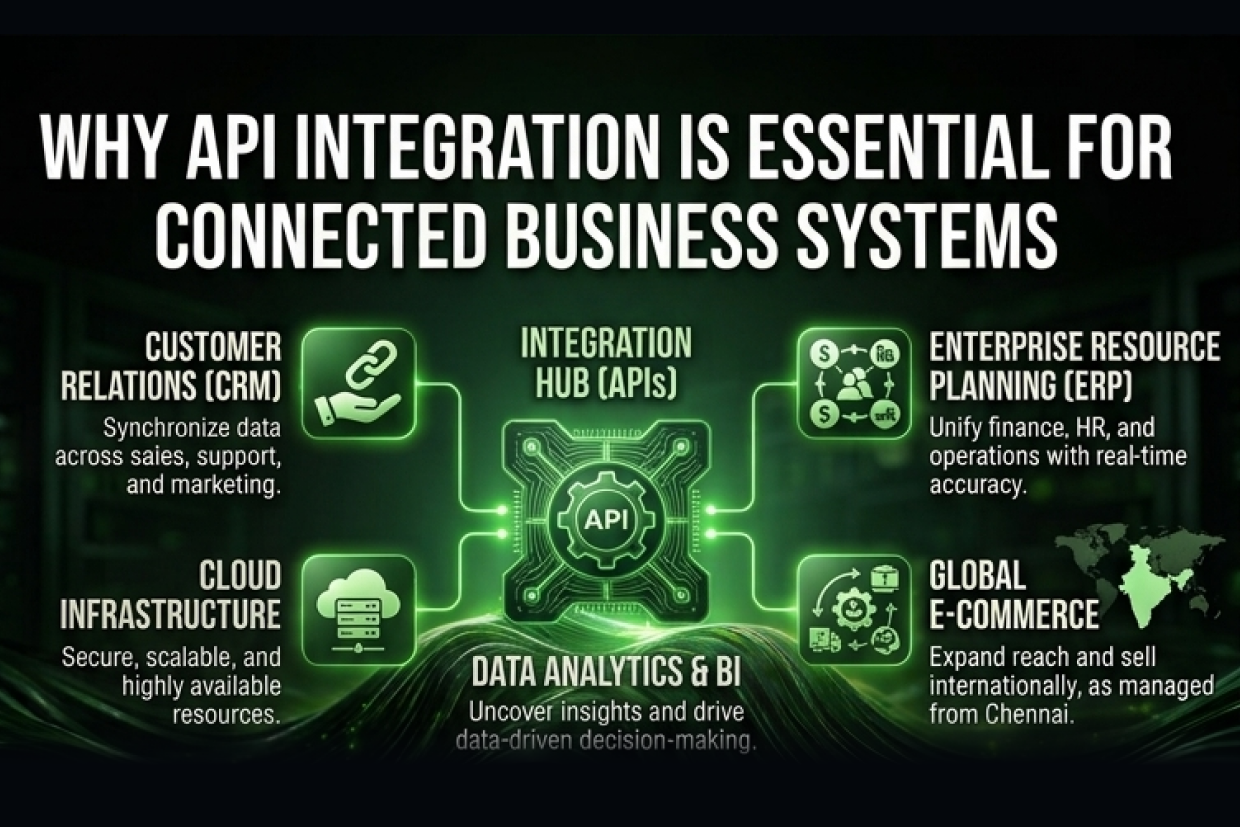
- Payments: Orders come in on the website, but payment confirmation, refunds, and reconciliation are handled manually against the payment gateway's dashboard.
- CRM and ERP: Sales data lives in the CRM, but accounting and inventory live in the ERP — and someone re-enters the same order twice.
- Mobile apps: A web platform exists, but the mobile app can't show live data because there's no API for it to call.
- Third-party services: SMS/WhatsApp notifications, maps, shipping providers, or accounting tools all need to be wired in rather than operated separately.
In each case, the fix isn't "more software" — it's connecting the software that's already there.
What Good API Integration Should Deliver
Not every integration is done well. Here's what separates a solid one from a fragile one that breaks the moment a third-party API changes something:
| Requirement | Why It Matters |
|---|---|
| Authentication & encryption (OAuth2, API keys, HTTPS) | Prevents unauthorized access to sensitive business and customer data |
| Real-time or near-real-time sync | Stock levels, order status, and payments stay accurate across every system |
| Error handling and retry logic | A failed API call gets logged and retried instead of silently losing data |
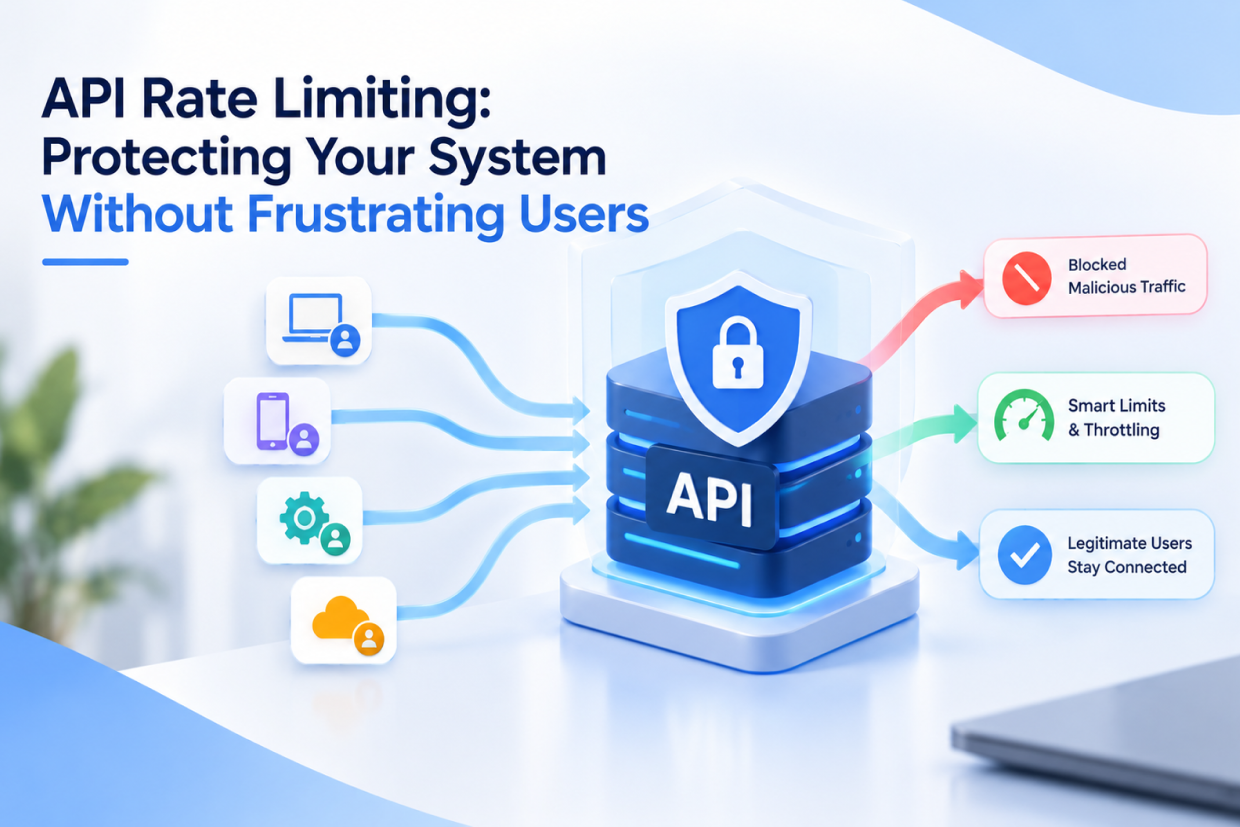
| Rate-limit awareness | Avoids getting your integration throttled or blocked by the third-party provider |
| Monitoring and logging | Issues get caught before a customer notices, not after |
How We Approach an API Project
- Understand the workflow, not just the systems. We map out how data actually needs to move — what triggers a sync, what happens on failure, who needs to be notified.
- Design the architecture. REST, GraphQL, or webhook-driven — chosen based on your data volume and how real-time the sync needs to be, not by default.
- Build or connect. Custom endpoints where you need them, secure connections to third-party APIs where you don't.
- Secure it. Authentication, encryption, and access control built in from the start, not bolted on afterward.
- Test under real conditions. Including failure cases — what happens when the third-party API is down or slow.
- Deploy and monitor. With logging in place so issues are visible before they become business problems.
Technologies We Work With
| Backend | Database | Cloud |
|---|---|---|
| Node.js, Laravel, ASP.NET, Java, Python | MySQL, PostgreSQL, MongoDB | AWS, Azure, Google Cloud |
What This Means for Your Business
The businesses that benefit most from API work aren't necessarily the largest — they're the ones losing the most time to manual, repetitive data entry between systems that should already be talking to each other. Done right, API integration typically pays for itself through:
- Fewer manual data-entry errors, and fewer hours spent on them
- Faster order-to-fulfillment and support-to-resolution times
- Accurate, real-time reporting instead of end-of-day reconciliation
- A platform that can add new integrations later without a rebuild
Why Work With Vriksha Techno Solutions
We build APIs and integrations that are secure, monitored, and designed for how your business actually operates — not generic connectors that break the first time a third-party API changes its response format. Our team handles:
- Custom API Development
- REST API Development
- Third-Party API Integration
- Payment Gateway Integration
- CRM & ERP Integration
- Cloud API Integration
- API Maintenance & Support
If manual data entry, disconnected systems, or a missing mobile API are slowing your team down, we can help you fix it. Talk to us about connecting your business systems the right way.
Frequently Asked Questions
What is an API?
An API (Application Programming Interface) is a defined way for two software systems to exchange data securely — for example, letting your website request payment confirmation from a payment gateway.
Can APIs integrate with the software we already use?
Yes. Most modern platforms — CRMs, ERPs, payment gateways, cloud services, and mobile apps — expose APIs specifically so they can be connected to other systems.
Are APIs secure?
When built correctly, yes. Modern APIs rely on authentication (like OAuth2), encrypted connections (HTTPS/TLS), and access controls to keep data secure in transit.
Will an API integration still work as our business grows?
It should — that's part of doing it right the first time. A well-architected API is built to handle increasing users, transactions, and data volume without needing to be rebuilt.
Ready to Build Your Next Digital Product?
Our experts will respond within 24 hours with a tailored approach for your project.