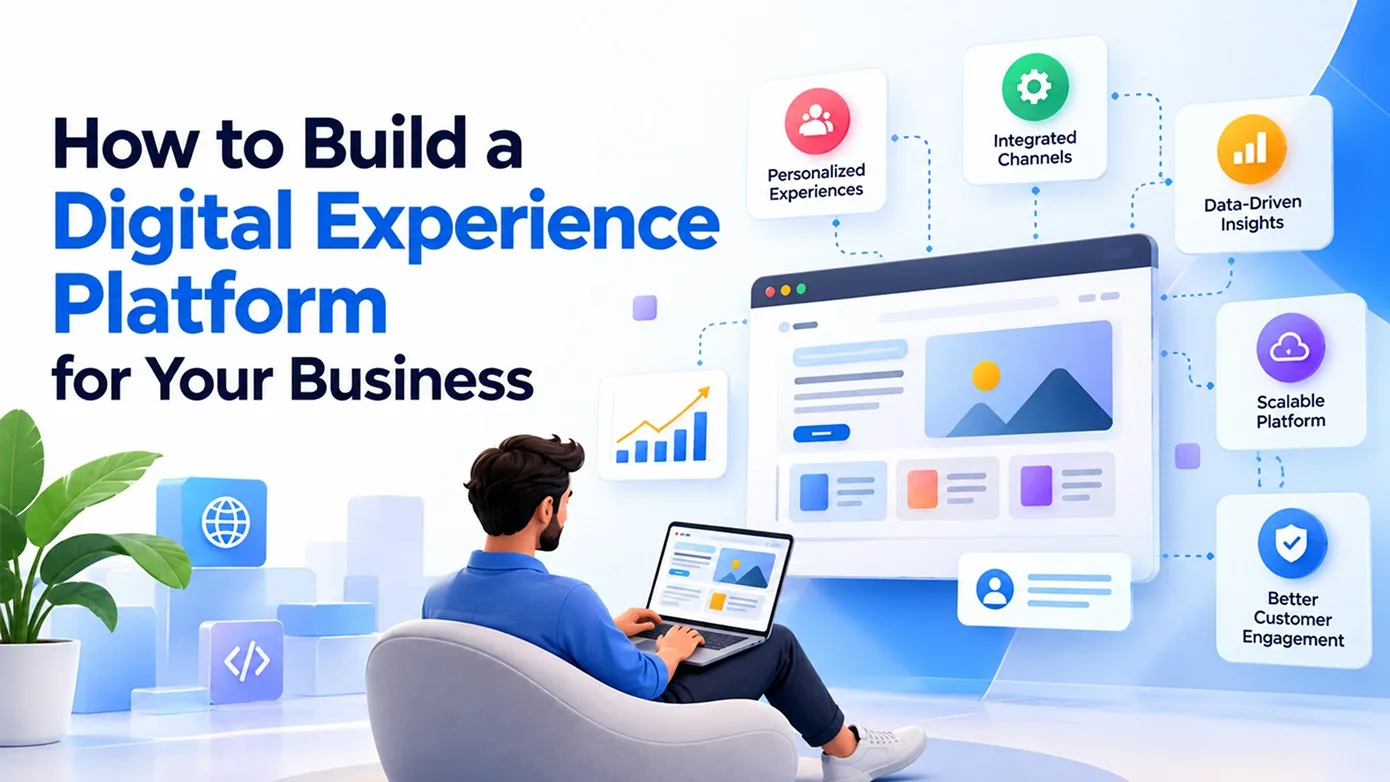
How to Build a Digital Experience Platform for Your Business
Customers interact with businesses through websites, mobile applications, email, social media, online stores, and other digital channels. When these channels operate separately, businesses may struggle to maintain consistent information, understand customer behaviour, and deliver a smooth experience.
A Digital Experience Platform (DXP) helps businesses bring different digital experiences together. It can connect content management, customer information, marketing tools, analytics, and digital services within a coordinated technology ecosystem.
For businesses planning digital transformation, digital experience platform development can provide a way to simplify operations, improve customer engagement, and support future growth. The right approach depends on your current systems, business goals, customer needs, and integration requirements.
What Is a Digital Experience Platform?
A Digital Experience Platform is a collection of integrated technologies that helps an organisation create, manage, deliver, and improve digital experiences across multiple customer touchpoints.
Rather than managing every channel independently, businesses can connect selected systems and workflows to provide more consistent experiences. For example, a customer might discover a product on a website, receive relevant information through email, and continue the purchase through a mobile application.
Depending on its architecture and integrations, a DXP may include:
- Website and content management
- Customer profiles and data integration
- Marketing automation and campaign integrations
- Personalised content and product recommendations
- Analytics and customer journey reporting
- E-commerce and payment integrations
- Mobile application and third-party system connectivity
- User access controls and administration tools
Not every business needs all these capabilities from the beginning. A DXP should be designed around the systems and customer journeys that matter most to the organisation.
Digital Experience Platform vs. Content Management System
A Content Management System (CMS) primarily helps businesses create, organise, and publish digital content. A Digital Experience Platform has a broader scope and can connect content with customer data, analytics, commerce, marketing, and other digital services.
| Area | Content Management System | Digital Experience Platform |
|---|---|---|
| Primary purpose | Create and manage digital content | Coordinate and improve digital experiences |
| Digital channels | Often centred on websites | Can connect websites, apps, and other channels |
| Personalisation | Depends on available features and integrations | Can use connected customer data and personalisation tools |
| Analytics | May provide basic content and traffic insights | Can integrate analytics across multiple touchpoints |
| Integrations | Usually focused on content-related needs | Can connect content, commerce, CRM, and marketing systems |
| Suitable use | Business websites, blogs, and content-led platforms | Businesses managing more complex digital customer journeys |
The distinction is not absolute. Modern CMS solutions can support APIs, personalisation, and multiple channels, while a DXP may incorporate a CMS as one of its components. The best choice depends on the complexity of your requirements.
Why Do Businesses Invest in Digital Experience Platforms?
1. Create a More Consistent Customer Experience
Customers expect consistent information when switching between a website, mobile app, and other channels. Connected systems can help businesses maintain consistent content, product information, service details, and communication.
2. Deliver More Relevant Experiences
When supported by suitable customer data and personalisation tools, a DXP can help businesses tailor content, recommendations, and communications to customer preferences and interactions.
Personalisation should be implemented with appropriate consent, privacy controls, and data governance.
3. Reduce Disconnected Workflows
When teams use separate systems for content, customer management, marketing, and reporting, information may need to be entered or updated repeatedly. Integrating the relevant systems can reduce duplication and help teams work with more consistent information.
4. Improve Marketing Coordination
A connected digital ecosystem can help marketing teams coordinate content and campaigns across selected channels. Integrations with email marketing, customer relationship management, and analytics tools can support better campaign measurement and follow-up.
5. Make Better Use of Business Data
Connecting analytics with relevant digital channels can help businesses understand which content attracts attention, where customers leave a journey, and which channels contribute to conversions.
These insights can support more informed decisions about content, customer engagement, marketing investment, and digital product improvements.
6. Support Business Growth
A well-planned, modular platform can make it easier to add new channels, integrate additional systems, or expand digital services as business requirements evolve. The actual scalability depends on the architecture, implementation quality, and operational capacity.
Essential Features of a Digital Experience Platform
The feature set of a DXP should reflect how your organisation attracts customers, delivers services, manages information, and measures performance.
Content Management
Content management tools help authorised users create, edit, organise, and publish website pages, articles, landing pages, images, and other digital content.
Customer Data Integration
Integrations with CRM systems and other approved data sources can help bring relevant customer information together. Access permissions, data accuracy, and privacy requirements should be considered from the beginning.
Omnichannel Content Delivery
Businesses may need to deliver consistent content across websites, mobile apps, and other digital touchpoints. API-based or headless architectures can support these use cases when appropriate.
Personalisation Capabilities
Personalisation features can use permitted customer preferences, interactions, and contextual information to display more relevant content or recommendations. These capabilities should match the available data and the business use case.
Marketing and Automation Integrations
Connecting campaign management, email marketing, customer follow-up, and other automation tools can reduce manual work and help teams coordinate communications.
Analytics and Reporting
Reporting tools can help teams monitor website engagement, content performance, conversions, and other relevant business metrics. Cross-channel reporting depends on how well the underlying systems share and standardise data.
E-commerce and Transaction Management
For commerce-focused businesses, integrations may support product catalogues, inventory, checkout, payment processing, orders, discounts, and customer support. The required capabilities will vary by business model.
Security and User Permissions
A DXP may handle sensitive customer or business information. Appropriate authentication, role-based access, secure integrations, logging, backups, and ongoing security updates should be part of the implementation plan.
How to Build a Digital Experience Platform
Developing a DXP requires more than selecting technologies. Businesses need a clear understanding of their existing systems, customer journeys, integration needs, and long-term goals.
Step 1: Identify Business Goals
Start by identifying the problems you want to solve. These may include inconsistent customer information, disconnected marketing systems, duplicated content management, limited reporting, or difficulty delivering services across multiple channels.
Define measurable objectives, such as reducing manual work, improving conversion rates, or making content updates more efficient.
Step 2: Map Customer Journeys
Document how customers discover your business, evaluate products or services, make purchases, and receive support. Identify the channels and systems involved at each stage.
This helps determine which integrations and digital experiences should be prioritised.
Step 3: Assess Existing Systems
Review your current CMS, CRM, e-commerce platform, marketing tools, analytics systems, and internal applications. Determine which systems should be retained, integrated, upgraded, or replaced.
A DXP does not always require replacing every existing system. Reusing suitable technology may reduce unnecessary complexity and disruption.
Step 4: Choose the Right Architecture
The architecture should support your required channels, integrations, performance expectations, and maintenance capabilities.
- Integrated architecture: Connects selected existing systems into a coordinated environment.
- API-first architecture: Uses defined interfaces to exchange data and functionality between applications.
- Headless architecture: Separates content management from the presentation layer so content can be delivered to different channels.
- Modular architecture: Organises capabilities into components that can be developed and maintained independently where appropriate.
These approaches can overlap. Select an architecture based on actual requirements rather than adopting a complex technology stack simply because it is popular.
Step 5: Prioritise Core Features
Identify the capabilities needed for the first release. For example, a content-focused business may begin with centralised content management and analytics integrations, while an e-commerce organisation may prioritise customer data, product information, and order-related workflows.
Prioritising essential features helps manage project scope and allows the team to validate the solution before introducing more advanced capabilities.
Step 6: Develop and Integrate the Platform
Build the required interfaces, backend services, data flows, and integrations according to the approved plan. Define how systems exchange information, handle failures, manage permissions, and keep data consistent.
For projects with evolving requirements, an iterative development approach can help teams review working features, collect feedback, and refine subsequent releases.
Step 7: Test Security, Performance, and Usability
Test important customer journeys, system integrations, access permissions, mobile responsiveness, and error handling. Validate performance under expected usage conditions and review security controls before launch.
Step 8: Launch, Measure, and Improve
Deploy the platform in a controlled manner, monitor system health, and review user feedback. Track the metrics associated with your original business goals and use the results to prioritise improvements.
Custom Development or Existing Technology: Which Should You Choose?
Businesses can build a digital experience platform by developing custom components, integrating existing tools, or combining both approaches.
Custom DXP Development
Custom development can be suitable when the business has specialised workflows, complex integrations, unique customer journeys, or requirements that existing systems cannot adequately support.
Potential advantages:
- Greater control over business-specific features
- Flexibility in technology and architecture choices
- Ability to design workflows around operational needs
- Greater control over future product enhancements
Considerations:
- Higher initial planning and development effort may be required
- Testing, documentation, and maintenance need ongoing investment
- Complex integrations can increase project scope
Integrating Existing Platforms
Using suitable CMS, CRM, commerce, analytics, and marketing tools can help businesses build a connected environment without developing every capability from scratch.
Potential advantages:
- Reuse of established tools and capabilities
- Potentially faster implementation for supported requirements
- Less need to maintain custom versions of common functions
Considerations:
- Subscription and integration costs may accumulate
- Customisation can be limited by the selected platforms
- Data compatibility and vendor dependencies need to be assessed
For many organisations, a hybrid approach is worth evaluating: use proven tools for standard functions and develop custom components for the workflows that differentiate the business.
What Affects Digital Experience Platform Development Cost?
The cost of custom DXP development varies significantly by project. A platform that connects a website to a few business tools has a different scope from an enterprise solution supporting multiple brands, channels, regions, and complex customer journeys.
Key cost factors include:
- Project scope: The number and complexity of required features.
- Platform coverage: The websites, mobile applications, and other channels that need support.
- Integration requirements: The number, availability, and complexity of third-party APIs and systems.
- Data migration: The amount of existing content and customer information that must be transferred, cleaned, or mapped.
- Personalisation and analytics: The sophistication of data processing, reporting, and customer experience rules.
- Security requirements: Access controls, privacy measures, audits, and regulatory obligations.
- Design and accessibility: User experience research, interface design, and accessibility testing.
- Ongoing support: Hosting, monitoring, updates, maintenance, and future enhancements.
Rather than relying on a generic price range, prepare a detailed feature list and integration inventory. A discovery and planning phase can help establish a realistic budget, delivery timeline, and implementation roadmap.
Common Challenges to Plan For
Disconnected or Inconsistent Data
Different systems may use different formats, identifiers, or update rules. Define data ownership, integration logic, and error-handling procedures before connecting them.
Unclear Project Scope
Trying to include every possible feature in the first release can delay delivery. Prioritise customer and operational needs, then plan additional capabilities in stages.
Overcomplicated Architecture
Not every business requires a highly distributed or enterprise-scale architecture. Choose a design that meets current needs while providing a practical path for future growth.
Insufficient Adoption Planning
A platform may offer useful functionality but still struggle if teams do not understand the new workflows. Include staff training, documentation, and change management in the rollout plan.
Neglecting Long-Term Maintenance
Integrations, security requirements, and third-party APIs change over time. Assign responsibility for monitoring, updates, incident response, and performance improvements.
Conclusion
A Digital Experience Platform can help businesses coordinate content, customer information, marketing tools, and digital channels in a more consistent way. However, its value depends on choosing the right scope, integrating systems carefully, and designing around real customer and business needs.
Start by assessing your current technology environment and identifying the customer journeys that need improvement. Then choose the appropriate architecture, prioritise essential capabilities, and create a development roadmap that supports measurable business goals.
Planning your digital transformation? Vriksha Tech helps businesses explore custom web applications, mobile applications, and software solutions based on their requirements. Connect with our team to discuss your digital platform goals and the right approach for your business.
Explore custom software development solutions with Vriksha Tech.
Frequently Asked Questions
What is a Digital Experience Platform?
A Digital Experience Platform is a set of integrated technologies that helps businesses manage and improve digital experiences across channels such as websites, mobile applications, and connected services.
What is the difference between a DXP and a CMS?
A CMS primarily manages and publishes content. A DXP has a broader role and can connect content management with customer data, analytics, commerce, marketing, and other digital systems.
Does every business need a DXP?
No. A standard CMS or a smaller set of integrated tools may be sufficient for businesses with straightforward requirements. A DXP is worth evaluating when multiple channels, systems, and customer journeys need to work together.
How long does DXP development take?
The timeline depends on project scope, integrations, data migration, design requirements, testing, and deployment. A clearly defined first release can help establish a more reliable schedule.
How much does a custom digital experience platform cost?
Costs depend on the required features, platforms, integrations, security requirements, and ongoing support. A requirements assessment is the best starting point for a project-specific estimate.
Can a DXP integrate with existing business software?
Yes, when the existing systems provide suitable APIs, connectors, or other integration methods. Compatibility, data access, security, and ongoing maintenance should be evaluated before implementation.
Should we build a DXP from scratch or integrate existing tools?
The decision depends on the uniqueness of your workflows, budget, time frame, and existing technology. Custom development offers flexibility, while integrating existing tools can reduce the need to recreate standard capabilities. A hybrid approach may suit businesses with a mix of common and specialised requirements.
Ready to Build Your Next Digital Product?
Our experts will respond within 24 hours with a tailored approach for your project.