Zero Trust Architecture: What SMBs Get Wrong When Adopting It
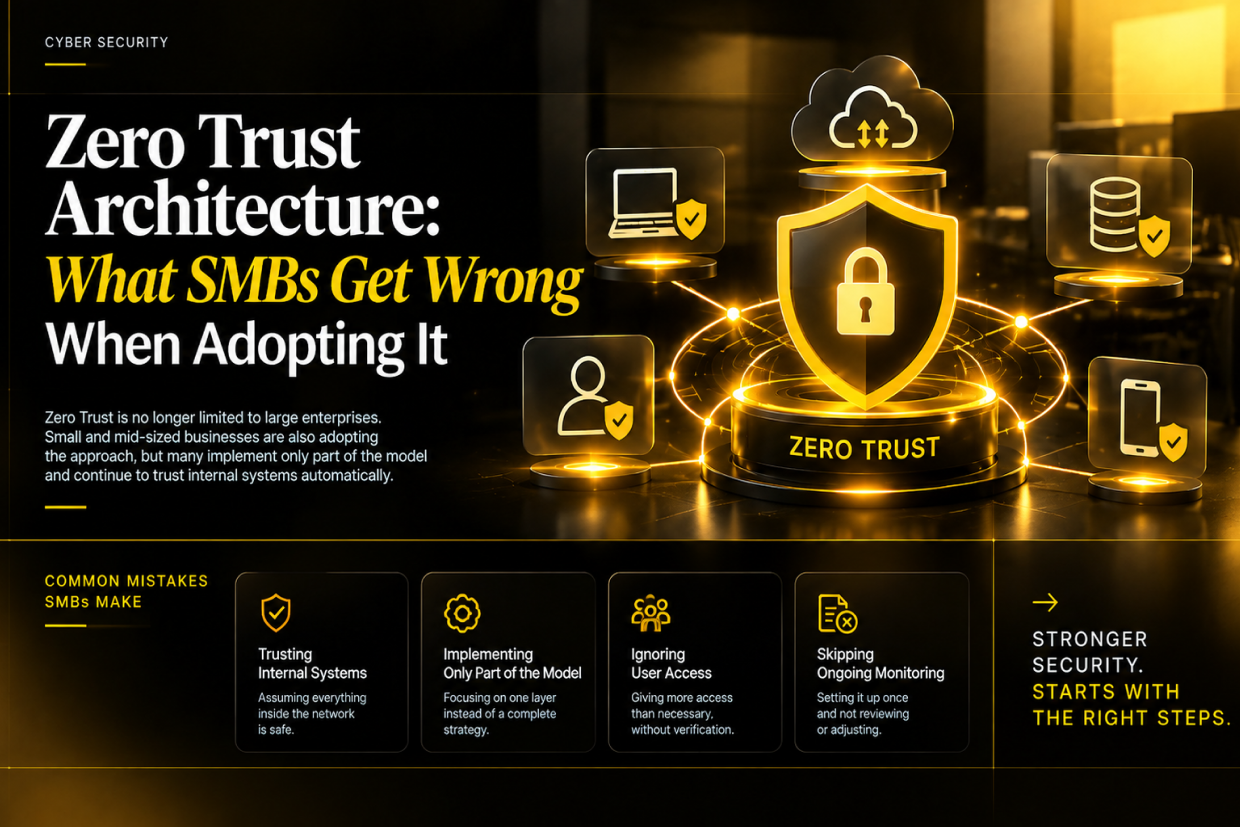
Zero Trust has become one of the most discussed security approaches, but many small and mid-sized businesses adopt the name without fully adopting the practice. They may purchase a security product labeled “Zero Trust” and assume the architecture is already handled. In reality, Zero Trust is a security principle: verify every request, regardless of where it originates, and never automatically trust internal traffic.
The common mistake is partial implementation. A business may secure its network perimeter while continuing to assume that users, devices, and systems inside the network are automatically safe. Once someone is authenticated, they may receive broader access than necessary.
Why Partial Zero Trust Creates Problems
A Zero Trust approach requires verification across multiple layers, including identity, devices, applications, and data. Simply securing the company network does not provide the same protection.
For example, an employee may have valid login credentials but be using an unmanaged or compromised device. A system that checks only the username and password may allow access without considering the condition of the device or the sensitivity of the requested information.
Authentication is only one part of Zero Trust.
Common Mistakes SMBs Make
Many growing businesses try to implement Zero Trust as a large security project and become overwhelmed by the number of systems involved. Others focus only on identity while ignoring device security, application access, or internal segmentation.
Another common problem is giving users more access than they actually need. If an employee only needs access to one application, providing access to an entire internal network creates unnecessary exposure.
A practical Zero Trust strategy should focus on least-privilege access, continuous verification, and protecting the most important systems first.
Start With Critical Systems
SMBs do not necessarily need to redesign their entire infrastructure immediately. A more manageable approach is to identify the systems containing sensitive business information, customer data, financial records, or important operational services.
These systems can become the starting point for stronger identity controls, device checks, access restrictions, and monitoring.
Start with the highest-risk areas instead of attempting an all-at-once security overhaul.
Identity Alone Is Not Enough
Strong identity management is important, but Zero Trust also considers the context of each access request.
A business can evaluate who is requesting access, which device they are using, which application they are trying to reach, and what information they are requesting.
This creates a more controlled model than simply asking whether the person has a valid password.
Zero Trust Should Grow With the Business
For SMBs, Zero Trust should be treated as an ongoing security strategy rather than a product purchase. As new employees, devices, applications, and cloud services are introduced, access rules should evolve with them.
The goal is simple:
Do not automatically trust a request simply because it comes from inside the business environment. Verify it based on identity, device, application, and access requirements.
At Vriksha Techno Solutions, cybersecurity solutions can help businesses approach Zero Trust through identity controls, access management, device security, application protection, monitoring, and segmentation, allowing growing organizations to strengthen security step by step.
Ready to Build Your Next Digital Product?
Our experts will respond within 24 hours with a tailored approach for your project.