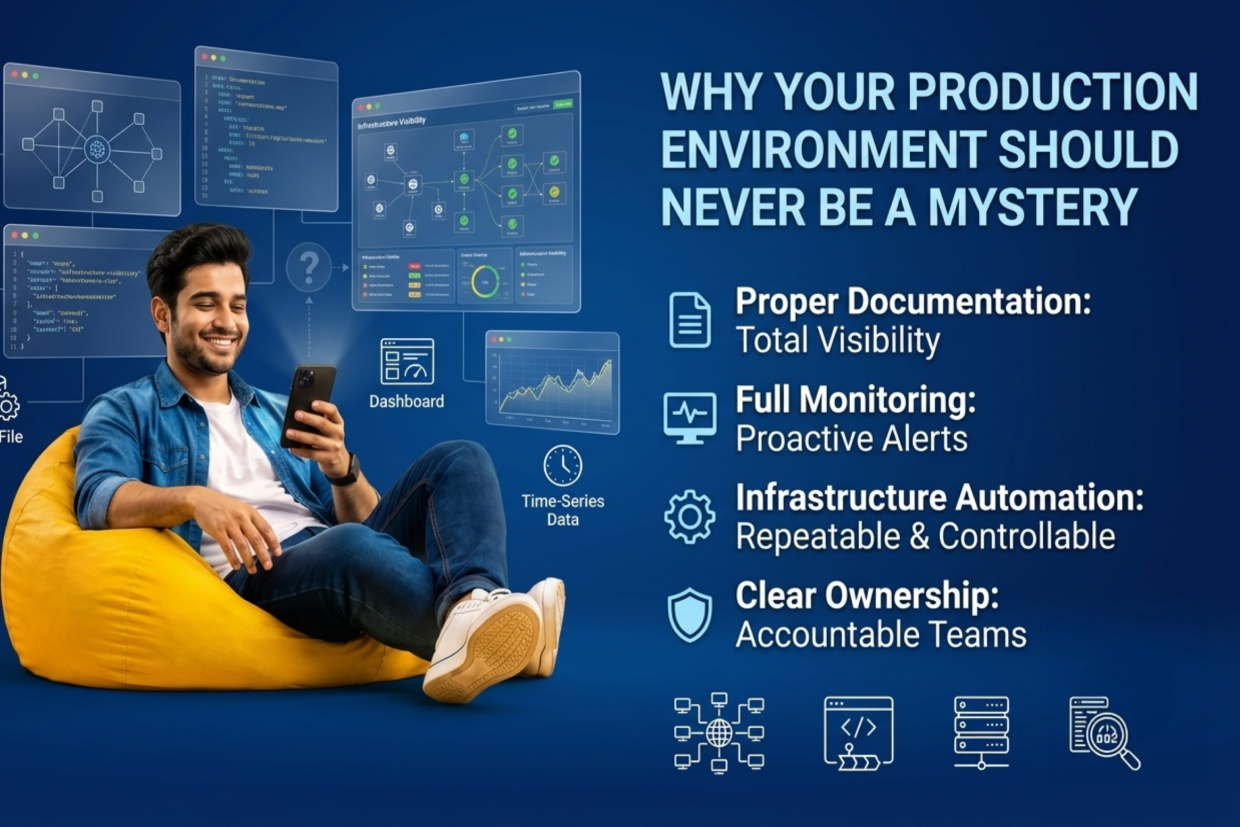
Why Your Production Environment Should Never Be a Mystery
Short answer: Production environments become a mystery when changes go undocumented, monitoring is incomplete and only one person knows how things work. Predictable production needs clear separation of development, staging and production, shared knowledge, visibility into what is actually running and monitoring that goes beyond logs.
Introduction
A production environment is where your application becomes real for your customers. It handles live traffic, business-critical data, payments, integrations, and daily operations.
But in many organizations, production slowly becomes difficult to understand. Configuration changes happen without documentation, monitoring is incomplete, and only a few people know how everything works.
When that happens, even a small issue can become a major business problem.
A healthy production environment should be predictable, observable, documented, and manageable by the team—not dependent on one person's memory.
01. Why Production Environments Are Difficult to Understand
Production environments rarely become complicated overnight. They evolve as businesses grow.
New servers are added. APIs are integrated. Databases are upgraded. Temporary fixes become permanent. Over time, nobody has a complete picture of what is actually running.
Common reasons include:
- Undocumented configuration changes
- Manually configured servers
- Multiple third-party integrations
- Outdated infrastructure documentation
- Different environments using different configurations
- Lack of centralized monitoring
- Deployment processes that depend on individuals
- Temporary fixes that were never properly removed
The result is an environment that works—but nobody completely understands why it works.
02. The Real Business Risk
A confusing production environment isn't just a technical inconvenience. It creates real business risks.
When teams don't understand their infrastructure, troubleshooting takes longer and operational decisions become harder.
This can lead to:
- Longer downtime
- Slower incident response
- Higher infrastructure costs
- Deployment failures
- Security risks
- Dependency on specific employees
- Difficulty scaling the application
- Loss of customer trust
The biggest risk isn't complexity itself. It's complexity that nobody can explain.
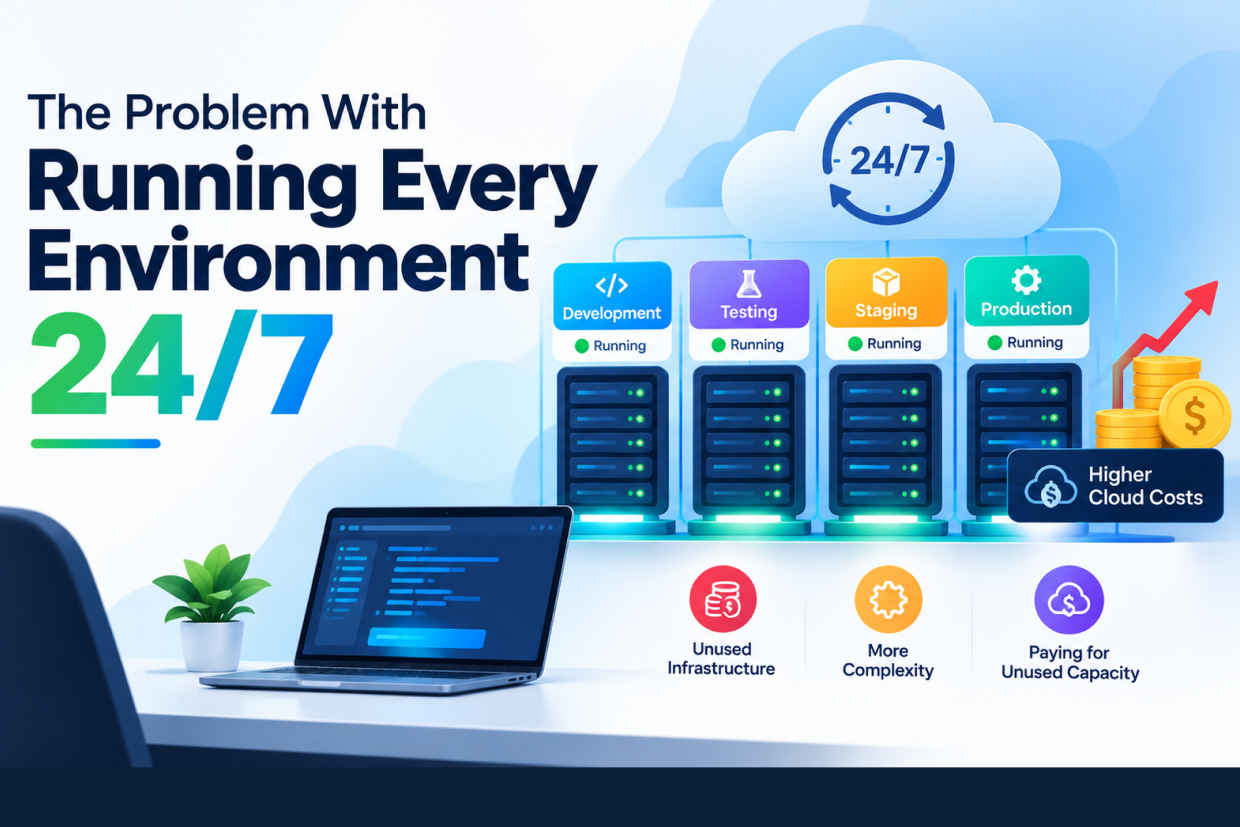
03. Development, Staging, and Production Must Be Clear
Every environment should have a clearly defined purpose.
| Environment | Purpose | Typical Usage |
|---|---|---|
| Development | Build and test features | Developers |
| Staging | Validate production-like changes | QA & Developers |
| Production | Serve real users | Customers |
The closer staging is to production, the easier it becomes to identify problems before they reach customers.
A clear separation also prevents developers from accidentally making changes directly to the live system.
04. The "Only One Person Knows" Problem
One of the biggest warning signs is when production knowledge belongs to a single employee.
"Ask the developer who originally configured the server."
This creates a serious operational dependency.
What happens when that person is unavailable?
- Nobody knows where a service is running
- Nobody understands certain configurations
- Deployment becomes risky
- Troubleshooting takes longer
- Knowledge becomes difficult to transfer
Production knowledge should belong to the organization, not an individual.
Build shared knowledge through:
- Infrastructure documentation
- Architecture diagrams
- Runbooks
- Deployment documentation
- Access procedures
- Incident-response guides
- Service ownership records
05. Production Should Be Predictable
A good production environment should behave consistently.
If the same deployment process is followed today and tomorrow, the expected result should be similar.
Predictability comes from:
- Automated deployments
- Infrastructure as Code
- Version-controlled configuration
- Standardized environments
- Automated testing
- Monitoring and alerting
- Documented procedures
- Clearly defined ownership
If production requires someone to remember a sequence of manual steps, the process is already fragile.
06. Know What Is Actually Running
You should be able to answer basic questions about your production environment immediately.
Your team should know:
- Which services are running?
- Where are they hosted?
- Which database do they use?
- Which APIs do they depend on?
- Which services communicate with each other?
- Who owns each service?
- How are deployments performed?
- Where are logs stored?
- What happens if a service fails?
If answering these questions requires searching through old messages or asking one particular developer, your infrastructure needs better documentation.
07. Logs Alone Are Not Enough
Logs are important, but logs should not be your entire monitoring strategy.
A production system needs multiple layers of observability.
A useful monitoring setup includes:
Logs
Understand what happened.
Metrics
Understand how the system is performing.
Traces
Understand how requests move between services.
Alerts
Know when something requires attention.
Example
A user reports that the application is slow.
Logs may tell you that an API request failed.
Metrics may show that CPU usage increased.
Tracing may reveal that the API is waiting on a slow database query.
Together, these signals help the team identify the actual problem much faster.
08. Every Production Service Needs an Owner
Every important service should have someone responsible for it.
Ownership doesn't mean that one person must do everything. It means the team knows who is accountable for maintaining and understanding the service.
Define ownership for:
- Application services
- Databases
- APIs
- Cloud infrastructure
- CI/CD pipelines
- Monitoring
- Security systems
- Third-party integrations
A simple ownership document can prevent hours of confusion during an incident.
09. Infrastructure Should Be Reproducible
If a server fails, your team should be able to recreate the environment without relying on someone's memory.
This is where Infrastructure as Code becomes valuable.
Instead of:
Manual Setup → Individual Knowledge → Unclear Configuration
Use:
Code → Version Control → Automated Provisioning → Repeatable Infrastructure
This makes infrastructure easier to review, reproduce, maintain, and scale.
10. Temporary Fixes Become Permanent Problems
Production incidents often lead to quick fixes.
A developer changes a configuration.
A server is manually modified.
A temporary workaround is introduced.
The application starts working again.
Then everyone moves on.
Months later, nobody remembers the change.
Every temporary production change should have:
- A reason
- An owner
- Documentation
- A follow-up task
- A plan to remove or replace it
Temporary solutions should have an expiration date.
11. What Happens During an Incident?
Production quality becomes most visible when something goes wrong.
Imagine an important API suddenly stops responding.
A mature team should already know:
- How the issue is detected
- Who receives the alert
- Who owns the service
- Where to check logs
- How to identify the affected component
- How to roll back a deployment
- How to communicate the incident
- How to restore the service
- How to document the root cause
Without these processes, every incident becomes a new experiment.
12. When Should You Audit Your Production Environment?
Don't wait for a major outage.
Regular reviews can identify infrastructure problems before they become incidents.
Review these areas regularly:
- Server and cloud resources
- Database configuration
- Application dependencies
- API integrations
- Access permissions
- Monitoring and alerts
- Backup systems
- Deployment pipelines
- Environment variables
- SSL certificates
- DNS configuration
- Infrastructure documentation
A production audit should answer one simple question:
"Could another qualified engineer understand and operate this environment without depending on one person?"
13. A Simple Production Readiness Checklist
Use this checklist before considering your production environment healthy.
Infrastructure
- ☐ Servers and cloud resources are documented
- ☐ Infrastructure is reproducible
- ☐ Production configuration is version controlled
- ☐ Dependencies are documented
Deployment
- ☐ Deployments are automated
- ☐ Rollbacks are possible
- ☐ Deployment ownership is clear
- ☐ Releases are tested before production
Monitoring
- ☐ Centralized logging is available
- ☐ Important metrics are monitored
- ☐ Critical services have alerts
- ☐ Application health is visible
Security
- ☐ Access is controlled
- ☐ Production credentials are protected
- ☐ Permissions are reviewed regularly
- ☐ Security-sensitive changes are documented
Documentation
- ☐ Architecture is documented
- ☐ Services have owners
- ☐ Deployment procedures are documented
- ☐ Incident procedures are available
- ☐ Important production changes are recorded
14. The Goal Isn't Zero Complexity
Modern production systems can be complex.
Microservices, cloud infrastructure, APIs, databases, queues, containers, monitoring tools, and third-party services all introduce additional moving parts.
The goal isn't to eliminate complexity.
The goal is to make complexity understandable.
Your team should be able to answer:
- What is running?
- Why is it running?
- How does it communicate?
- Who owns it?
- How do we monitor it?
- What happens when it fails?
If your team can answer these questions confidently, your production environment is no longer a mystery.
Conclusion
A production environment shouldn't depend on tribal knowledge, undocumented changes, or one person's memory.
Good production engineering creates an environment where systems are visible, documented, monitored, reproducible, and owned.
The real measure of a healthy production environment isn't how complicated it is.
It's how confidently your team can understand, operate, and recover it.
Is Your Production Environment a Mystery?
Make your infrastructure easier to understand, monitor, deploy, and maintain.
Build predictable production systems with better documentation, observability, automation, and ownership.
Talk to Our Team →Frequently Asked Questions
Why do production environments become hard to understand?
Configuration changes happen without documentation, monitoring is incomplete and only a few people know how everything works.
What is the 'only one person knows' problem?
Knowledge is concentrated in one person, so when they are unavailable even a small issue can become a major business problem. Shared documentation and knowledge reduce that risk.
Are logs enough to monitor production?
No. The article says logs alone are not enough and recommends a broader monitoring setup.
Ready to Build Your Next Digital Product?
Our experts will respond within 24 hours with a tailored approach for your project.