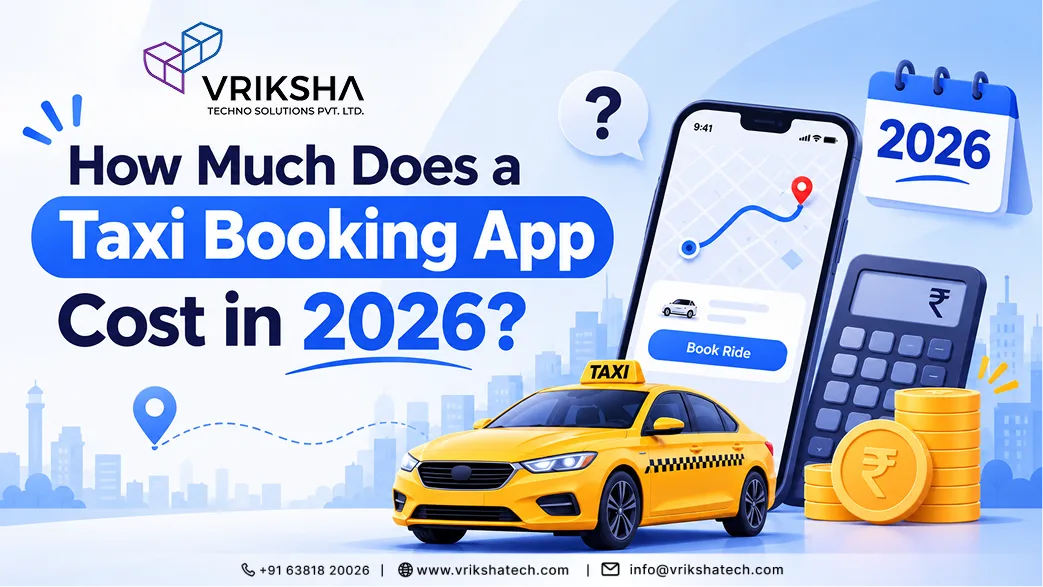
Short answer: A taxi booking app needs a passenger app, a driver app and an admin panel. Built from scratch in 2026, a launch-ready version typically costs $25,000 to $65,000 with an India-based team and $120,000 to $300,000 with a US-based team. Licensing a ready-made taxi platform and customising it costs less and launches faster. Budget separately for maps, SMS, hosting and yearly maintenance.
If you run a taxi or cab business, or plan to launch a ride-hailing service in your city, the first question is usually the budget. The honest answer depends on what you build and who builds it. This guide breaks the cost down into parts you can check against any quote: the apps you need, the cost of each scope level, the difference between India-based and US-based teams, and the running costs most estimates leave out.
It is written for taxi operators, fleet owners and founders in India, the Gulf, Africa, Europe and the US who are comparing quotes or planning a budget.
What Does a Taxi Booking App Include?
A working taxi platform is not one app. It is four connected parts:
- Passenger app: sign-up, pickup and drop location, fare estimate, booking, live driver tracking, payment, ratings and ride history.
- Driver app: online and offline status, ride requests, navigation, trip start and end, earnings and documents.
- Admin panel: drivers and vehicles, fares and zones, bookings, payments, payouts, promotions, complaints and reports.
- Backend and real-time layer: matching passengers to nearby drivers, live location updates, notifications and the fare engine.
Many quotes look cheap because they price only the passenger app. Always ask which of these four parts a quote includes. Our taxi booking app development page lists what a complete platform covers.
How Much Does a Taxi App Cost in 2026?
Most of the cost is developer time, so the two things that matter most are the scope (how many hours) and the team's hourly rate. These are typical 2026 ranges for a complete platform (passenger app, driver app, admin panel and backend):
| Scope | Typical effort | Estimated cost |
|---|---|---|
| Launch version (one city, core booking, tracking, payments) | 1,200 to 1,800 hours | India team: $25,000 to $65,000 US team: $120,000 to $300,000 |
| Growth version (multiple cities, scheduled rides, wallets, promotions, corporate accounts) | 2,500 to 3,500 hours | India team: $50,000 to $130,000 US team: $250,000 to $550,000 |
| Advanced platform (multiple services, dynamic pricing, dispatcher console, analytics) | 4,500 hours and more | India team: $90,000 and up US team: $450,000 and up |
These ranges are based on typical agency rates: about $20 to $45 an hour for an experienced team in India and $100 to $180 an hour in the US. Our guide to the cost of hiring dedicated developers in India explains how those rates work.
Which Features Change the Cost the Most?
- Real-time tracking and matching: the heart of the product. Smooth live tracking and fair driver matching take careful backend work.
- Fare engine: fixed fares, distance and time fares, night charges, airport fees, tolls and surge pricing each add logic and testing.
- Payments: cash only is simplest. Cards, UPI, wallets, refunds and driver payouts add integration and reconciliation work.
- Safety features: SOS buttons, trip sharing, driver document checks and ride OTPs are expected in most markets.
- Corporate accounts and scheduled rides: valuable for revenue, but each adds its own billing and admin screens.
- Languages and markets: every extra language, currency and tax rule adds design and testing time.
Custom Build or Ready-Made Taxi Platform?
You have two routes. A custom build gives you full control and suits a unique business model, but you pay for every feature. A ready-made platform already has the core passenger, driver and admin features, so you pay mainly for licensing, your branding and the changes your market needs. For most operators launching in one or two cities, the ready-made route is faster and cheaper.
Our own taxi platform, Vrix Ride, is built for this: a branded passenger app, driver app and admin panel that we adapt to your fares, zones and payment methods. You can also book a live demo from that page to see it working before you decide.
What Are the Monthly Running Costs?
Launch is not the last bill. Plan for these from the start:
- Maps and routing: map display, address search, distance and route calls are billed by usage and grow with every ride.
- SMS and WhatsApp messages: OTP logins and ride alerts are charged per message.
- Cloud hosting: servers, database and real-time services; a small launch setup is modest, and costs rise with traffic. Our cloud and DevOps services team plans this so you do not overpay early.
- Payment gateway fees: a percentage of each online payment.
- Maintenance: plan roughly 15 to 20 percent of the build cost each year for OS updates, store policy changes, fixes and small improvements.
How Can You Launch a Taxi App for Less?
- Start with one city and one ride type. Add rentals, outstation trips and parcels after you see demand.
- Use a cross-platform framework. Flutter developers can build the passenger and driver apps for Android and iOS from one codebase. See Flutter vs React Native for the trade-offs.
- Build a minimum viable product first. An MVP with booking, tracking and one payment method proves demand before you spend on extras.
- Keep the admin panel simple. Many operators start with manual payouts and basic reports, then automate later.
- Write a one-page brief before asking for quotes, so you compare like with like. Our guide on the factors to settle before starting a custom app includes a template.
How Long Does It Take?
A custom launch version usually takes 3 to 5 months: about 3 to 4 weeks for planning and design, 2 to 3 months of development and 3 to 4 weeks of testing and store approval. A ready-made platform skips most of the build, so the timeline depends mainly on branding, configuration and your changes. Delivery apps follow a similar pattern; see our guide to building a courier delivery app.
Get a Taxi App Estimate for Your City
Every market is different: fares, payment habits, driver rules and competition all change the scope. Tell us your city, fleet size and the ride types you plan to offer. We will send you a free scope and cost estimate for both routes, custom build and Vrix Ride, so you can compare them side by side. Vriksha Techno Solutions has built web and mobile software from Chennai since 2006, for 800+ clients across 1,200+ projects.
Frequently Asked Questions
How much does it cost to build a taxi app like Uber?
A launch-ready taxi app with passenger, driver and admin apps typically costs $25,000 to $65,000 with an India-based team and $120,000 to $300,000 with a US-based team. A full Uber-scale product with many cities, services and advanced pricing costs far more and is built over years.
How long does it take to build a taxi booking app?
A custom first version usually takes 3 to 5 months. Customising a ready-made taxi platform can shorten this considerably because the core booking, tracking and payment features already exist.
What are the monthly running costs of a taxi app?
Expect costs for maps and routing APIs, SMS or WhatsApp messages, cloud hosting, payment gateway fees and app maintenance. At launch these are usually a few hundred to a few thousand dollars a month and grow with ride volume.
Is it cheaper to use a white-label taxi app?
Usually yes. A ready-made platform such as Vrix Ride already has the core features, so you pay mainly for licensing, branding and the changes your market needs, instead of building every feature from scratch.
Which technology is best for a taxi app?
Cross-platform frameworks such as Flutter let one team build the passenger and driver apps for Android and iOS together, which lowers cost. The backend needs real-time location updates, so it is usually built with Node.js or Laravel plus a real-time messaging layer.
Ready to Build Your Next Digital Product?
Our experts will respond within 24 hours with a tailored approach for your project.