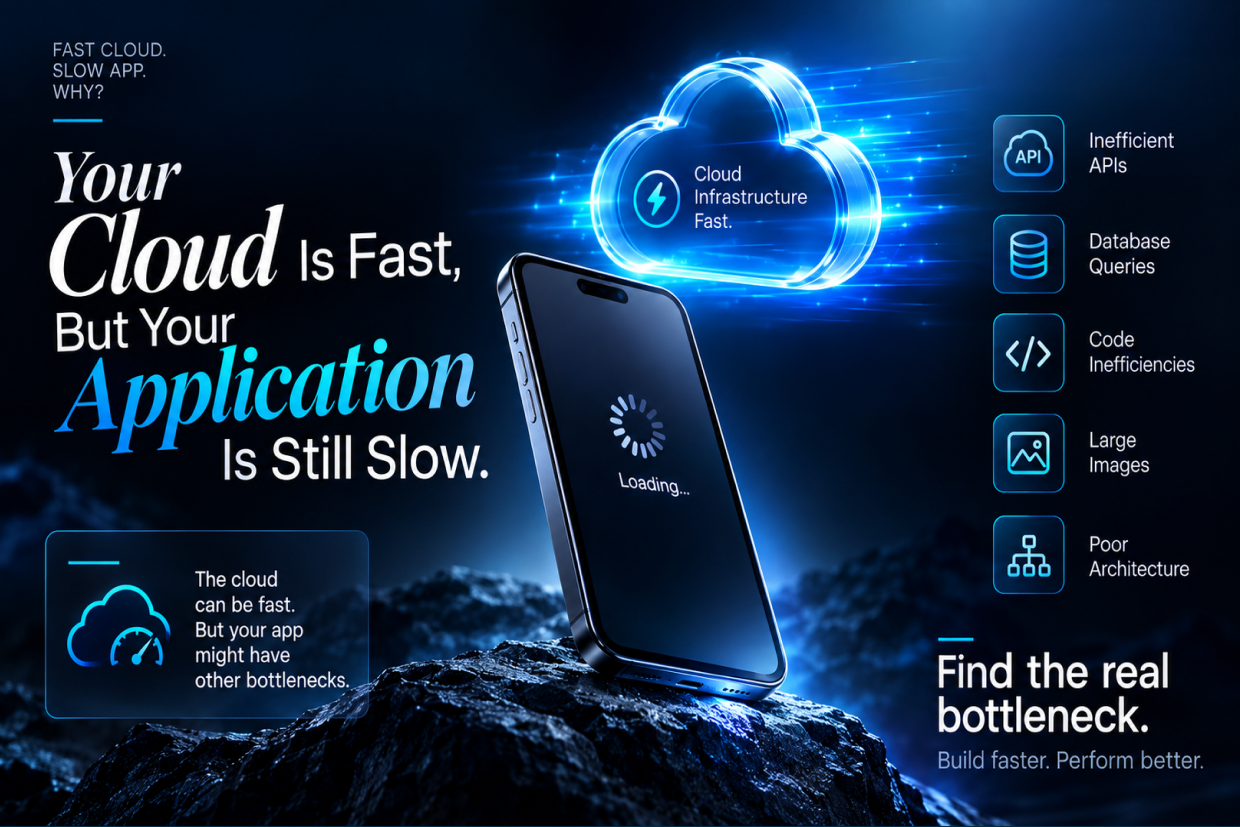
Your Cloud Is Fast, But Your Application Is Still Slow
A business moves its application to a powerful cloud server.
- More CPU.
- More memory.
- Faster storage.
- Better network capacity.
The team expects everything to become faster.
But the customers still complain:
“The page is taking too long to load.”
“The dashboard freezes.”
“Search is slow.”
“Why does it take so long to open an order?”
This creates a common misunderstanding.
The cloud infrastructure may be perfectly healthy.
The application itself may be the bottleneck.
Moving a slow application to a larger server can sometimes be like putting a bigger engine in a car with a blocked fuel line. You have more power, but the underlying problem remains.
A Powerful Server Cannot Fix Every Problem
Application performance depends on much more than server specifications.
A typical request may travel through several layers:
User → Mobile/Web App → API → Application Logic → Database → External Service → Response
If one of these layers is slow, the customer experiences the entire application as slow.
For example, the server may respond quickly, but the database query may take several seconds.
Or the API may make five external requests before returning a single response.
Or the frontend may download a huge amount of unnecessary data.
The cloud is only one part of the performance equation.
Where Does the Real Bottleneck Come From?
| Potential Bottleneck | What the User Experiences |
|---|---|
| Slow database queries | Pages take too long to show data |
| Inefficient APIs | Delayed screen updates |
| Large images and files | Slow page loading |
| Heavy frontend processing | Laggy interactions |
| External API delays | Waiting during transactions |
| Poor caching | The same data is repeatedly requested |
This is why simply upgrading the server may not solve the issue.
The Database Can Quietly Become the Problem
Consider an e-commerce application.
A customer opens a product page.
The application needs:
Product Information + Stock + Reviews + Offers + Recommendations
If every request triggers several inefficient database queries, the page can become slow even when the cloud server has plenty of available resources.
As the amount of business data grows, the problem becomes more noticeable.
A query that worked well with 10,000 records may perform very differently when the database contains 10 million records.
This is why database design and query optimization are important parts of application performance.
More Servers Don't Always Mean More Speed
Businesses often assume that adding more servers automatically solves performance problems.
Sometimes it does.
Sometimes it doesn't.
If the real bottleneck is a poorly optimized database query, adding application servers may simply cause more queries to hit the same database.
The architecture has scaled horizontally.
The bottleneck has not moved.
This is why performance engineering should begin by identifying the limiting component before increasing infrastructure capacity.
APIs Can Create Hidden Delays
Modern applications depend heavily on APIs.
A single screen may call multiple services:
- Customer API
- Product API
- Payment API
- Notification API
- Analytics API
If these calls are made sequentially, users may have to wait for one service before the next request begins.
A more efficient design may allow independent requests to run simultaneously, cache frequently used data, or avoid requesting information that isn't immediately required.
The goal is simple:
Send less unnecessary data, make fewer unnecessary requests, and avoid unnecessary waiting.
Third-Party Services Can Slow Down Your Application
Your application may be fast while an external service is slow.
For example, a business may depend on:
- Payment providers
- Mapping services
- SMS gateways
- Shipping APIs
- Identity providers
- AI services
If one of these services takes longer to respond, the user may experience the delay inside your application.
This creates an important architectural question:
What should your application do when a dependency is slow or temporarily unavailable?
A resilient application should not allow one slow external service to freeze the entire customer journey.
Caching Can Remove Repeated Work
Not every piece of information needs to be fetched from the database every time.
Consider information such as:
- Product categories
- Frequently viewed products
- Website configuration
- Public content
- Popular search results
Caching can temporarily store frequently requested information so that the application doesn't perform the same work repeatedly.
Instead of:
Every User → Database → Same Result
the system can sometimes use:
First Request → Database → Cache
Then:
Next Requests → Cache → Faster Response
The right caching strategy depends on how frequently the data changes and how accurate it needs to be.
Images Can Make a Fast Website Feel Slow
Sometimes the backend is performing perfectly.
The real problem is the amount of data sent to the user's device.
A website may contain:
5 MB image → 8 MB banner → 12 MB video → Large JavaScript bundle
Everything works technically.
But the customer is downloading far more data than necessary.
Image compression, responsive image sizes, lazy loading, content delivery networks, and efficient asset handling can significantly improve the user experience.
The Difference Between Server Health and User Experience
A dashboard might show:
- CPU: 35%
- Memory: 42%
- Network: Normal
Everything appears healthy.
But customers are still waiting five seconds for a page to load.
This happens because infrastructure metrics don't always tell the full story.
Businesses should also monitor application-level performance.
| Infrastructure Metric | Application Metric |
|---|---|
| CPU utilization | Page load time |
| Memory usage | API response time |
| Network traffic | Database query time |
| Server health | Transaction completion time |
| Resource capacity | Error and timeout rate |
A healthy server does not automatically mean a healthy application.
How to Find the Actual Bottleneck
Instead of immediately upgrading infrastructure, businesses should follow the request.
Step 1: Measure
Find out which part of the user journey is slow.
Step 2: Trace
Follow the request through frontend, API, application logic, database, and external services.
Step 3: Identify
Determine which component is contributing the largest delay.
Step 4: Optimize
Fix the actual bottleneck rather than increasing resources everywhere.
Step 5: Measure Again
Confirm that the optimization improved real user performance.
This process avoids spending money on infrastructure that does not solve the underlying problem.
A Simple Example
Imagine an online booking platform.
A booking page takes 6 seconds to load.
The business upgrades the cloud server.
The page still takes 6 seconds.
After investigation, the team discovers:
- 2 seconds → Database queries
- 1.5 seconds → External availability API
- 1 second → Large images
- 1 second → Frontend processing
- 0.5 seconds → Server processing
The server itself was only responsible for a small portion of the delay.
This is why performance optimization requires investigation, not assumptions.
When Should Businesses Investigate Application Performance?
Look deeper when:
- Customers report slow screens but servers appear healthy.
- Response times increase as data grows.
- A new feature causes noticeable delays.
- External integrations frequently time out.
- Database queries become slower over time.
- Application performance changes significantly during peak hours.
- Increasing server capacity doesn't produce meaningful improvement.
These are signs that the application may need optimization at the architecture or code level.
Cloud and DevOps Should Support Performance, Not Hide Problems
Cloud infrastructure provides powerful tools for scaling and monitoring.
DevOps practices make it easier to deploy, observe, test, and improve applications.
Together, they can help teams identify performance problems earlier and respond faster.
But the goal isn't simply:
“Add more servers.”
The goal is:
“Understand why the application is slow and fix the right layer.”
That difference can save both time and infrastructure costs.
Conclusion
A powerful cloud environment can provide excellent infrastructure and your application can still be slow.
The reason may be a database query, inefficient API, oversized image, slow external dependency, excessive network traffic, or poorly optimized application logic.
That's why application performance should be treated as a complete system rather than a server problem.
When your cloud is fast but your application is slow, don't upgrade first. Investigate first.
At Vriksha Techno Solutions, we help businesses identify application bottlenecks across cloud infrastructure, APIs, databases, frontend systems, and third-party integrations, then optimize the architecture to deliver faster and more reliable digital experiences.
Ready to Build Your Next Digital Product?
Our experts will respond within 24 hours with a tailored approach for your project.