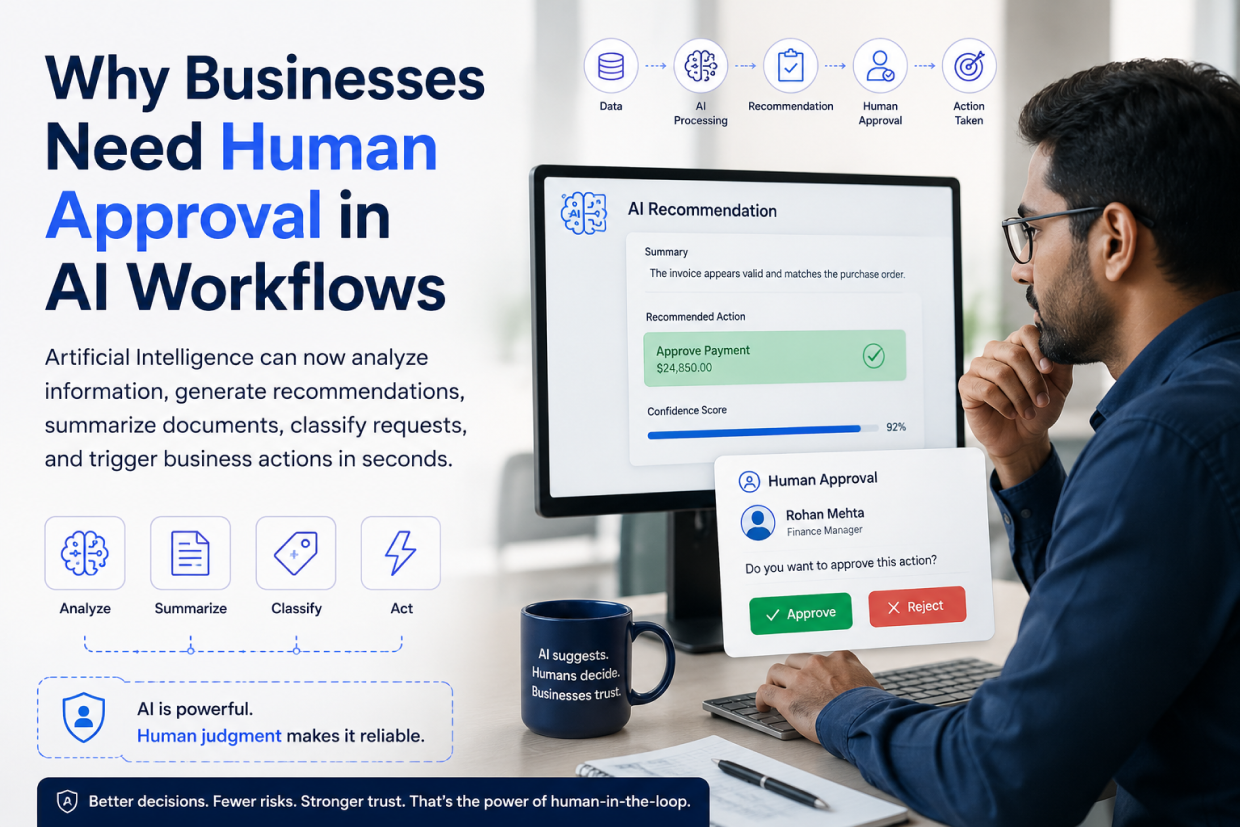
Why Businesses Need Human Approval in AI Workflows
Short answer: Fully automated AI decisions can be risky, so businesses need human-in-the-loop workflows where people approve important actions. An effective approval workflow shows the AI recommendation, supporting information, the reason, a confidence or risk level and the actions available to the reviewer.
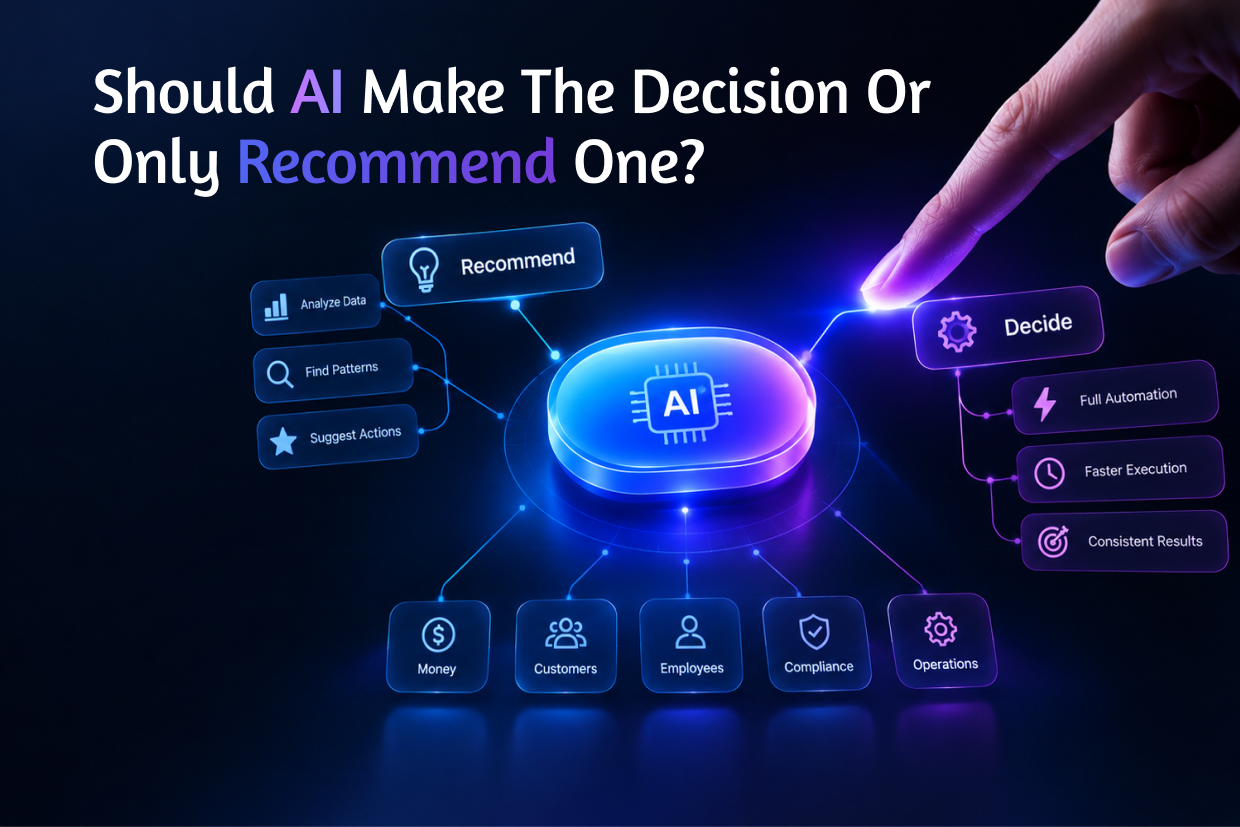
Artificial Intelligence can now analyze information, generate recommendations, summarize documents, classify requests, and trigger business actions in seconds.
That speed creates enormous opportunities for businesses.
But it also creates a difficult question:
Should AI be allowed to make every decision on its own?
Imagine an AI system handling customer refunds. It identifies a request, checks the order, and recommends a refund.
For a simple case, fully automated processing may be useful.
But what happens when the refund amount is unusually large, the customer's account contains suspicious activity, or the request does not match the company's policy?
This is where human approval becomes an important part of AI workflow design.
The goal is not to make humans review everything.
The goal is to make sure that AI handles routine decisions while humans remain responsible for important or uncertain ones.
The Problem With Fully Automated Decisions
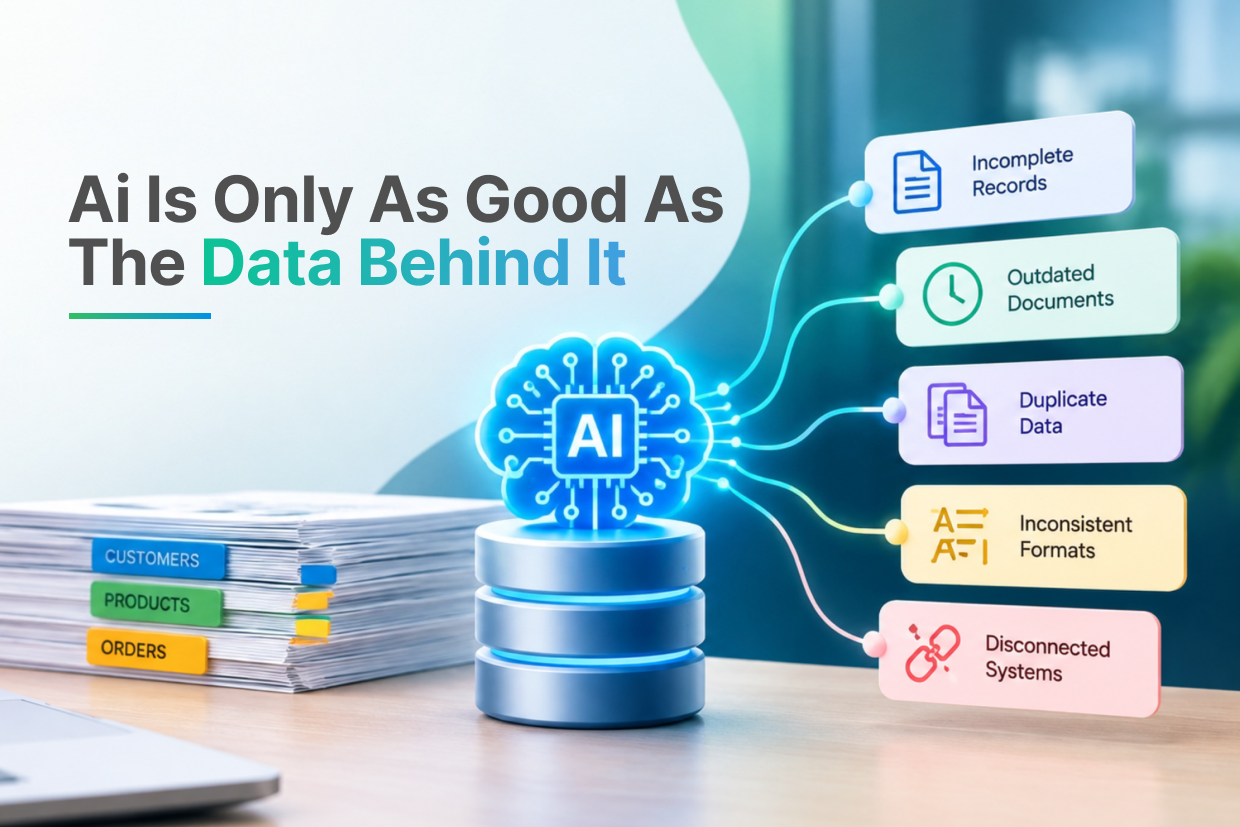
AI systems can process information quickly, but they do not always understand business context the way an experienced employee does.
A model may identify a pattern correctly but still recommend the wrong action because:
- The available information is incomplete.
- Business rules have changed.
- The customer situation is unusual.
- The AI misunderstood the request.
- Multiple policies apply at the same time.
- The decision has financial or reputational consequences.
An automated system can therefore be technically correct while still producing a poor business outcome.
Where Human Approval Matters Most
Not every AI workflow requires human intervention.
A useful approach is to separate decisions according to their risk and complexity.
| AI Decision Type | Recommended Approach |
|---|---|
| Routine, low-risk task | Fully automate |
| Repetitive task with clear rules | Automate with validation |
| Unusual or uncertain case | Human review |
| High-value financial decision | Human approval |
| Legal or compliance-sensitive action | Human approval |
| Customer-impacting exception | Human review |
This approach allows businesses to gain the speed of automation without giving up control over important decisions.
A Better AI Workflow: Human-in-the-Loop
A human-in-the-loop workflow allows AI to perform the work it is good at while giving people control over critical actions.
For example:
Customer Request → AI Analysis → Recommendation → Confidence Check → Human Approval → Action
The AI may:
- Read the request
- Identify relevant information
- Recommend an action
- Explain why it made the recommendation
The human then decides whether the action should proceed.
This makes AI an assistant in the decision process, rather than an uncontrolled authority.
Example: AI in Customer Support
Consider a customer service platform.
A customer asks for a refund.
The AI checks the order details, reads the refund policy, and determines that the request appears eligible.
If the refund is small and the case matches standard rules, the system can process it automatically.
But imagine a customer requests a very large refund or the account contains conflicting information.
Instead of processing the request immediately, the AI can send it to an employee.
The workflow becomes:
Standard Case → Automatic Processing
Unusual Case → AI Recommendation → Human Review
This lets support teams focus their attention where it matters most.
Human Approval Does Not Mean Manual Work Everywhere
Some businesses avoid human approval because they think it will eliminate the benefits of automation.
That happens when every AI decision is sent to a person.
The better strategy is risk-based approval.
For example:
- Low confidence → Human review
- High-value transaction → Human review
- Policy exception → Human review
- Routine request → Automatic processing
- High-confidence repetitive task → Automatic processing
This creates a balance between speed and control.
Confidence Should Influence the Workflow
AI systems can often provide confidence or uncertainty signals.
Businesses can use these signals to determine what happens next.
For example:
High Confidence + Low Risk → Execute
Medium Confidence → Additional Validation
Low Confidence → Human Review
This creates a more intelligent workflow than simply deciding that every task should be automated or every task should require approval.
What Happens When AI Makes a Mistake?
AI systems can make errors.
The important question for businesses is not:
"Can we build AI that never makes a mistake?"
It is:
"What happens when the AI makes a mistake?"
A well-designed workflow should have:
Validation → Approval → Audit Trail → Correction
This creates accountability.
If an AI-generated recommendation is rejected, the business can record the reason.
Over time, these decisions can help the organization improve its workflows, rules, and AI evaluation process.
Human Approval Also Protects Customer Trust
Customers may accept automation when it makes their experience faster.
But they may react very differently when an automated mistake affects their money, account, access, or personal information.
For example, an incorrect AI decision could:
- Reject a legitimate claim
- Cancel an order
- Flag the wrong transaction
- Send incorrect account information
- Approve the wrong request
Human review provides an additional layer of protection for situations where the consequences are significant.
Creating an Effective Approval Workflow
A good human-in-the-loop design should not simply place a large "Approve" button in front of an employee.
The reviewer needs enough information to make a decision.
A useful approval screen can show:
AI Recommendation
What the AI believes should happen.
Supporting Information
The customer data, documents, or records used to make the recommendation.
Reason
Why the AI reached its conclusion.
Confidence or Risk Level
How certain the system is.
Available Actions
Approve, reject, request more information, or escalate.
This allows employees to review the decision instead of blindly accepting it.
The Business Benefits
Human approval can provide several advantages when integrated correctly.
Reduced Risk
Important decisions receive additional oversight.
Better Accountability
Businesses can identify who approved an action and why.
Safer Automation
Routine processes remain automated while sensitive cases receive review.
Improved Employee Productivity
Teams review exceptions instead of manually processing every request.
Better Customer Protection
High-impact decisions receive additional scrutiny.
Continuous Improvement
Rejected AI recommendations can reveal where models or workflows need improvement.
AI Should Automate Work, Not Responsibility
This is one of the most important principles for businesses adopting AI.
Automation can reduce the amount of work employees need to perform.
It should not automatically remove responsibility from the organization.
A company remains responsible for the outcomes of its systems.
That means AI workflows should define:
- What AI can decide
- What AI can recommend
- What requires human approval
- What should never be automated
These decisions should be made before the AI system enters production.
When Should Businesses Use Human Approval?
Human approval is particularly valuable when a workflow involves:
- Large financial transactions
- Legal or compliance decisions
- Customer account changes
- Sensitive personal information
- High-value claims
- Security-related actions
- Irreversible operations
- Unusual or low-confidence cases
The higher the potential impact of a decision, the stronger the case for human oversight.
Conclusion
AI can make business workflows dramatically faster, but speed should not come at the expense of judgment.
The most effective AI applications are not necessarily the ones that automate everything.
They are the ones that automate the right things and involve people at the right moments.
A human-in-the-loop approach allows businesses to combine the speed of AI with human judgment, accountability, and context.
The result is a system that is faster than a purely manual process without becoming blindly dependent on automated decisions.
Build Responsible AI Workflows for Your Business
At Vriksha Techno Solutions, we design AI applications with practical business controls, validation workflows, system integrations, and human approval mechanisms so organizations can adopt AI while maintaining control over important decisions.
Talk to our team →
Frequently Asked Questions
Why do businesses need human approval in AI workflows?
Because AI can make mistakes and fully automated decisions carry risk. Human approval reduces that risk and protects customer trust.
What is human-in-the-loop AI?
A workflow where AI analyzes and recommends, while a person approves the decisions that matter.
What should an AI approval workflow show the reviewer?
The AI recommendation, supporting information, the reason for it, a confidence or risk level and the actions available.
Ready to Build Your Next Digital Product?
Our experts will respond within 24 hours with a tailored approach for your project.